


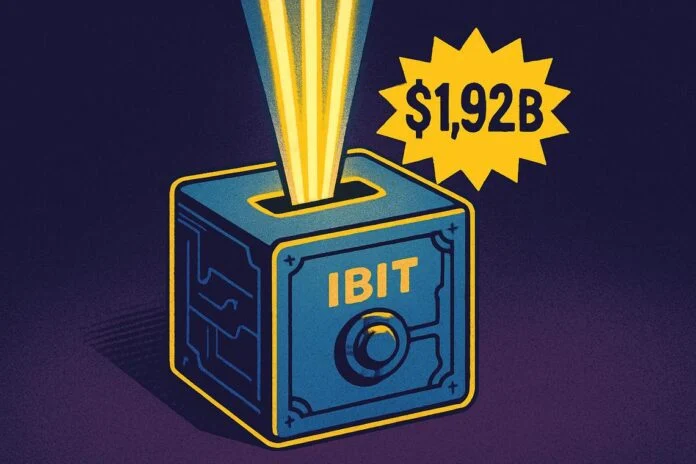
Data shows that last week, the net inflow into Bitcoin spot ETF reached $1.92 billion, a significant rebound from the volatile fluctuations of the previous months. The re-inflow of funds into regulated products also provides a more direct window for observing whether institutional demand is picking up.
IBIT absorbs most of the new funds
Reports cited data published by OKX on the X platform, stating that last week Bitcoin ETF had a total net inflow of 1.92 billion US dollars. Combining data compiled by other media, IBIT under BlackRock is still the main product undertaking.
The Motley Fool mentioned that IBIT attracted $693 million in inflows during the first week of August and recorded a single-day net inflow of $503 million on August 20. This represents a strong round of capital attraction for the fund since mid-April, indicating that this rebound is not just a one-day spike.
Against the backdrop of an overall encryption market that is not yet very active in terms of transactions, the amplification of ETF's capital flow has drawn even more attention. The market generally regards this as a sign of a resurgence in institutional investment intentions, rather than merely being driven by short-term trading.
Bitcoin once approached $80,000
While capital flowed back, the price of Bitcoin also significantly strengthened. Reports indicate that BTC approached $80,000 on August 27, representing a cumulative increase of about 22% since the U.S. Treasury Department announced on August 19 that it would double the scale of long-term government bond repurchases starting from September 9.
This policy is expected to drive down U.S. Treasury yields and also prompt some funds to shift towards risk assets and scarce assets. During the same period, gold rose by about 5%, which is lower than Bitcoin. The report also mentioned that short covering may have amplified this round of gains.
Derivatives indicators become the next point of observation.
As the demand for spot ETF rebounds, market attention is shifting to derivatives markets such as futures and options. Traders are currently focusing on open positions and funding rates to determine whether this round of gains will continue to spread to leveraged markets.
If the rates for both open positions and funds rise rapidly simultaneously, it usually indicates that long leverage is accumulating, and short-term fluctuations may also increase accordingly. If the inflow of ETF slows down while leveraged positions remain high, the risk of market pullbacks will also increase.
From the current structure, the capital flow back of ETF is providing new price support for Bitcoin. However, whether this trend can continue still depends on whether the capital inflow will be maintained after the start of U.S. Treasury bond repurchases in September, as well as whether leverage in the derivatives market will continue to rise.