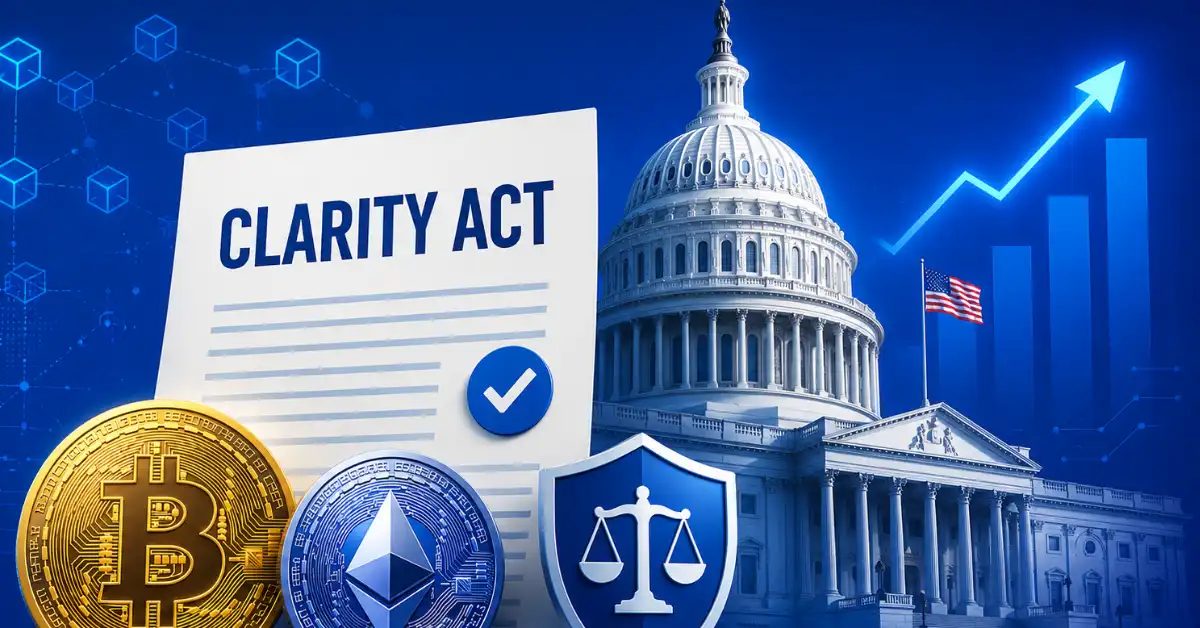


Foreign media reports that the US CLARITY Act attempts to address a core issue that has long existed in the crypto industry: at what stage do tokens constitute investment contracts, and when do they become more akin to commodities? This distinction will directly determine who will regulate them, what information project parties need to disclose, and what rules trading platforms must follow when launching and hosting related tokens.
The regulatory scope for Bitcoin may expand.
The article points out that Bitcoin is currently generally regarded as a commodity because it does not have a centralized issuer. Under the current framework, the authority of the U.S. Commodity Futures Trading Commission (CFTC) over the spot Bitcoin market is mainly focused on combating fraud and manipulation.
If the CLARITY Act is passed, the powers of CFTC will be expanded. It will no longer be limited to post-event law enforcement but will also have the authority to directly regulate the operations of Bitcoin trading platforms. This means that spot trading venues will face clearer federal regulations.
ETH may have a conversion path with XRP.
Regarding tokens that fall in the grey area, such as Ethereum and XRP, the article suggests that the bill attempts to classify them based on their "current functionality" rather than their "initial issuance method." The portion of a project's financing that came from token sales in the early stages may still be subject to regulation by the U.S. Securities and Exchange Commission (SEC).
However, as the network becomes more decentralized and the reliance on a single team decreases, subsequent transactions may shift to a new CFTC framework. This does not mean that all tokens will automatically be classified as commodities, but rather it provides a path for some tokens to transition from securities regulation to commodity regulation.
Differences between Platform Obligations and Legislative Requirements
The article mentions that if a platform incorporates the new CFTC regulatory system, it is required to complete registration and separate customer assets from its own funds. At the same time, the platform must also comply with requirements for information disclosure, record-keeping, and conflict of interest management. When project parties raise funds through token sales, they are also obliged to disclose information about the project controllers and the underlying technology.
There are still three main disagreements regarding the advancement of the bill, including whether stablecoin rewards should divert bank deposits, whether the federal framework should weaken the law enforcement powers of individual states, and the extent of restrictions on members of Congress and federal officials participating in digital asset interest arrangements. It is reported that the Senate Banking Committee has been working on a revised version of the bill since May.
Whether it is approved or not affects the certainty of regulation.
The article argues that even if the bill is not passed, the crypto industry will not be left unregulated. Existing laws, regulatory agencies, courts, and state regulations will continue to play a role. The difference is that many of these boundaries are often only gradually clarified after products are launched or problems arise, whereas this bill attempts to establish these boundaries in advance.