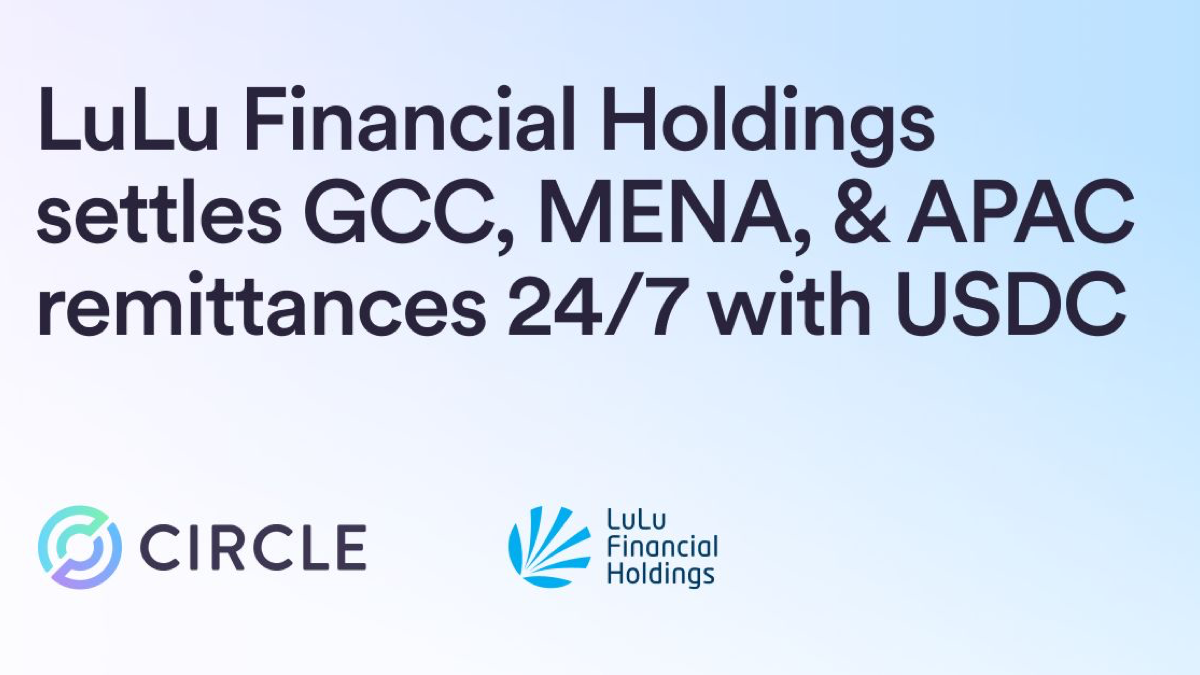


Circle released a case in August stating that LuLu Financial Holdings uses USDC to support cross-regional remittance settlements in the Gulf, Middle East, and Asia-Pacific regions. The case study describes a specific institution using stablecoin infrastructure in a particular business process and should not be extrapolated to imply that the entire regional remittance system has been fully decentralized on-chain. Cross-border remittances involve licensing for both the sender and recipient, bank cooperation, foreign exchange conversion, customer identity verification, anti-money laundering checks, and local cash or account payment networks; on-chain settlement can improve one of these processes, but it does not necessarily replace all of them.
Traditional cross-border remittances often face multiple intermediaries, differences in business hours, and costs associated with pre-funding and reconciliation. If stablecoins can play a role in inter-institutional fund transfers or liquidity management within a compliant framework, it is theoretically possible to extend some settlements beyond bank business days to a longer time window, and it may also reduce the need for funds to be pre-deposited in multiple regions. However, being "faster" does not mean that every payment to consumers will be credited immediately. The final step still depends on local payment partners, the status of the recipient's account, compliance reviews, and currency exchange arrangements.
Institutional settlement and consumer experience are not the same thing.
The use of USDC in the news can easily lead readers to believe that individual recipients directly hold or operate stablecoins, but the actual business model may be quite different. Institutions can use USDC in the backend to complete fund transfers, while consumers still receive payments in their local currency, through bank cards, bank accounts, or mobile wallets. Such a design may offer ordinary users more stable services or less waiting time, but users may not necessarily need to come into contact with private keys, on-chain addresses, or the prices of crypto assets. When evaluating cases, it is important to distinguish between backend settlement technologies and frontend customer products to avoid confusing the two.
Compliance cannot be concealed on a “24/7” basis. Cross-border capital flows still need to comply with sanctions screening, suspicious transaction monitoring, identity verification, record-keeping, and local foreign exchange regulations. Automation and on-chain traceability can help improve the efficiency of certain processes, but they cannot eliminate legal responsibilities; on the contrary, as systems are connected to more networks, permission management, address screening, and handling of exceptions become even more important. If companies promote settlement speed as a selling point, they should also clearly explain the regions where their services are available, the conditions for processing times, the fee structure, and the channels for filing complaints in case of errors.
What should prove value are comparable operational results.
What is most worth questioning in case reports are the actual metrics: by how much has the settlement time been reduced, has the capital occupation decreased, how are failed transactions handled, has compliance auditing become more effective, and have user fees and complaints improved? Without these comparable results, "adopting USDC" is merely a technical choice, not a proven commercial advantage. For remittance companies, any new infrastructure still has to withstand the tests of peak periods, bank holidays, network congestion, liquidity fluctuations, and regulatory changes.
LuLu Case Study: Stablecoins are being explored as part of cross-border financial infrastructure, a direction that deserves attention; however, it is important to clarify the limitations: what is described here is institutional cooperation and settlement practices, not a guarantee of returns for all users, nor does it imply that all countries allow such services. True industry maturity does not lie in how fast transactions can be processed on the blockchain, but rather in the ability to deliver those transactions to recipients reliably under conditions of compliance, transparency, and the possibility for appeals.
Stablecoin settlement also involves risks related to reserves, issuers, and network operations. Even if the backend fund allocation is faster, companies still need to understand the redemption arrangements for the assets used, the custody relationships, contingency plans for on-chain abnormalities, and how to return to traditional banking systems in case of service interruptions. The customer experience depends on the entire process, not just a single segment: whether the sender can clearly understand the fees, whether the recipient can receive the local currency as promised, whether error messages can be manually processed, and whether there is a clear responsible party in case of disputes. Only by ensuring these aspects will the new infrastructure truly reduce friction.
For regulators and the public, the significance of these cases also lies in providing observable test examples. If institutions can disclose their compliance frameworks, scope of operation, and comparable results, it will be possible for outsiders to determine whether the technology has brought about beneficial improvements; however, if only slogans about speed are disclosed without information on user protection, the value of such innovations is difficult to verify. Cross-border remittances are closely related to household income and emergency expenses, and any innovation should place reliability and the right to appeal on an equal footing with efficiency.
Remittance services also must address information asymmetry. Senders are often most concerned about the total cost and the time it takes for funds to arrive, while recipients are concerned about receiving their currency in a familiar manner; the technology used in the backend should not be an excuse to hide fees or obscure responsibilities. If institutions use stablecoins to improve settlement processes, they should clearly display the prices, exchange rates, and expected arrival conditions that consumers can see, and provide accessible human support in cases of transaction failures, account restrictions, or name mismatches. The more complex the technology, the simpler and more accurate the explanations provided to users should be.
Cross-regional operations also require consideration of systemic pressures: bank holidays, communication disruptions, blockchain congestion, insufficient liquidity, or changes in local regulations can all cause what were once smooth paths to become temporarily unavailable. Reliable services will pre-set up backup channels, limits, and notification processes, rather than waiting for problems to occur before asking customers to understand the technical details. Whether a case can be replicated ultimately depends on whether these operational capabilities can be maintained simultaneously in multiple regions.