

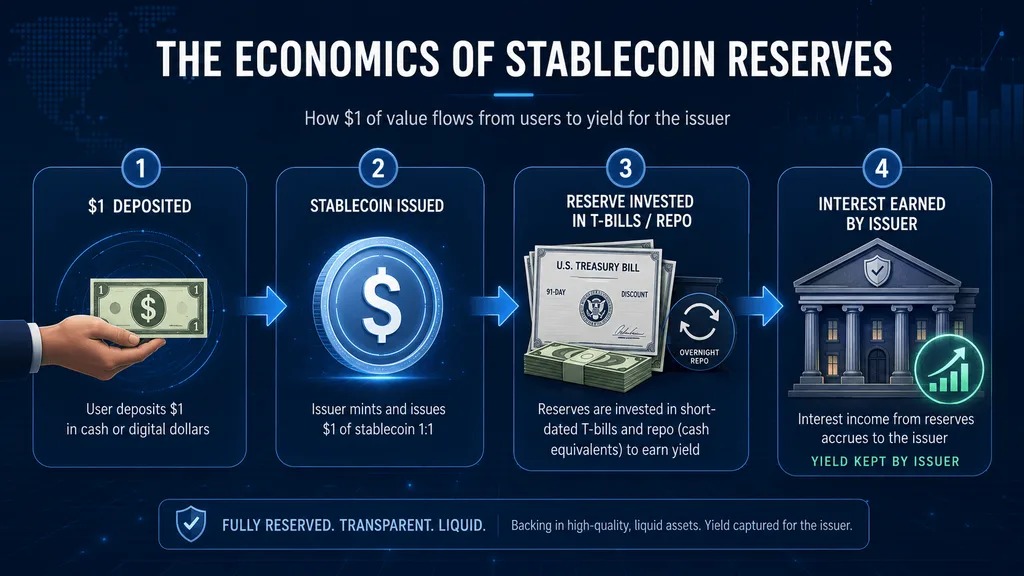
Foreign media reports that while US dollar stablecoins appear to be simply "1 US dollar for 1 token," the real profit-making aspect for issuers lies in their reserves. Most institutions allocate the received US dollars into short-term US Treasury bonds, government money market funds, bank deposits, and overnight repurchases, retaining the interest income generated by these assets.
Reserve interest constitutes the main income.
The article points out that holders of ordinary payment-type stablecoins receive tokens with a redemption value close to $1, rather than investment products that directly share the profits from reserves. Therefore, the interest generated by the reserve assets usually belongs to the issuer, which is also one of the most important sources of income for the stablecoin industry.
If an institution issues 10 billion stablecoins, supported by a reserve of about $1 billion, and assuming an annualized return on that reserve of 4%, the corresponding annual gross income could reach $400 million. For the issuer, the larger the circulation scale, the more substantial the revenue from the reserve.
- Common reserves include short-term U.S. Treasury bonds.
- Also includes bank deposits and government monetary funds.
- Overnight treasury bond repurchase is also one of the main tools.
Circle's income is highly dependent on the reserves of USDC.
The article uses Circle as an example to illustrate this pattern. As a listed company, Circle submits detailed financial reports to the US Securities and Exchange Commission. In the second quarter of 2026, the company recorded $667.7 million in reserve income, while other incomes amounted to only $33.6 million; reserve income accounted for 95.2% of the total revenue.
Circle indicates that the reserves of USDC and EURC include bank cash as well as investments in Circle Reserve Fund. The company receives interest and dividends from these investments. Disclosure shows that in the second quarter of 2026, the average daily trading volume of USDC increased by 25.2% year-on-year, generating approximately $147.4 million in additional reserve income; however, a decline in interest rates reduced reserve income by about $113.9 million.
This means that an increase in the circulation of stablecoins can boost revenue, but declining interest rates will reduce the returns on each dollar of reserves. By the end of the second quarter, the circulation scale of USDC was approximately $73.3 billion.
Tether and RLUSD have different paths.
The article states that the reserve structure of Tether is different from that of Circle, but the underlying profit-making logic is similar. Tether indicates that USDT is supported by traditional currencies, cash equivalents, and other assets, and it regularly releases reserve information and quarterly independent reports. By the end of the second quarter of 2026, Tether disclosed that the issuance scale of USDT was approximately 184.6 billion US dollars, with a reserve buffer of about 4.11 billion US dollars, and a quarterly net operating profit of about 1.5 billion US dollars.
The RLUSD of Ripple further reflects the regulatory requirements on the limitations of the reserve scope. According to the article, RLUSD reserves can include U.S. Treasury bonds with a remaining maturity of no more than 3 months, government money market funds, overnight Treasury bill repurchases, and qualified bank deposits. As disclosed on Ripple, as of August 20, 2026, the RLUSD reserve funds amounted to approximately $1.98 billion, corresponding to a circulation scale of about $1.87 billion, and third-party reserve certifications are published monthly.
The article argues that the purpose of RLUSD is to serve as a payment and settlement tool, rather than a product designed to provide returns for its holders. This is also the main distinction between ordinary payment-type stablecoins and tokenized money market funds: the former focuses on maintaining a stable redemption value, while the latter distributes investment returns to investors.