


Foreign media commented that the Ramses token RAM has recently seen a rapid rise driven by the popularity of Robinhood Chain, climbing from its long-term low to a historical high. The article argues that this upward trend is not merely driven by sentiment but is also related to Ramses's role as the underlying infrastructure for blockchain DEX. However, the current value of the token has not yet fully been realized.
It's not a new project, but recently it has gained popularity due to the rise of new chains.
Ramses has been in operation since 2023, initially deployed on Arbitrum, and later expanded to HyperEVM. Nowadays, it runs natively on Robinhood Chain. The article mentions that this distinguishes it from a group of projects that quickly issue coins by taking advantage of the popularity of new chains.
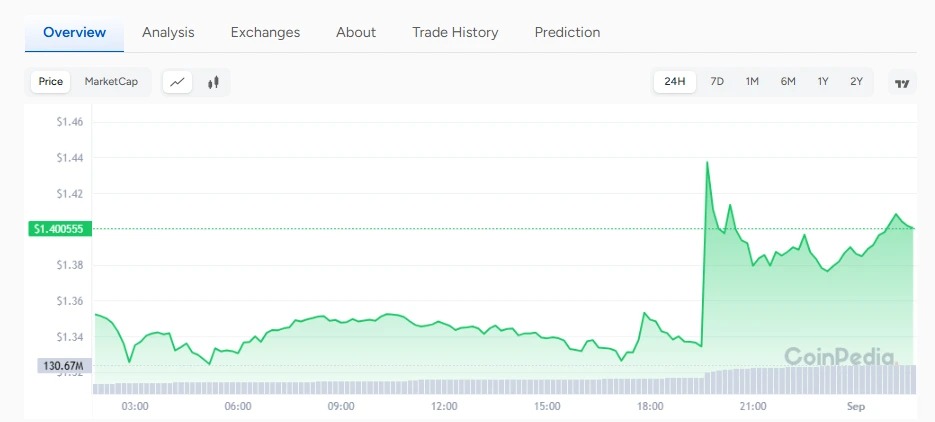
RAM's price has recently risen from $0.01461 to $0.9307, representing a multiple-fold increase in just one week, making it one of the tokens with the most significant fluctuations among Robinhood Chain related assets.
The design of RAM and xRAM still leans towards a governance-oriented approach.
The article states that RAM can be converted to xRAM, and during this conversion process, 50% of RAM will be destroyed, creating a deflationary mechanism. Users holding xRAM will then be able to participate in the governance, voting, and fee-related decisions of Ramses.
- 95% of the exchange fees are allocated to liquidity providers.
- 5% is used for the protocol and the Sarcophagus destruction mechanism.
- There is currently no RAM emission on Robinhood Chain.
The article argues that this design is conducive to highlighting the protocol's dependence on actual trading volume, rather than continuing to rely on high-emission incentives to maintain liquidity.
What the market is buying is the expectation of subsequent volume increase.
However, it is also clearly stated in the text that equating 'buying RAM' with 'directly holding Ramses for income' is not accurate. At present, the majority of transaction fees still flow to liquidity providers, rather than directly to the holders of RAM. Moreover, a complete value capture system on Robinhood Chain has not yet been fully established.
In other words, the current market seems to be betting on one thing: if Robinhood Chain continues to see increased trading volume in the future, Ramses, as the token that will take over the transactions from DEX, may benefit from higher transaction fees and a more comprehensive token mechanism.
Valuation has already reflected high expectations in advance.
The article mentions that Robinhood Chain initially focused on the narrative of tokenized stocks, real-world assets, and DeFi, but the early activity on the chain currently comes more from meme token transactions. Comments suggest that as long as the trading volume on the chain continues to grow, DEX, which is in the middle layer of the transaction flow, still has the opportunity to benefit.
However, the comments did not directly conclude that RAM was underestimated. The article pointed out that Ramses has not yet established an absolute liquidity advantage over Robinhood Chain, and some cross-chain architectures are still under construction. The current pricing mainly reflects the market's expectations for future trading volumes.