

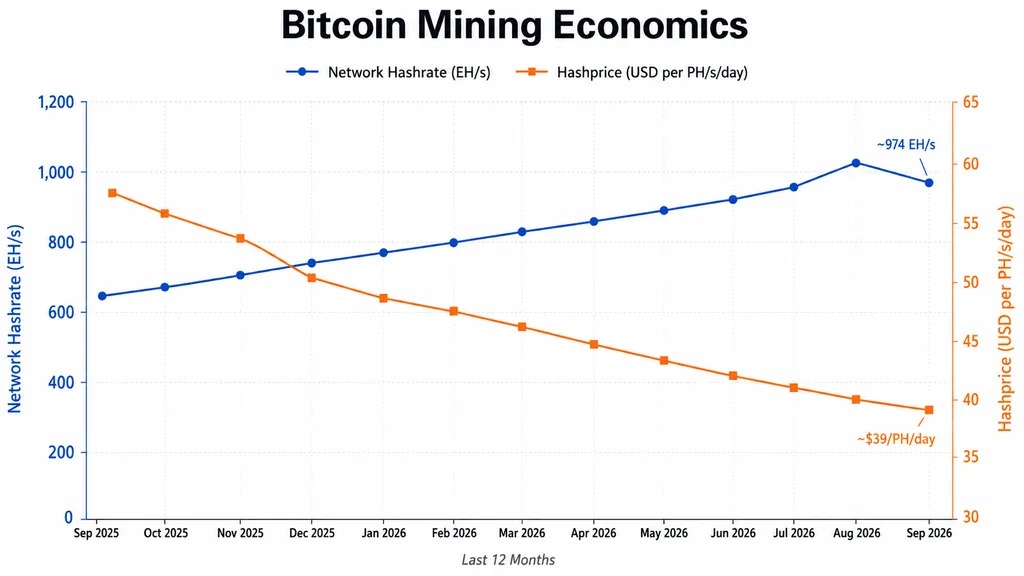
The computing power of the entire Bitcoin network has once again approached historical highs recently. On September 1st, the estimated value was around 974 EH /s. Previously, on August 31st, it exceeded 1.03 ZH /s and reached over 1 ZH /s multiple times within August. The increase in computing power enhances network security and also intensifies the competition among miners for fixed block rewards.
Miners' income margins continue to narrow
The commonly used industry indicator "hash price" reflects the mining revenue that can be generated per unit of computing power per day. Hashrate Index Recently, the level has been around PH /s, which is equivalent to 39 US dollars per day. This puts greater pressure on older mining machines and mining farms with higher electricity costs.
As more computing power is connected to the network, the difficulty of mining Bitcoin will continue to increase in order to maintain an average of one block every 10 minutes. For miners, this means that even just to maintain their current share of rewards, they need to continuously expand their computing power.
The performance of listed mining companies has already reflected this pressure. MARA saw its computing power increase by 22% year-on-year to 70.3 EH /s in the second quarter of 2026, but its quarterly revenue declined by 27% to $174.9 million. The company mined 2,422 bitcoins that quarter, with the cost of electricity for its own mines amounting to approximately $38,690 per bitcoin.
AI Data centers compete for similar resources
AI Infrastructure is becoming a new competitor in the power resources market for mining companies. Although Bitcoin mines and AI data centers use different hardware and operating environments, both require large-scale, stable power supply, as well as access to the power grid and data center capacity.
This has led many mining companies to begin re-evaluating the use of their energy assets. In the past, electricity was primarily used for Bitcoin mining; now, electricity itself is becoming a resource of greater strategic value that can be allocated to more profitable businesses.
Mining companies are beginning to shift towards AI business.
Riot Platforms is a typical case. The company previously signed a 20-year lease agreement involving 191 megawatts of critical IT capacity in its Rockdale campus. According to the company's expectations, the contract revenue corresponding to this agreement is approximately 9.1 billion US dollars.
IREN also disclosed that it is gradually phasing out some Bitcoin mining hardware and reallocating the associated electricity to its AI cloud service business. It is expected that most of these adjustments will be completed by the end of 2026.
This does not mean that Bitcoin mining is withdrawing from the market, but the profit model of the mining industry is changing. With the overall network computing power approaching 1 ZH /s and hash prices remaining low, mining companies are increasingly relying on the new generation of ASIC, low-cost electricity, or income sources other than mining to maintain their profit margins.
Additional information:The computing power data mentioned in the text is an estimated value. Since the total computing power of the Bitcoin network is usually inferred from the block generation situation rather than measured in real-time, there may be fluctuations in short-term readings.