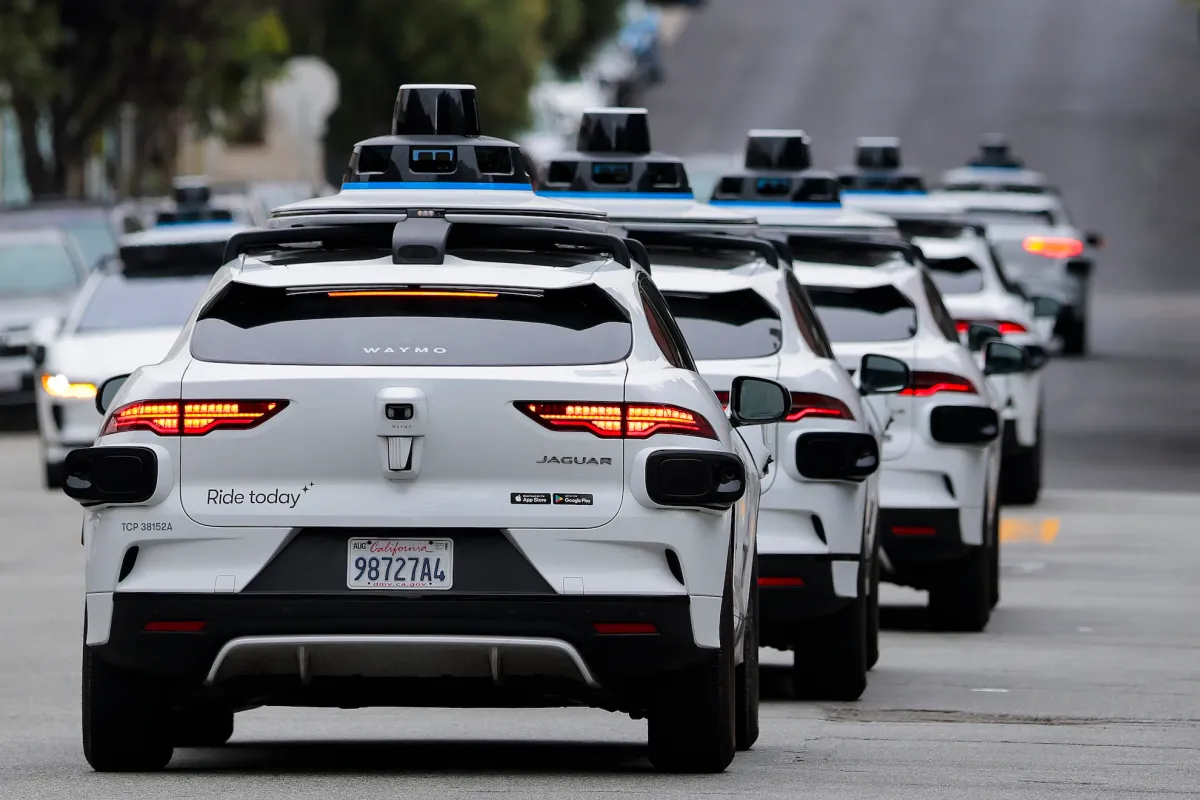


On September 3, when Tesla plans to officially introduce its two-seater unmanned taxi Cybercab, Waymo has taken the initiative to clarify its stance on technology in advance. The company recently stated in its blog and media interviews that relying solely on cameras and pure end-to-end AI is insufficient to support safe, large-scale fully autonomous driving.
Waymo Publicly Emphasizes Multi-Sensor Solutions
The vice president in charge of driving software, Waymo, stated that while the camera capabilities are strong, they are not sufficient to achieve full autonomous driving on their own. Waymo mentioned that after accumulating over 200 million miles of real-road operation, the conclusion from the data is that to safely expand autonomous driving to a larger scale, it is still necessary to combine cameras, lidars, and millimeter-wave radars.
He also pointed out that there is a risk of "black box failure" with the shift from directly outputting from raw images to pure end-to-end neural networks that process instructions. In an interview with Axios, Waymo further stated that even AI models with extremely large parameter scales can still experience hallucinations, whereas autonomous driving systems in the physical world do not have the option to "restart and try again."
Tesla bets on pure vision and AI
This statement by Waymo is generally seen as being directed at Tesla. Musk has long criticized lidar, calling it nothing more than a "crutch." Tesla, on the other hand, focuses its autonomous driving approach on cameras and AI, and has developed Cybercab around this concept.
According to reports, this vehicle model does not have a steering wheel or pedals, and its battery capacity is relatively small; it is intended to be operated as a native autonomous vehicle. Recent Tesla documents indicate that the company plans to increase the production capacity of Cybercab to over 125,000 units per year.
However, Tesla still needs to prove that its autonomous driving software has true full autonomous driving capabilities. Musk once set a goal of having one million Robotaxi on the road by 2020, but progress has clearly lagged behind. Over the past year, Tesla has only conducted small-scale tests of the Robotaxi network in a few cities in Texas and Florida, using modified versions of the Model Y.
Robotaxi Competition shifts towards scale and cost
Reports indicate that Tesla only began to remove safety officers from most of its test vehicles in recent weeks. Meanwhile, the company completed the motor vehicle registration for Cybercab in Texas prior to an event on September 3rd, and it is expected that the expansion pace of Robotaxi will soon become a focus of market attention.
In contrast, Waymo has currently deployed approximately 4,000 Robotaxi in 14 cities across the United States, completing 500,000 paid trips per week. The company also announced this week that it is entering 3 new markets to continue expanding its operational network.
The differences between the two companies lie not only in their technical approaches but also in their cost structures. Waymo uses more sensors and is based on modifications to vehicles produced by other automakers, which means that their upfront procurement and assembly costs are higher. Taking Ojai produced by Xpeng as an example, Waymo also has to bear import duties before installing the autonomous driving system.
If Tesla can prove that its solution, which centers around AI and relies primarily on cameras, can operate on a large scale, the competitive landscape of the Robotaxi market could change significantly. However, even if the software capabilities are up to par, operational challenges such as harsh weather, unexpected events, and driving in areas around campuses remain real issues that all autonomous taxi platforms must continuously address.