


Foreign media reports that as the U.S. government debt approaches $40 trillion, Bitwise's Chief Investment Officer, Matt Hougan, has put forward a clear view: rather than debating macroeconomic trends, it is better to hold both AI stocks and Bitcoin at the same time to prepare for two possible outcomes of the U.S. economy.
Two scenarios correspond to two types of assets.
The judgment of Hougan revolves around the policy objectives of the U.S. Treasury Secretary Scott Bessent. According to him, the fiscal department needs to maintain high growth while reducing deficits, and there are roughly only two possible outcomes for this approach.
The first approach is to rely on AI to drive up productivity and absorb debt pressure through faster economic growth. If this scenario holds true, chip companies, processors, and other AI technology-related firms will benefit. Hougan believes that the recent pullbacks in some individual stocks are more like a temporary realization of profits rather than a reversal of the long-term trend.
If debt is resolved through inflation, Bitcoin will receive even more attention.
Another scenario is that if growth does not accelerate significantly, the fiscal authorities will have no choice but to dilute the debt burden in an environment of higher inflation. The article mentions that fluctuations in the bond market have intensified, forcing relevant departments to take action in response.
In this case, Hougan regards Bitcoin as a primary asset for crisis hedging. He mentioned that Bitcoin faced pressure in the first half of 2026, and by July, it had declined by 33% within that year under a tightening monetary environment, reaching a temporary low point.
However, in August, as the bond market fluctuated again, Bitcoin saw a clear rebound. According to the text, it regained most of its previous losses that month, and the annual decline narrowed to 10.91%.
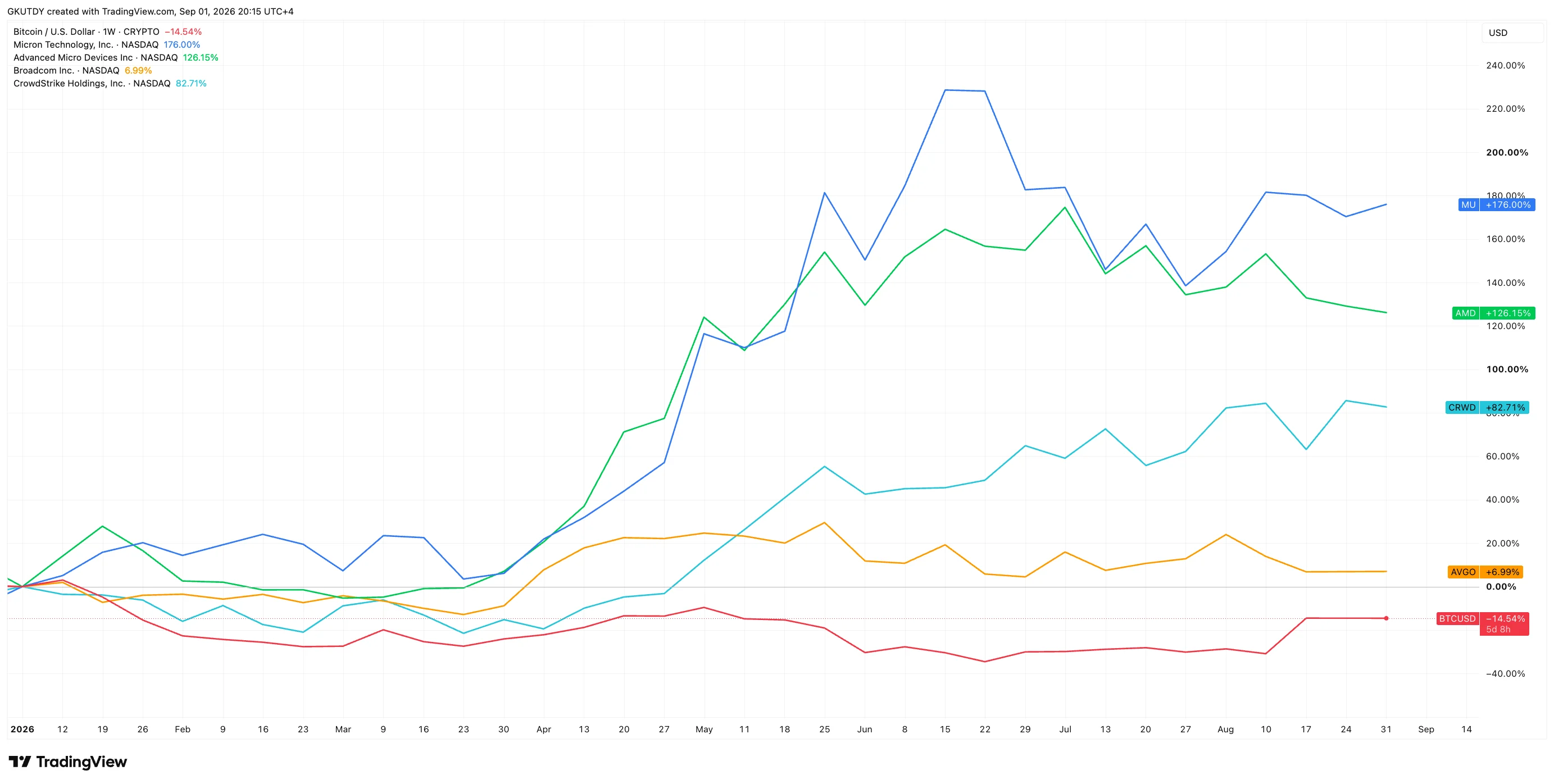
The combination strategy is derived from the summer market performance.
Hougan believes that the performance of these two types of assets this summer has already demonstrated a complementary relationship. During the decline of Bitcoin, AI stocks such as semiconductors supported the investment portfolio; and when the AI sector entered a period of adjustment in August, the rebound of Bitcoin partially offset the losses of other assets.
The article concludes that if the United States ultimately relies on growth to alleviate debt pressure, AI stocks may benefit; if inflation becomes the main solution, the attractiveness of Bitcoin will increase. Hougan concludes that, in the current U.S. macroeconomic environment, holding both types of assets simultaneously can better cover different outcomes.