

After another round of attacks between the United States and Iran, markets quickly shifted towards safe-haven and inflation-related trading. On Tuesday, major U.S. stock indices fell, oil prices soared, and the yield on U.S. Treasury bonds approached a 19-month high. Investors began to re-evaluate the impact of the Middle East situation on inflation and interest rate trends.
The S&P 500 index fell by about 0.7% on the day, the Dow Jones Industrial Average dropped by around 0.9%, and the Nasdaq Composite Index, which is dominated by tech stocks, fell by approximately 1%. The market's concern is that if transportation risks near the Strait of Hormuz increase, crude oil supply could be further disrupted.
Brent crude oil approaches $95
Oil prices are the most direct market signal in this round of fluctuations. Brent crude oil once approached $95 per barrel, and market data cited in reports showed that the settlement price was $94.65, with a one-day increase of $4.16, representing a rise of about 4.6%.
The reason why rising oil prices affect the stock market is that energy costs directly drive up inflation expectations. The current market is already discussing whether the Federal Reserve needs to maintain high interest rates for a longer period. If crude oil continues to remain at high levels, these concerns will further intensify.
U.S. Treasury yields suppress the tech sector
The impact of oil prices quickly spread to the bond market. The yield on 10-year U.S. Treasury bonds rose to around 4.79%, approaching a 19-month high. Traders adjusted their forecasts for future inflation and interest rates accordingly.
Higher long-term yields tend to compress the valuations of growth stocks, especially in the technology sector, as the market uses higher discount rates to estimate future earnings. During trading on Tuesday, Microsoft fell by more than 1%, and AMD as well as other chip stocks generally weakened, with the technology sector becoming one of the main factors dragging down the overall market.
Energy stocks perform strongly against the trend
Contrary to tech stocks, the energy sector benefited from rising oil prices. ExxonMobil and Chevron's stock prices increased because higher crude oil prices improved the profit forecasts of major oil producers.
This has led to a clear divergence in the market regarding the same geopolitical event: technology stocks and consumer stocks are under pressure, while energy producers are supported. What Wall Street is now more concerned about is not just whether the conflict will continue to escalate, but whether oil prices and yields will remain high for a longer period of time.
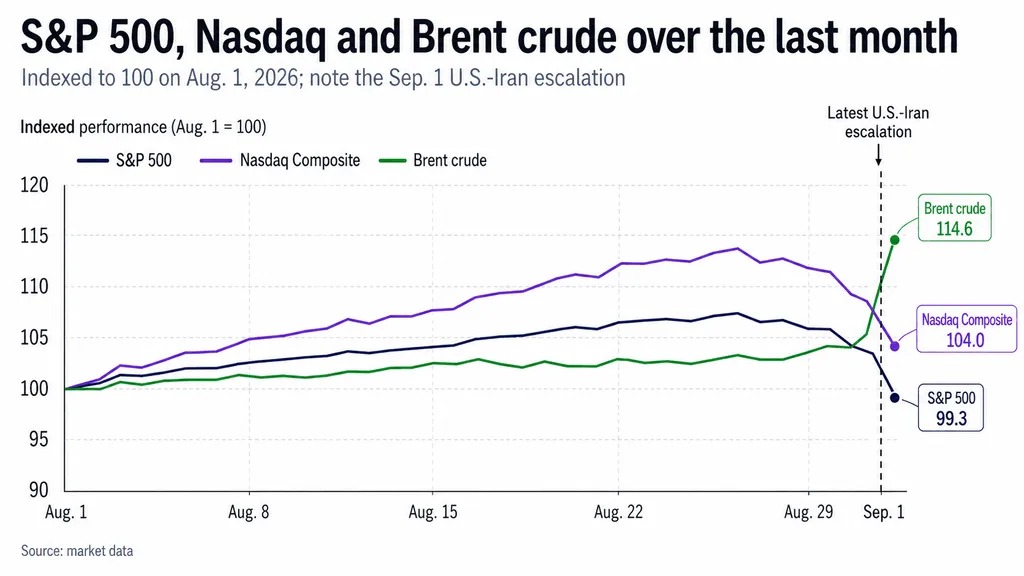
If Brent crude oil remains around $95 per barrel, fuel and transportation costs are likely to continue to rise, putting pressure on corporate profit margins and consumer spending, which will also increase the difficulty for the Federal Reserve to control inflation. For the stock market, this means that a geopolitical shock could evolve into broader valuation pressures.