

LINK has recently rebounded from the $7 to $8 range, rising to around $12 and breaking through the downward trend line that persisted for several months. As Bottomline integrates Chainlink's infrastructure into its service network, the market's focus on LINK is shifting from merely a price rebound to simultaneous improvements in both fundamental and technical aspects.
Bottomline connects to over 600 banks
The latest developments come from fintech company Bottomline. The company has integrated the Chainlink infrastructure into its network, which serves over 600 banks. According to the article, the focus of this integration is on the Chainlink cross-chain capabilities, as well as its infrastructure that supports blockchain financial processes.
This means that the use cases of Chainlink are expanding beyond traditional DeFi predictors to include cross-chain settlement, tokenized assets, payments, and institutional-level blockchain applications. For LINK, such institutions provide new fundamental support for price rebounds.
CCIP becomes the main growth driver
Chainlink One of the current core products is the cross-chain interoperability protocol CCIP. This protocol allows applications and institutions to transfer messages and assets between different blockchains without having to build separate interoperability systems for each connection. As the demand for tokenization and cross-chain finance increases, the role of CCIP is also growing.
The article also mentions that Runtime Environment of Chainlink, commonly referred to as CRE, is also contributing to this layout. Its role is to help developers coordinate more complex on-chain processes across different networks and services. As a result, the positioning of Chainlink is gradually shifting from being a single oracle service to becoming a broader range of on-chain financial infrastructure.
$12 becomes a key level in the short term
From a price structure perspective, LINK has been constrained by a downward trend line over the past few months, with multiple rebounds followed by declines. Subsequently, the price formed a temporary bottom in the $7 to $8 range, creating a double-bottom pattern. After that, LINK gradually raised its high and low points, eventually breaking through the downward trend line and reaching above the $10 to $11 resistance zone.
The current focus of the market is on the range of $12 to $12.20. If the price breaks through this level and can hold its ground during subsequent pullbacks, the previous resistance level may turn into a support level, and the rebound structure will be further consolidated.
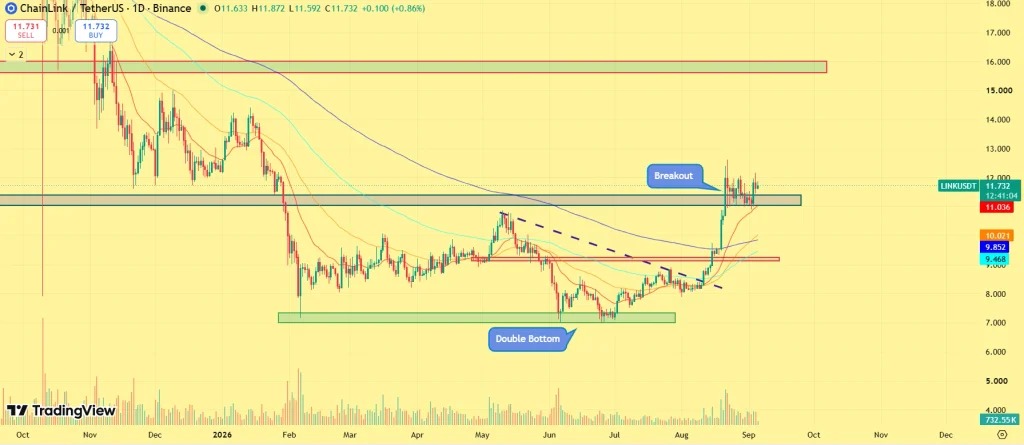
If it continues to break above $14 in the future, the price is expected to test the $16 to $17 range. On the contrary, if LINK falls below $11 again, the current strong structure will come under pressure; if it further loses support at $10, the price may return to the previous consolidation range.