

Wall Street Journal cited an article from Chuangye Bang, stating that in recent months, there has been a new development in AI's programming products: the reasoning cost for a single Token has decreased, but the platform has become more cautious about the available quota for users. The article argues that this is not contradictory, as the key point is that with the improvement in model capabilities, the total number of calls by users has increased even faster.
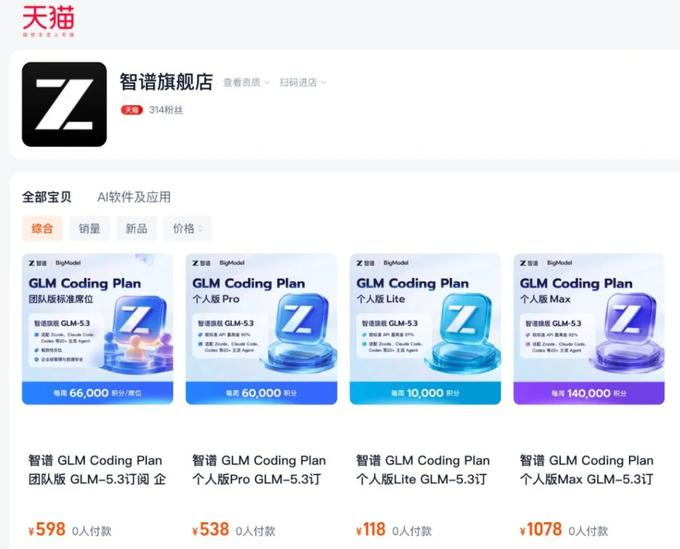
What is sold on Tmall under Zhipu is call quotas.
On September 2nd, Zhipu opened an official flagship store on Tmall, listing GLM Coding Plan. The personal version Lite costs 118 yuan per month, Pro costs 538 yuan per month, and Max costs 1078 yuan per month, corresponding to different point quotas. The product is based on GLM-5.3 and is compatible with more than 20 other Agent tools such as ZCode, Claude Code, and Codex.
The article points out that the entry of such products into e-commerce channels means that the usage quota of AI is being packaged into standardized services that can be purchased directly, taking on a form that is more akin to cloud services or data traffic packages, rather than merely being technical interfaces aimed at developers.
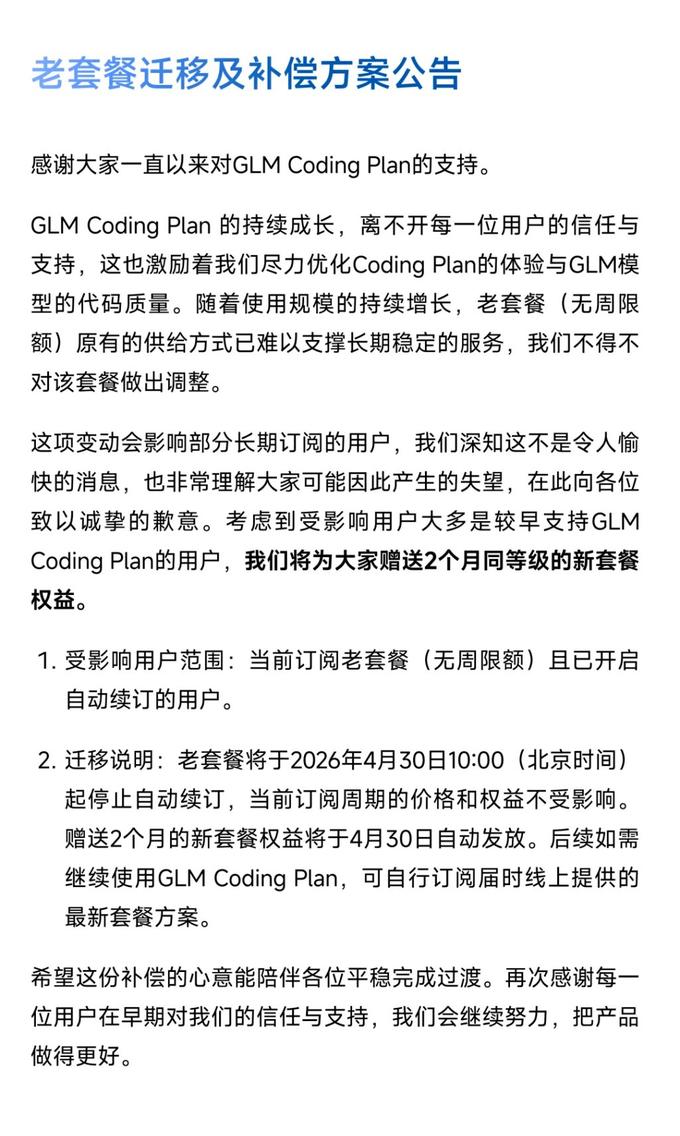
Multiple platforms have begun to tighten their package restrictions.
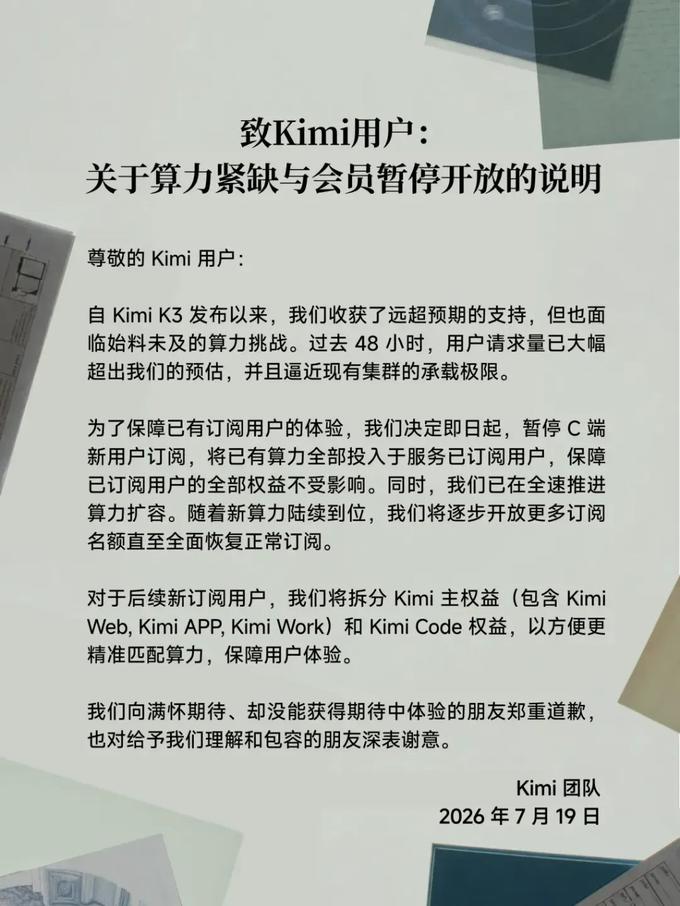
Recently, several manufacturers have adjusted their related product strategies. Kimi once suspended new user subscriptions on the C-side due to computational power constraints; Alibaba Cloud adjusted Coding Plan, and Lite packages stopped new purchases, renewals, and upgrades; Tencent Cloud also increased the prices of some Hunyuan models.
- Kimi used to prioritize computing power for paid users.
- Alibaba Cloud discontinues some low-price Coding packages
- Tencent Cloud raises the input prices for some models
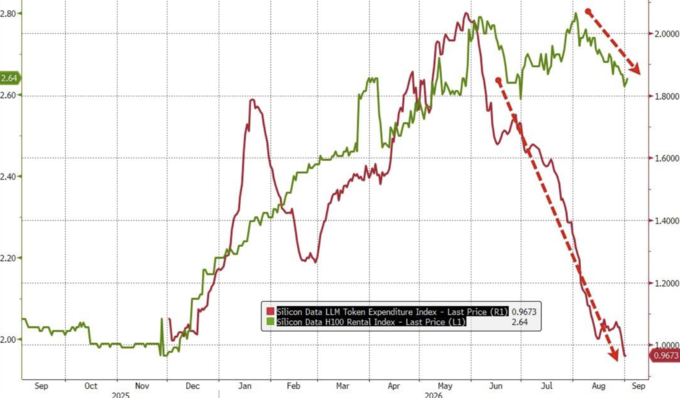
The article argues that behind these changes, it is not that AI has become more expensive, but rather that as models improve, users are more willing to entrust more complex tasks to AI. Compared to early chat-based interactions, tasks such as code generation, tool invocation, and continuous execution significantly increase the consumption of Token.
The total number of calls is increasing faster than the cost is decreasing.
Zhipu revealed that with the optimization of model architecture and inference infrastructure, the inference cost per unit of Token has decreased by 80% compared to the beginning of the year. However, the article also mentioned that the consumption rate of Token has increased more rapidly, which has become a real pressure facing the commercialization of AI at present.
Zhipu's semi-annual report shows that in the first half of 2026, the company's revenue reached 954 million yuan, a year-on-year increase of 399.7%. Among this, the revenue from the MaaS open platform and API business amounted to 825 million yuan, a year-on-year increase of 2735.7%, accounting for 86.5% of the total revenue; the proportion of localized deployment revenue decreased from 84.8% in the same period last year to 13.5%.
Shift from selling models to selling results
This means that the revenue structure is shifting from one-time project deliveries to recurring fees based on ongoing usage. Based on this, the article concludes that AI no longer sells just the models themselves, but rather the ability of those models to complete tasks.
The article mentions that the management of Zhipu summarizes its business approach as "selling models, selling calls, selling subscriptions, and selling end-to-end task results." In this process, the pricing method may also shift from "how much per million Token" to "how much for completing one task."
The article also cites industry data stating that in the first quarter of 2026, the global weekly usage of Token reached 22.7 trillion; the number of Token calls on the OpenAI platform also increased significantly within a few months. The core conclusion is that with the expansion of Agent and multiple Agent applications, a decrease in the Token unit price may not necessarily lead to a reduction in total costs; instead, it could potentially drive overall usage to continue to rise.