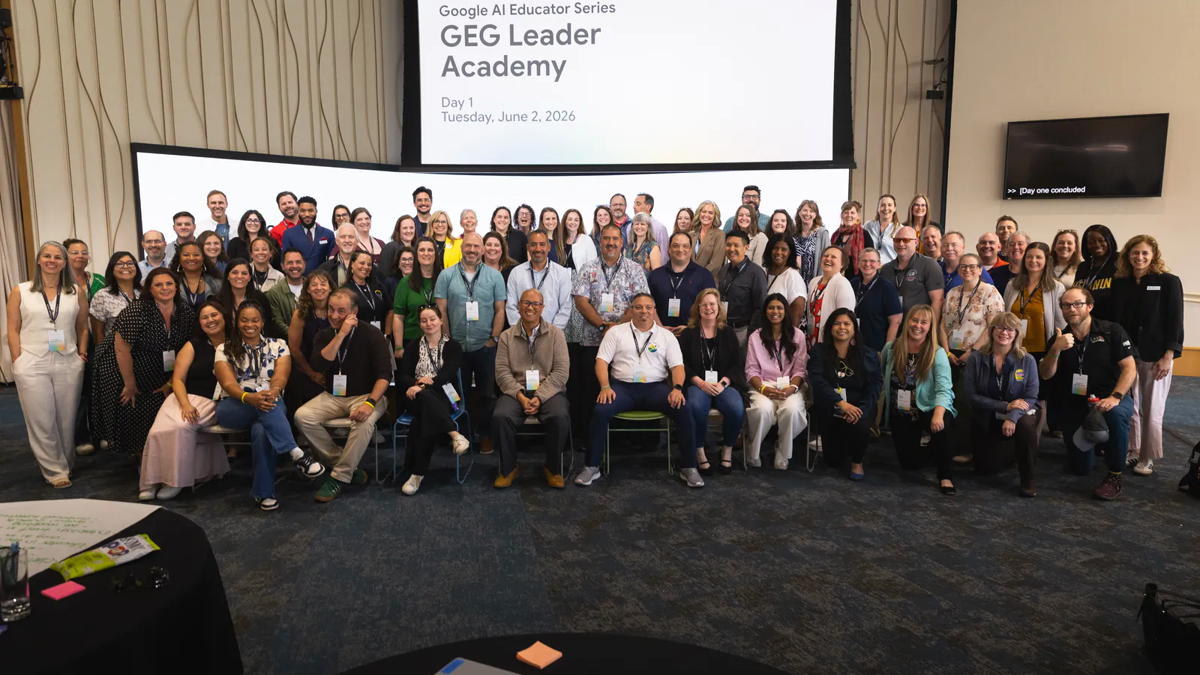


There are many free AI courses, but few of them can actually be credited to teachers' continuing education records or university transcripts. On September 18th, Google announced the addition of credit pathways for Google AI Educator Series: participants will be able to obtain free undergraduate recognized credits through College Unbound in the future, and may also convert these credits to graduate-level credits with the cooperation of ISTE and Dominican University; teachers and administrators in Illinois can also use Illinois Digital Educators Alliance to accumulate the continuing education hours required for license renewal.
The focus of this message is not on “Google creating another set of AI courses.” Google AI Educator Series was launched as early as May this year, targeting approximately 6 million K-12 students and higher education teachers in the United States. The courses are divided into short modules of about 15 minutes each. The real new development is that the platform is attempting to integrate sporadic learning into a formal certification system. For teachers, whether the training can be used for degree completion, certification renewal, or career development often determines their willingness to invest time more so than a mere platform badge.
Micro-courses will no longer only award badges; instead, they will be integrated with the university and teacher licensing systems.
Google has announced three pathways, but each one has clear boundaries. The undergraduate pathway is provided by College Unbound; recognized credits can be used to complete a bachelor’s degree or converted into continuing education units. The official statement is that it will be available “later this year,” so not everyone can obtain credits immediately today. The graduate pathway comes from the collaboration between ISTE and Dominican University and also requires compliance with the course and credit recognition rules of the partner institutions. The continuing education hours in Illinois are intended for the renewal of licenses for teachers and administrators in that state and should not be understood as universally applicable across the United States.
Such restrictions are very important. University credits are never automatically awarded just by watching videos. Participants usually need to complete designated modules, pass knowledge checks, or meet certain requirements for their work, and the issuing institutions will also decide how these credits will be credited towards their major or degree. Google provides a channel that is officially recognized by institutions, but it does not make promises on behalf of all colleges, universities, or state education departments. For teachers who teach across states, it is still the safest approach to first confirm with the local school, school district, or licensing authority.
The course itself emphasizes being “small but functional.” As previously mentioned, Google, new modules will be updated on the first Wednesday of each month, and comprehension checks will be implemented. The content includes using tools to handle repetitive notifications, using Guided Learning to help students solve problems step by step, planning research with Deep Research, and creating interactive learning experiences through AI Quest. It focuses on the most common questions teachers have: how to use these tools in the classroom tomorrow, rather than starting with an explanation of the entire set of model principles.
This design has a practical context. It is difficult for teachers to set aside several consecutive days to participate in intensive training; 15-minute modules can be incorporated into their lesson preparation or lunch breaks. These modules are relatively independent of each other, yet they can be combined to form a more complete learning pathway. The event held on September 19th, Badge-a-thon, was such an entry point. Google allows participants to join at any time during a 12-hour online activity, where they can watch teacher demonstrations, learn time-saving techniques, and earn digital badges that align with the standards of ISTE. Although the event has concluded, the related courses remain part of the on-demand learning program.
The real barrier has shifted from "whether one knows how to click buttons" to course design and the definition of responsibilities.
Replacing AI with credits addresses the issue of motivation for participation, but it does not equate to solving the quality of classroom instruction. Teachers will use prompting words, which is just the first step. What is more challenging is determining when AI should not be used, how to verify the generated content, how to protect student data, and how to use tools to facilitate thinking rather than replace it. If training focuses only on speed and automation, it is easy to turn the classroom into a assembly line for mass-producing lecture notes, emails, and assignments.
Google emphasizes in the course that teachers still hold a central position, and introduces the participation of educational organizations such as ISTE + ASCD in the design, which can make the content more relevant to teaching situations. However, since platform providers are also product providers, courses will inevitably use Gemini, NotebookLM, and Google Workspace as the main examples. When adopting these, schools need to consider perspectives beyond just the suppliers, such as comparing the limitations of different tools, establishing rules for the use of student information, and specifying that teachers bear the ultimate responsibility for reviewing the output.
For colleges and school districts, there is an even greater issue regarding the recognition of micro-courses: how to evaluate competence. Traditional training often scores based on attendance duration, but short courses are better suited for assessment through tasks and evidence. Whether a teacher can design activities that align with learning objectives, whether they can explain why a particular tool is chosen, and whether they can identify fabricated models or biases are more significant factors in assessing professional growth than simply completing a certain number of minutes of video. What is referred to as “rigorous checks for understanding” needs to be proven in practice, and certification bodies should also make their evaluation criteria public.
For individual teachers, the most valuable aspect of this new approach is the reduction in the cost of trial and error. With courses being free, short in duration, and potentially convertible into formal credits, learning is no longer solely dependent on large-scale projects purchased uniformly by the school. Teachers can complete the modules that are most relevant to their own work first, and then decide whether to continue accumulating credits. However, "convertible" does not equate to "obligatory acceptance"; it is still necessary to check qualifications, fees, availability times, and local recognition before enrolling.
AI In the past, the education market was accustomed to creating a loud presence by focusing on the number of people covered and the quantity of courses offered. What is more noteworthy this time is the certification framework: technology companies are responsible for the content and platforms, universities handle academic credits, professional organizations set the standards, and state-level partners facilitate license renewals. If this system operates smoothly, teacher training could transform from a one-time product launch into a cumulative professional record; however, if the rules are vague, it might merely be a rebranding of badges with a more catchy name. The ultimate criterion for success is simple: after completing the training, can teachers truly bring a more reliable and well-defined AI approach to their classrooms?