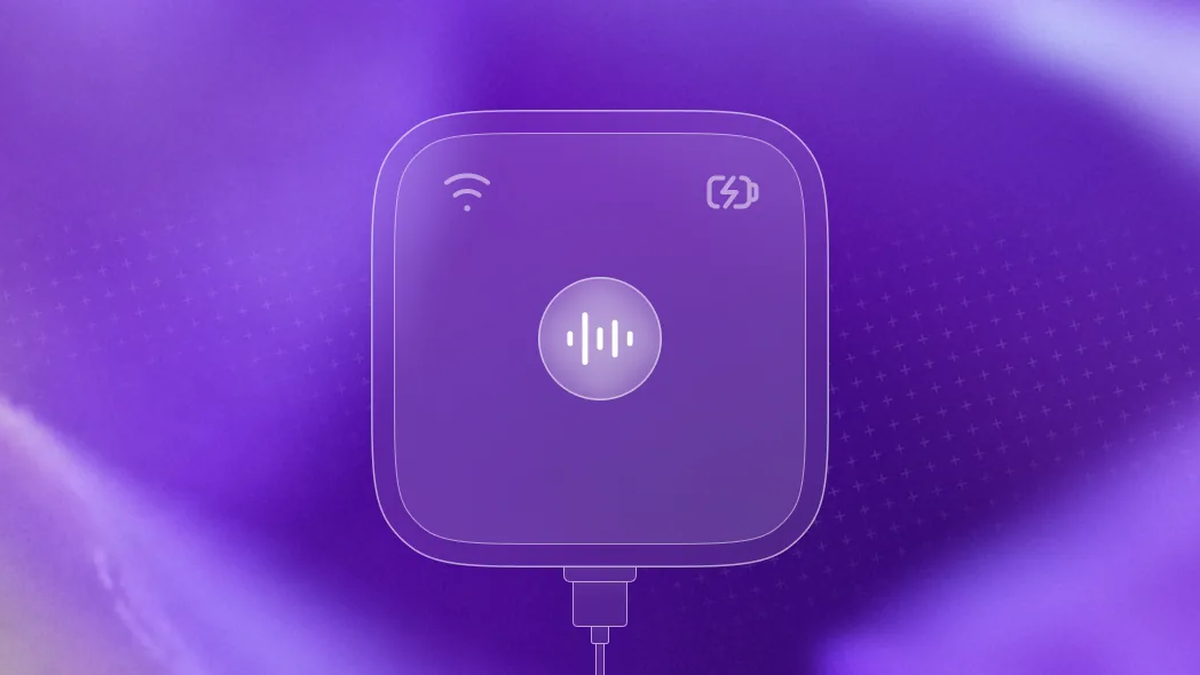


On September 23, the developer blog OpenAI published a rather practical project: Developer Sid Rampally assembled a Raspberry Pi, a 128×64 dot matrix LED screen, a microphone, and a speaker into a desktop voice assistant, then used GPT-Live-1 to handle real-time conversations, and completed the device-side development with Codex. This project is not new hardware released by OpenAI, nor is it a finished product for ordinary consumers; it is more like a functional engineering note, demonstrating how a voice agent can evolve from being able to chat to being capable of assigning tasks.
The devices demonstrated in the presentation can understand requests, update screen content, and when external information or more complex reasoning is needed, they can offload tasks to cloud models for processing. Examples given by OpenAI include looking up information, managing calendars, generating images, and modifying display walls. The core structure is clear: the Raspberry Pi maintains a low-latency voice connection and provides screen feedback; GPT-Live-1 determines the user's intentions; when faced with complex tasks, the client uses Responses API to offload the tasks to GPT-5.6 and Luna, which then return the results to the current conversation.
For a voice interface to be user-friendly, the key is not just to “speak like a human,” but to know when to hand over the task to another system or entity.
In the past, voice assistants were typically designed around fixed intentions. When a user said something, the system would match it to preset functions such as weather updates, alarms, or music. Generative voice models, however, offer greater freedom in expression, but they present new engineering challenges: if all tasks are packed into a single real-time conversation, responses can slow down, and it becomes difficult to manage the tool's permissions; if each task is handled by a separate background process, users may find the device to be slow to respond and the context to be disconnected.
This LED project adopts a layered approach. The real-time model is responsible for maintaining the conversation, explaining the current state, and deciding whether more powerful capabilities are needed, while the backend model handles tasks that require retrieval, planning, or generation. Layering is not something new; operating systems and cloud services have long used front-end and back-end processes to solve similar issues. Interestingly, large models can now perform routing at the natural language level, eliminating the need to write separate rules for each type of expression.
For developers, what is most valuable to learn from is status feedback. Once a voice system calls an external service, the latency can increase from a few hundred milliseconds to several seconds or even longer. Animations on the screen, brief text, and voice confirmations can tell users that "the system has heard you and is processing your request." This is not just for decoration; it is part of the design that enhances the credibility of the product. Without such feedback, users may repeat their commands, leading to concurrent tasks and redundant operations.
Local hardware also makes the boundaries of permissions more intuitive. Microphone audio, screen control, calendar functions, and network searches are different capabilities that, ideally, should be authorized separately. A model capable of changing display content does not need to automatically have the right to write to the calendar; a task that involves searching for information should not permanently hold control over the device either. Demonstrations have shown that these capabilities can be combined, but when it comes to real use in homes or offices, it is still necessary to implement minimal permissions, logging, and revocation mechanisms.
The prototype is easy to create, but a reliable product needs to address issues such as network interruptions, mishearing, and repeated executions.
The value of a blog case lies in executing the entire process smoothly, rather than proving that a few pieces of hardware can replace a mature assistant. The Raspberry Pi has limited resources, and network fluctuations, audio echoes, environmental noise, and power restarts can all affect the experience. Real-time models may also misinterpret user intentions. If the request is simply to change a pixel image, the cost of an error is very low; however, if in the future it involves connecting to door locks, payment systems, or enterprise systems, the same misinterpretation cannot be executed directly.
In engineering, idempotence must be addressed first. When a user asks "Is it done yet?", the system should check the original task instead of creating a calendar event again or generating an image once more. Secondly, it is important to save clear task identifiers, input parameters, and execution results so that users can cancel or retry the task if necessary. For operations with side effects, reconfirmation should be performed before final submission. Smooth speech should not be a reason to bypass this confirmation process.
Privacy cannot be overshadowed by the fun of prototypes either. Microphones that are always on standby require clear recording instructions, mute switches, and data retention policies. It should be transparent to users which audio is uploaded, how long it is transcribed and saved, and which accounts background tasks will access. Experiments conducted on a developer's personal desktop can rely on self-discipline, but commercial products need to incorporate these constraints into their user interfaces and system architectures.
The role of Codex within the project is also worth distinguishing. It helps developers write Raspberry Pi code, debug displays, and connect services, but it does not mean that everything during device operation is directly controlled by Codex. By describing development tools, real-time speech models, and backend inference models separately, we can prevent users from mistakenly thinking that this is a "magic box" where a single model handles all tasks.
The real product direction conveyed by this case is that interactive terminals may become increasingly lightweight. Devices do not need to have the most powerful models installed locally; they only need to stably perform functions such as receiving audio, displaying information, controlling permissions, and handing over tasks. Complex calculations can be performed in the cloud as needed. This approach lowers the hardware requirements but also increases dependence on network stability, account security, and service availability. The LED screen is just a small experiment, but it represents a proxy architecture that is likely to appear in automotive, home, and office devices.
Therefore, it should not be regarded as a preview of the next consumer electronics product. A more accurate description is: The members of the OpenAI team have used the existing API to create a reference implementation, proving that real-time dialogue and asynchronous tasks can collaborate naturally. If developers wish to reuse this approach, they should first copy its layered design concept, and then redesign the permissions, confirmation processes, and failure recovery mechanisms for their own use cases, rather than simply copying the shiny casing.