

Analysts said that the five-year cooperation between Circle and Binance could give USDC greater momentum in emerging markets and global trading, and it may also put more pressure on Tether's long-term leading position in the competition for US dollar stablecoins.

Analysts said that Binance's $100 million stake in Circle and the cooperative relationship between the two parties provide a strong distribution channel for Circle, especially in markets where USDT is already deeply established.
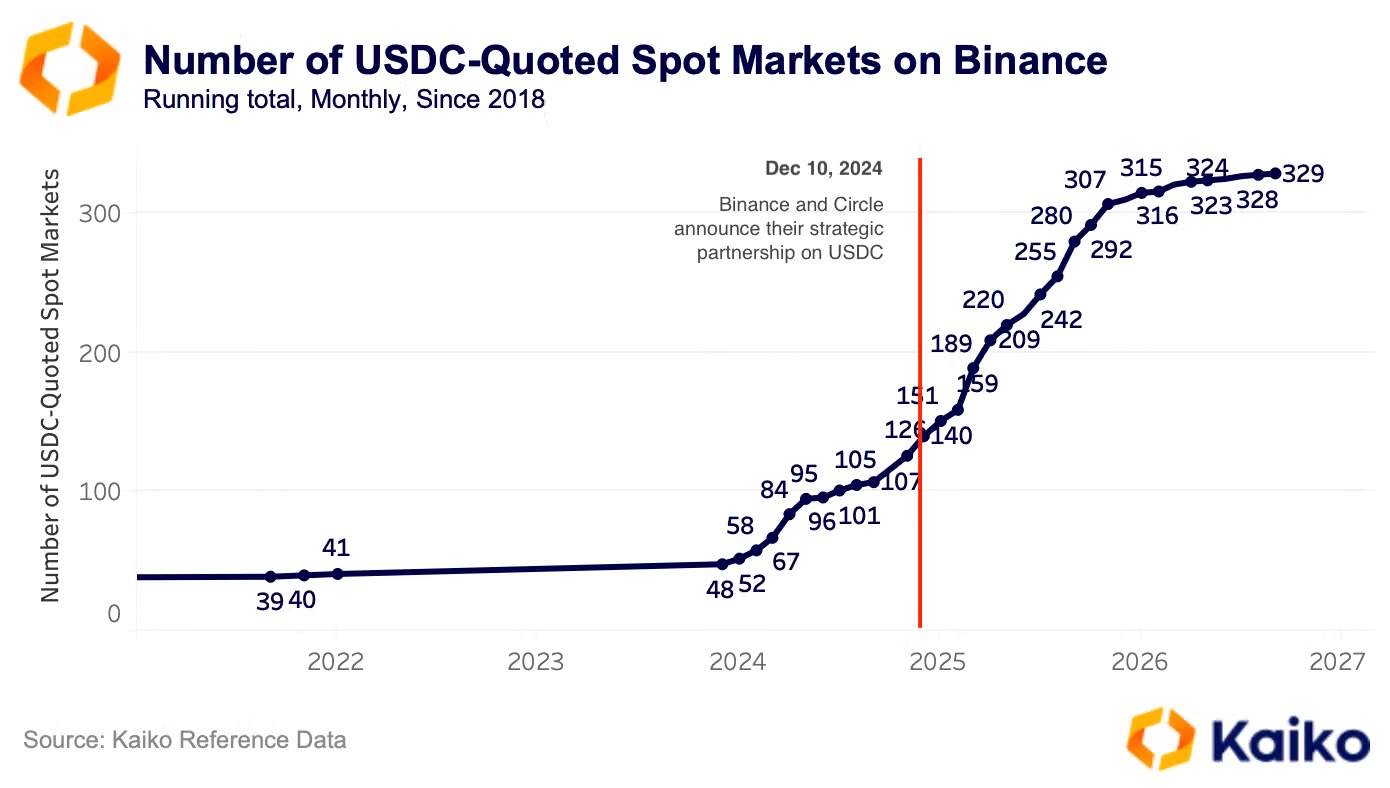
Kaiko data shows that since the two companies first collaborated in 2024, USDC's trading on Binance has significantly increased.
Binance has become an important trading venue for USDC.
The two companies first collaborated in December 2024, and this partnership has since changed the way USDC is traded on Binance.
According to Kaiko data, at the beginning of the collaboration, Binance provided 140 spot trading markets denominated in USDC; currently, this number has increased to 329. In contrast, it took until the end of 2024 for the number of markets to rise from 39 in 2021 to 140, indicating a significantly slower growth rate.
The monthly trading volume of USDC on Binance has also roughly doubled, rising from the range of $20 billion to $40 billion before the cooperation to continuously exceeding $80 billion.
According to Kaiko, the trading volumes of USDC on other major exchanges are still generally within the previous range, indicating that this increase is largely driven by Binance.
Melachrinos indicates that as Binance accelerates the coverage of USDC in emerging markets, this dominant position may further expand.
Places more pressure on Tether
The market value of USDC is approximately $74 billion, making it the second-largest US dollar stablecoin after Tether with a market value of around $140 billion and USDT.
Gravity Team, co-founder and CEO, and Martins Benkitis stated: "Both parties clearly have the motivation to leverage Binance's user base and infrastructure to drive the growth of USDC."
Circle is also expanding its business beyond the issuance of stablecoins. Its Circle Payments Network aims to connect financial institutions for stablecoin payments; while its recent announcement to acquire Tazapay, headquartered in Singapore, for $400 million will add local bank relationships and payment channels in emerging markets.
At the time this strategy was introduced, the competition in stablecoins was no longer limited to Circle and Tether. Banks and payment companies such as Visa, Mastercard, and Stripe were also further deploying stablecoin payments and infrastructure.
Benkitis means: "This will bring greater pressure to USDT, especially in global trading and emerging markets – where USDT has established a very strong position over the years. However, relying solely on distribution channels will not change this overnight. USDT has a deep range of trading pairs and local liquidity, and more importantly, people have already gotten used to using it."