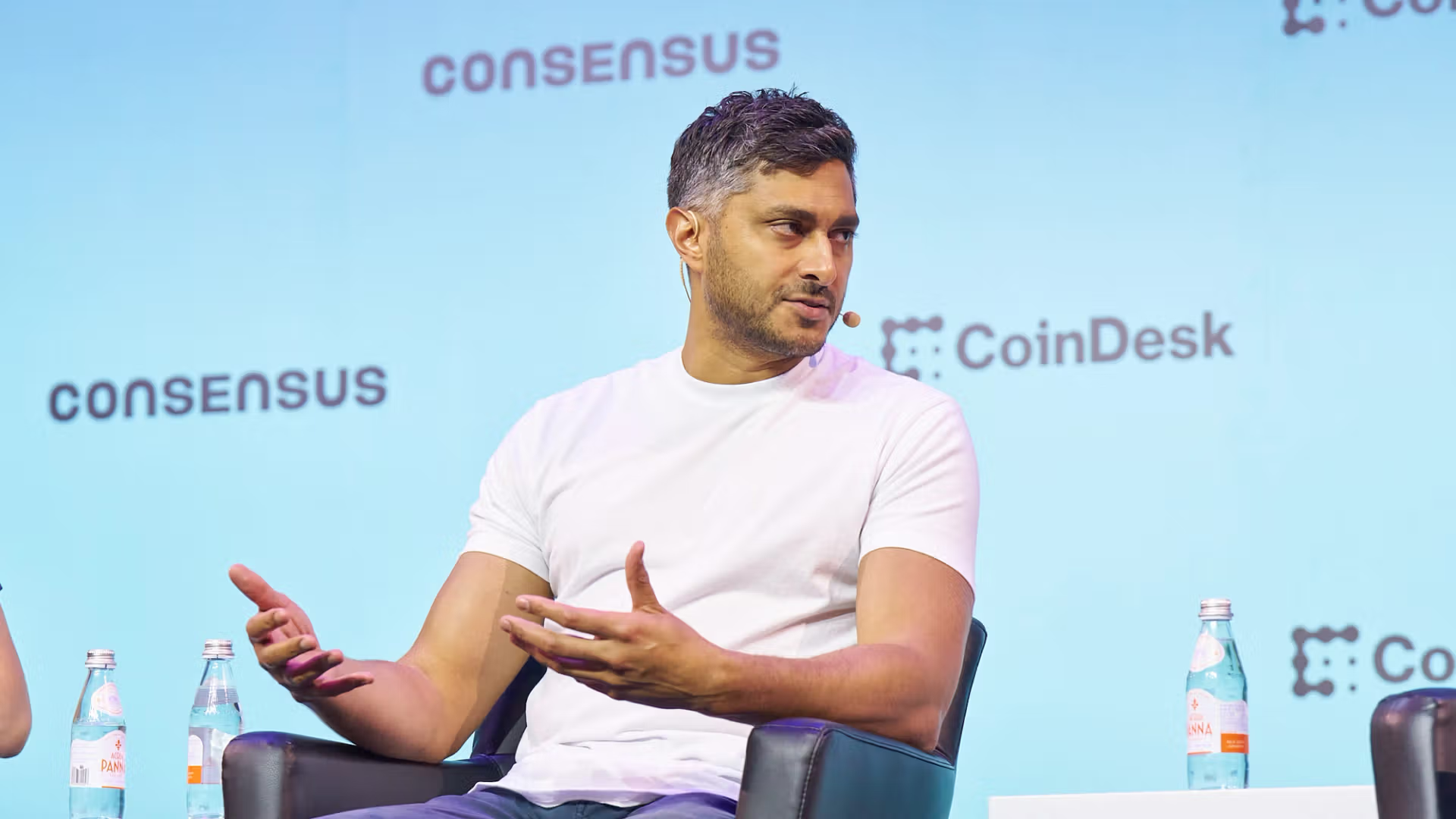


Kraken's parent company, Payward, stated that CEO Arjun Sethi is integrating transactions, payments, asset management, and institutional services onto a common infrastructure.
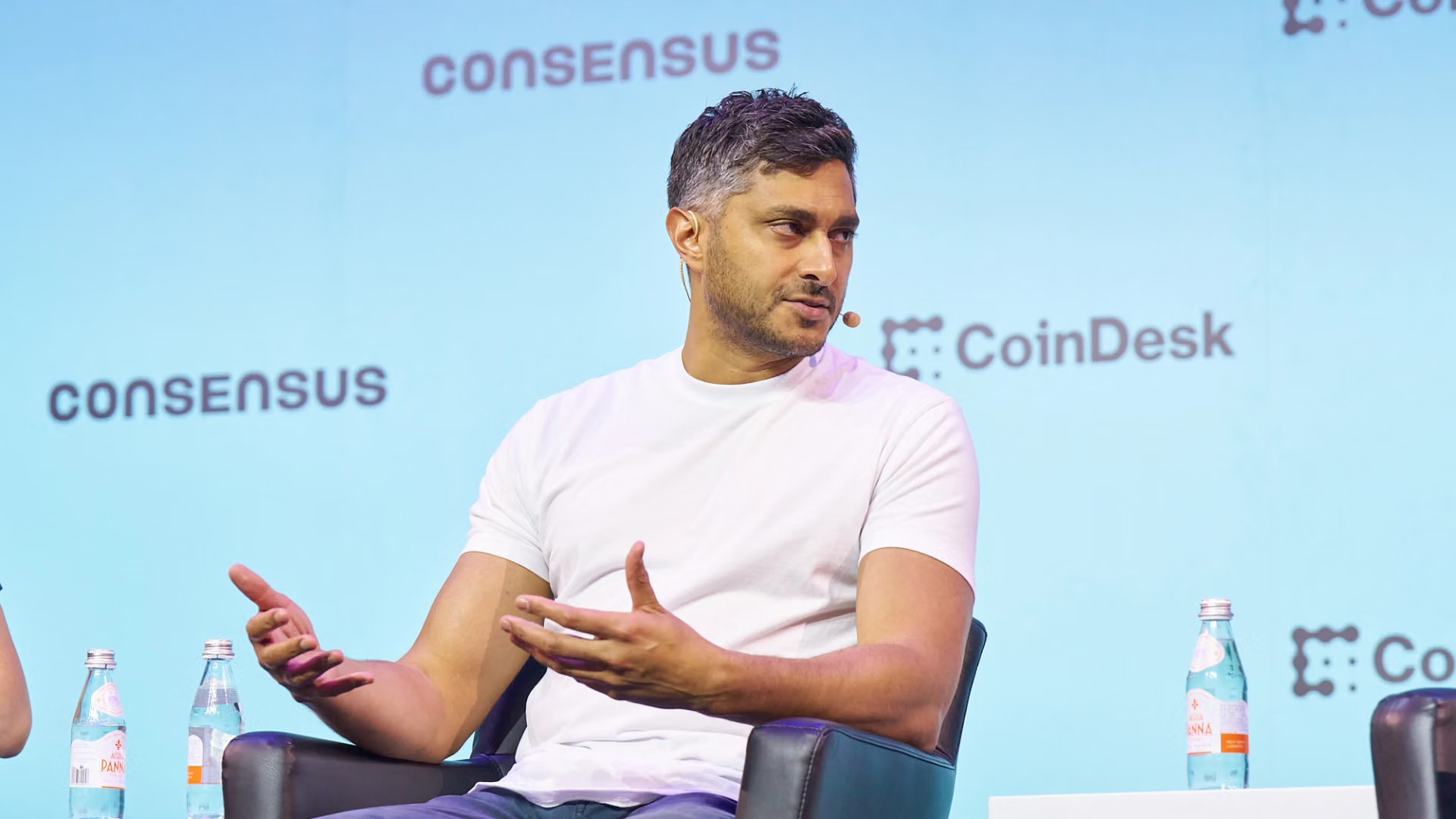
Payward is unifying transactions, banking, asset management, and institutional services, all running on the same infrastructure stack.
On one hand, the parent company of this Kraken develops products in-house, and on the other hand, it acquires capabilities that require too much time to develop on its own, while also collaborating with established institutions.
Sethi said that as the platform expands, Payward is currently profitable and is not in a hurry to advance IPO.
Kraken has spent most of the past 15 years building an encrypted exchange. In the past two years, its parent company has been acquiring and putting together the various components needed to expand its operations on a larger scale.
The parent company, headquartered in Wyoming and identified as Payward, invested several billion dollars in the acquisition to expand its business into the fields of futures and derivatives, enter the realm of tokenized stocks, and seek additional banking capabilities in both the United States and Europe.
All these measures serve a larger goal: to transform Payward into a unified financial platform, allowing transactions, banking, asset management, and services for other enterprises to operate under the same infrastructure.
"We are not a holding company," he said. "This is a platform, a balance sheet, a set of regulatory frameworks," Payward, co-led by CEO Arjun Sethi, stated in an interview with CoinDesk.
The core of this strategy is what Sethi refers to as “a single ledger,” which allows funds and assets to flow between different products without relying on the traditional financial system that is composed of multiple intermediaries.
Payward is not the only company pursuing a broader financial platform. Coinbase is building a “Everything Exchange” that covers cryptocurrencies, stocks, derivatives, and forecasting markets, while Binance is integrating trading, payment, investment, and income products into one platform.
However, according to Architect Partners, a digital asset investment bank, Payward adopts a different approach. It does not concentrate all its products under a single Kraken brand platform; instead, it is building an infrastructure that can support multiple brands and be utilized by external financial companies.
Architect Partners indicates that: Payward seems to have chosen a different aggregation layer: a regulated infrastructure stack that can provide financial product support for multiple brands, customer groups, and collaboration channels.
In our view, Payward is helping to define the next phase that goes beyond Everything Exchange: the Everything Financial Infrastructure mode.
In terms of trading volume, Kraken is still relatively small: CoinGecko data shows that in the first four months of 2026, its average daily spot trading volume was about 1.1 billion US dollars; whereas Binance accounted for 38.7% of the spot trading volume of the top ten centralized exchanges in the second quarter, and Coinbase reported a share of 8.6% of the total crypto trading volume in the first quarter.
One ledger, four businesses
The theory behind Payward is that most of the traditional financial system is still constrained by technologies and market practices from decades ago. Securities settlement takes time, markets are closed at night and on weekends, and banks, brokers, custodian institutions, and clearinghouses each maintain their own independent ledgers, which necessitates reconciliation.
Sethi says that every boundary brings more intermediaries, delays, and costs. In his view, blockchain systems provide an alternative solution because they allow assets to function simultaneously as investments, collateral, and programmable tools on a shared infrastructure.
Payward has broken down this vision into four main pillars: conducting transactions through Kraken, banking services, asset management, and Payward Services – its infrastructure department for enterprises.
Sethi indicates that Kraken currently has approximately 6.6 million funded accounts, holding assets totaling between 40 and 50 billion US dollars, with its services covering over 190 countries and regions.
In order to advance the vision of a unified financial platform, Payward is now adding services around these accounts, including cards, lending, derivatives, and tokenized stocks, as well as products that allow customers to borrow using assets as collateral or to deploy assets into decentralized financial applications. Kraken Financial, a specially licensed deposit institution in Wyoming, is also part of this system.
Build in-house, acquire, or collaborate?
This theory is also shaping the company's acquisition strategy.
Payward will develop some capabilities in-house, but they will also acquire those capabilities that take several years to replicate, and cooperate with institutions that cannot gain a position solely through acquisitions.
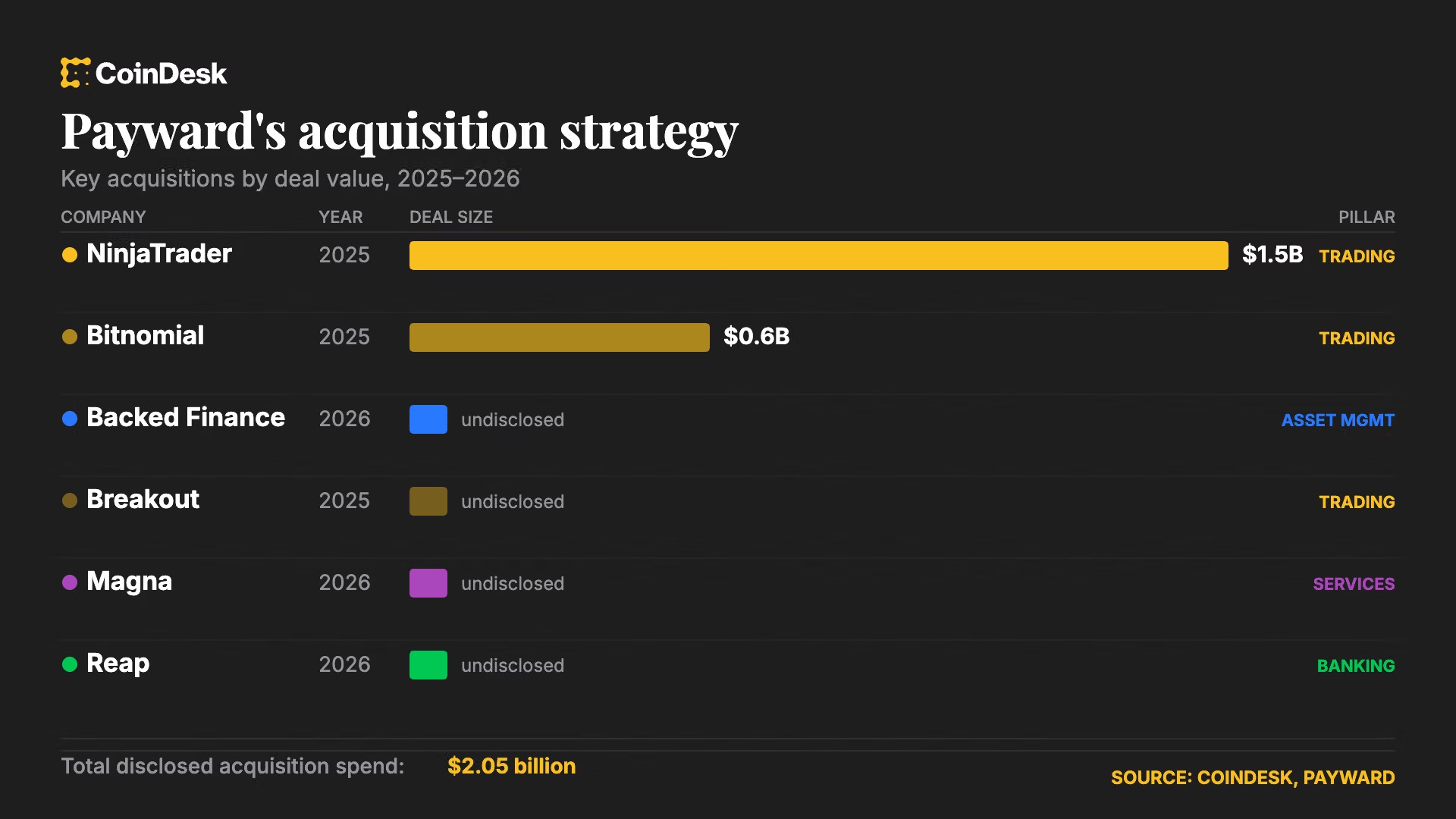
Sethi said that Payward paid $1.5 billion to acquire NinjaTrader in order to establish a futures brokerage business in the United States, which included its technology and regulatory licenses. All of these efforts came at a high cost and took a considerable amount of time. Subsequently, the company acquired Bitnomial for $550 million, thereby expanding its regulated derivatives infrastructure, which includes exchanges, clearinghouses, and futures brokerage services.
Sethi said that the company "is about to acquire a European bank," but did not disclose the target. In July, reports indicated that Payward planned to acquire a Lithuanian bank as part of its strategy to expand across the European continent.
The company does not maintain a shopping list, nor does it widely solicit projects from investment banks. Instead, it uses a set of quantitative frameworks to determine whether a target fills an infrastructure gap and provides the capabilities that customers desire, says Sethi.
However, not every component of the financial system is available for purchase. Some of Payward's most recent and important moves have come from collaborations with traditional institutions that blockchain technology once tried to replace.
For example, Nasdaq has agreed to invest $100 million in Payward this month, while also expanding cooperation between the two parties in Nasdaq Equity Tokens and market monitoring technology. Both parties expect to launch these tokens in the second quarter of 2027, with Payward providing distribution, trading, and post-trading infrastructure.
At the same time, the London Stock Exchange is also working independently with Payward to explore the tokenization of listed stocks. Subject to regulatory approval, both parties plan to list xStocks – that is, the tokenized representation of publicly traded stocks – on their upcoming LSE platform in 2027.
For Payward, these relationships reflect a reality: blockchain infrastructure cannot erase everything that traditional exchanges have built over the course of several decades.
“Trust is their currency,” says Sethi, and believes that Payward can complement rather than replace the listing and regulatory infrastructure of traditional exchanges.
Moreover, in order to continue to advance this vision, Payward does not intend to wait for legislators to pave the way first.
Sethi does not believe that the stagnant US crypto legislation will become an obstacle. The company supports Clarity Act and has also spent many years educating policymakers about the relevant issues, but he states that legislation is about formalizing the industry, not creating the industry itself.
"Bitcoin has been around for 17 years, but the market structure legislation has not yet been introduced," he said. "Rights come before laws; laws follow later, and legislation is a result of that."
Open infrastructure to other companies
Payward is also transforming the infrastructure that was initially built for Kraken into an independent business.
Payward Services provides services to banks, fintech companies, securities firms, and crypto platforms through a set of universal API. Sethi states that at least 25 companies are using this infrastructure to develop products, with launches expected this year. Hyperliquid is also one of its partners.
This department is built upon the infrastructure that Payward has already established, which includes hosting, liquidity, compliance, risk management, payment, and settlement. Now, the company packages these capabilities and offers them to external companies through a single integration.
Architect Partners indicates that this may provide Payward with a distribution channel that does not rely on directly directing customers to Kraken. Banks, fintech companies, securities firms, and other enterprises can use the infrastructure of Payward in products with their own brands.
“Even if end-users never have direct contact with Kraken, the model of Payward can still operate,” said Architect Partners.
This strategy has brought Payward another potential source of revenue in addition to its Kraken trading customers, and it also puts it in competition with an increasing number of crypto companies that are selling infrastructure to banks and fintech companies.
Move asset management onto the blockchain
The company is also taking similar actions in terms of investment products.
Payward has long provided hosting, staking, and income generation products, but now it is formalizing this business into an asset management platform to accommodate more managers, strategies, and asset categories.
It does not seek investment management authorization in the traditional sense, but rather aims to provide an execution and distribution layer that allows customers to access structured products, tokenized stocks, credit, and multi-asset strategies, while keeping the assets on the Payward platform.
The initial focus was on tokenizing stocks, followed by structured products that could be divided into smaller units and distributed globally. Payward recently collaborated with Bitwise to launch an institutional investment product, and it is expected that more managers and strategies will be added in the future.
Sethi says that these products may appear similar to traditional asset management from the outside, but they will be managed in a tokenized form on the infrastructure of Payward, thereby reducing costs and counterparty risks.
Not in a hurry to go public
As Payward prepares for a future public listing, expansion is also being advanced in parallel. Although Sethi indicates that the company does not rely on IPO to finance its ambitions.
Payward submitted an application for IPO in November 2025, however, CoinDesk reported earlier this month that the company will not go public until at least the second quarter of 2027 at the earliest.
Sethi refused to comment on the timeline beyond what is publicly available, and stated that Payward is still profitable, with revenue continuing to grow. He said that the company will go public only when it is appropriate for the business, shareholders, and regulatory authorities.
Sethi also indicates that Payward does not require external funds to maintain its operations and can use its balance sheet to fund investments.
He added that the recent financing is more aimed at bringing in strategic partners, including Citadel Securities and Nasdaq. Their professional capabilities will help to expand the platform.
Payward reports that in the second quarter of 2026, adjusted revenue amounted to 508 million US dollars, representing a year-on-year increase of 17%.
Ultimately, the goal of Payward is to simplify the financial system through blockchain technology, enabling individuals to also have access to the same type of financial infrastructure used by mature trading companies such as Jump Trading and Jane Street.
“Fix money, fix the world,” said Sethi.