On September 27th, according to a message from the IT community, Li Bin, the founder and chairman of NIO, stated at the 2026 NIO Power Day event that NIO has put 4,125 battery swapping stations into operation. With each station having a battery reserve of about 2,000 kWh, this constitutes an energy storage network of 8 GWh, which can serve both car owners and society as a whole.
According to the introduction, each battery swapping station is essentially a distributed energy storage unit, and in theory, these stations have the hardware infrastructure necessary to participate in grid peak shaving and valley filling. NIO's Xinjiang Xingxingxia off-grid photovoltaic, energy storage, and battery swapping station has already achieved a closed-loop system of "photovoltaic power generation - on-site energy storage - battery swapping for energy replenishment," which also verifies the feasibility of implementing battery swapping combined with energy storage in remote areas.
As previously reported by IT, on September 26th, with the launch of the 4,125th NIO battery swapping station at Sayram Lake, NIO's Silk Road battery swapping network was officially completed across the entire route.
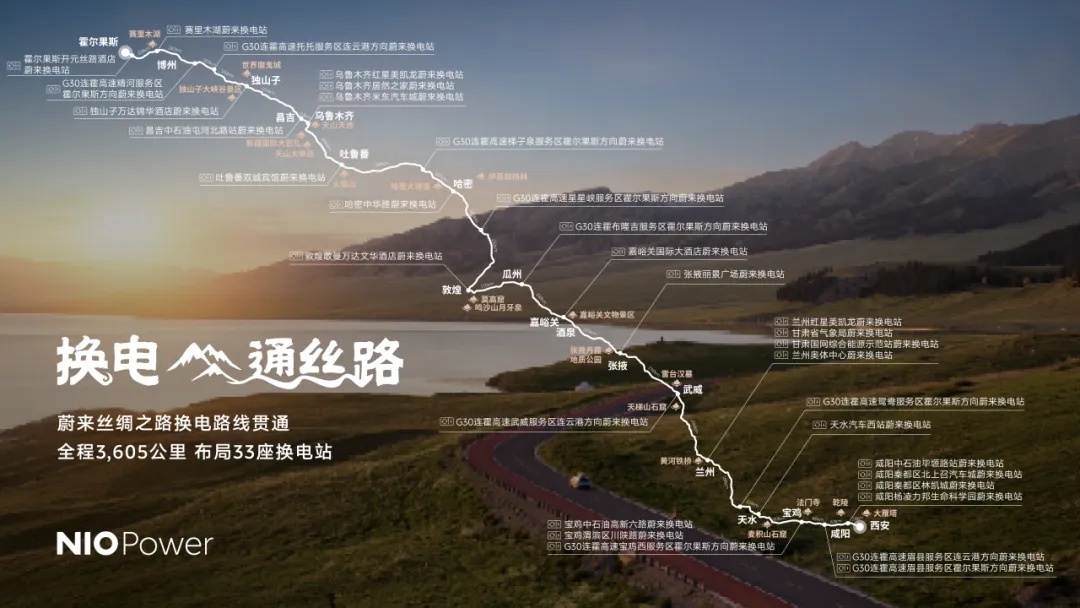
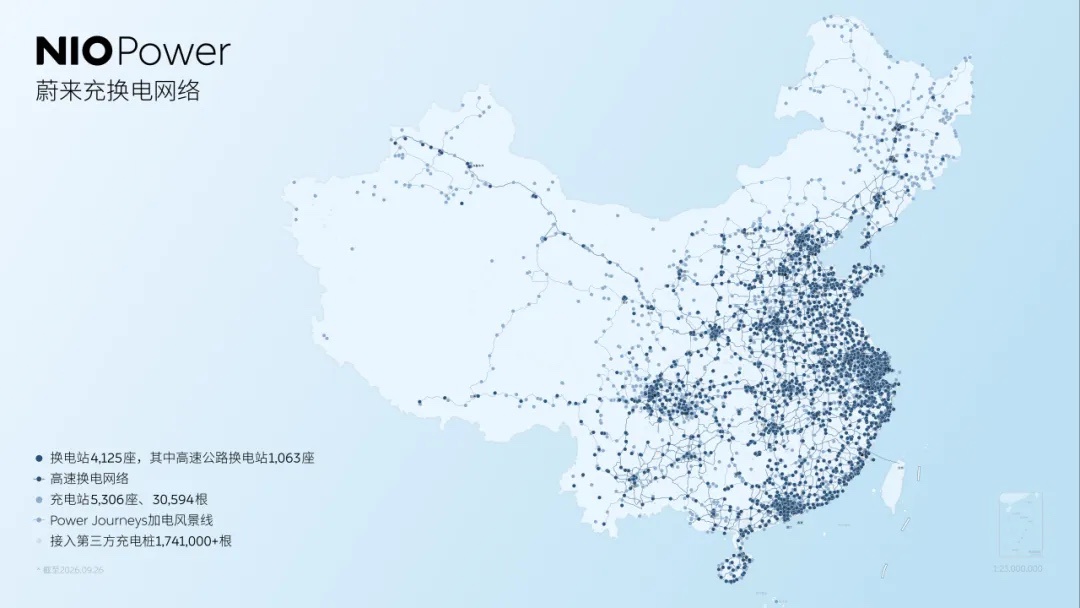
The route starts from Xi'an in Shaanxi in the east and extends to Horgos in Xinjiang in the west, covering a total distance of 3,605 kilometers. Along the way, there are 33 NIO battery swapping stations set up. Once the route is fully established, it will be possible to complete a full battery swap from any battery swapping station across the country to all provincial administrative regions of mainland China.