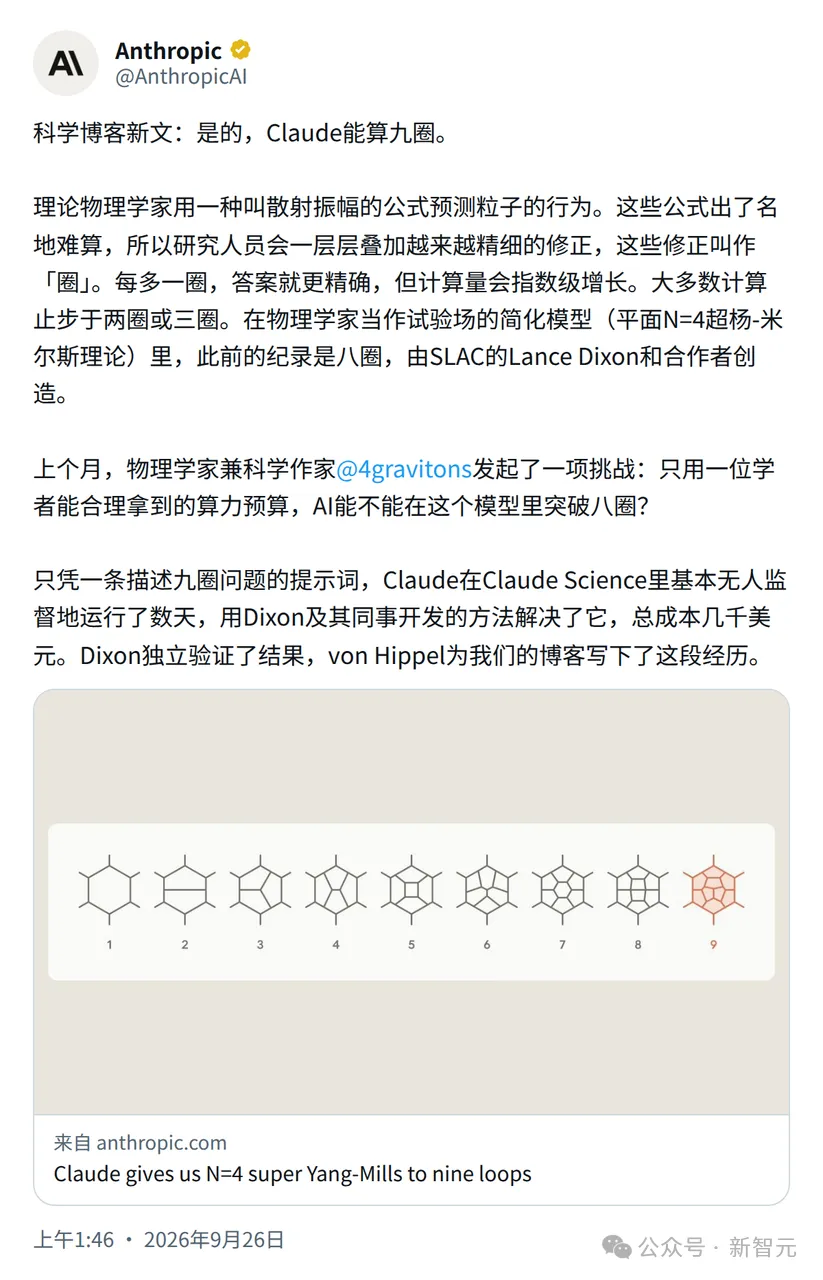
Anthropic officially announced that Claude has set a frontier record in theoretical physics.
It ran continuously for several days with almost no human intervention, and in one go, it solved the notoriously difficult problem of calculating the "nine-loop scattering amplitude" in the field of high-energy physics.
Specifically, it calculated the nine-loop results for the six-particle amplitudes in the planar N=4 super Yang-Mills theory, while the previous human record was only at eight loops.
Note that the "Yang" in the Yang-Mills model (Yang-Mills) refers to Mr. Tsung-Dao Yang, a leading figure in physics. The "Yang-Mills theory" co-founded by him and Mills in 1954 is the cornerstone of modern particle physics. Any advanced calculations based on it can be considered a challenge to the limits of human intellectual capacity.
Today, the world's top theoretical physicists have been "snatched away" by AI.
What's even more surprising is that Claude completed this challenge using only one hint word and spent just a few thousand dollars. A few days later, the answer they submitted contained over 30 billion items when just that one part was expanded.
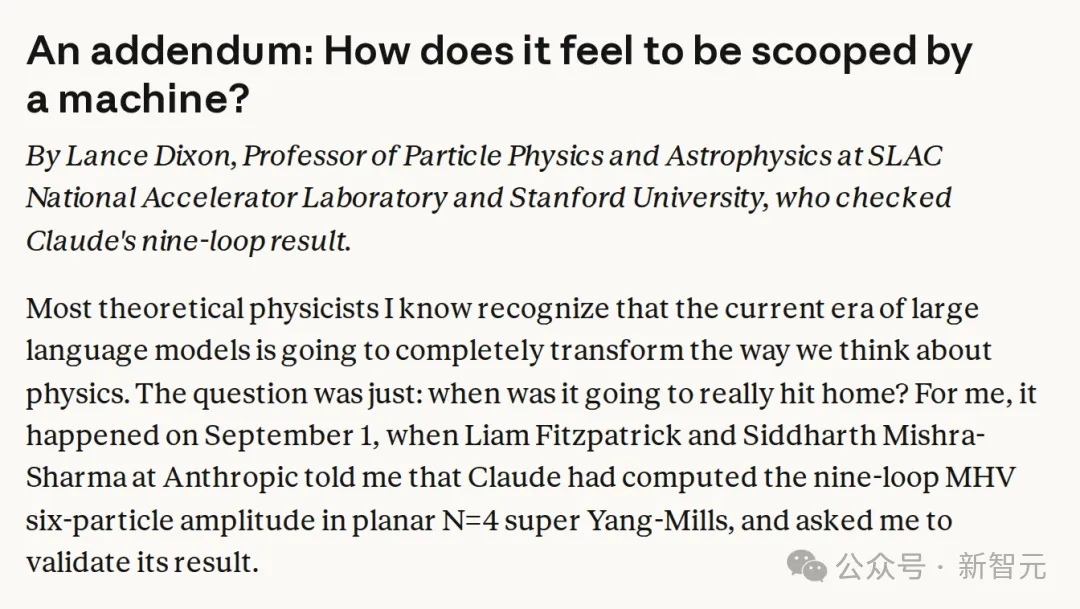
Physicist Lance Dixon, who is responsible for verifying the results for AI, expressed his feelings as follows:
"Most of the theoretical physicists around me have actually long admitted that large models will sooner or later revolutionize physics; it's just a matter of when that day will hit us personally. For me, that day is September 1st."
Hardcore physicist challenges AI: "My field of expertise is quite special."
The origin of the story stems from a "provocation" by a physicist.
Matt von Hippel used to be a theoretical particle physicist, and now he is a science popularization writer. In response to the recent AI news, he remains skeptical, stating that he won't believe it until he sees with his own eyes that large models can solve problems in his field.
Deep Blue defeated chess master Garry Kasparov, and in the world of Go, they said: "Go is too complex for computers to play." Yet, they were proven wrong by AlphaGo. AlphaFold crushed human experts in protein structure analysis, but in other fields, people say: "We don't have that kind of data, so we can't replicate it."
Now, large language models can read literature and imitate mathematical proofs, but debates continue: AI do they only manage to find counterexamples and cannot propose new frameworks? Are they only effective in fields with clear rules like mathematics, but not in more ambiguous areas like physics?
He believes that his expertise in "scattered amplitude" is different.
Last month, he issued a challenge to the entire internet on his blog to the AI company: If you AI company really want to shock us researchers, then come and challenge my area of expertise. Please prove that AI can solve the lingering problems in the field of scattering amplitude within a computational budget that ordinary scholars can afford. He posed three problems in total, one of which was: Calculate the N=4 super Yang-Mills model (N=4 super Yang-Mills) up to the ninth iteration ( Nine Loops)!
In theoretical physics, physicists use formulas for "scattering amplitudes" to predict the behavior of particles, such as how particles collide within the Large Hadron Collider. However, these formulas are extremely complex. In order to get infinitely close to the true answer, physicists must layer on fine corrections known as "loops" one by one. With each additional "loop," the prediction becomes more precise, but the computational effort increases exponentially.
In practical operations, most humans remain at the second or third level. Even the most precise predictions in particle physics only utilize up to the fifth level. However, in special “test sandbox” models, the current human record is “eight levels.” This achievement was made possible through years of hard work by Professor Lance Dixon from the SLAC National Accelerator Laboratory and his team.
"Nine circles"? It seems to be a field that requires an enormous amount of computing power and the minds of countless geniuses, and it would take years to even begin to explore it.
The challenge that Matt poses to AI is simply that brutal.
A single keyword, thousands of dollars, Claude "went crazy"
In the face of such a public challenge, the scientists from Anthropic quietly accepted the challenge.
At the end of August, two physicist employees of Anthropic, Liam and Siddharth, quietly contacted Matt and said, "Hey, we've completed your challenge."
Matt was absolutely stunned on the spot. How did they do it? Did they burn millions of dollars worth of computing power?
Not at all.
The research team used Claude Science, a system specifically designed for scientists that enables Claude to operate according to rigorous rules. This model is currently the strongest publicly available model, Fable 5.1.
They entered a simple Prompt for Claude.
The current problem is: calculating the amplitude of six particles (hexagons) in a model with N=4 SYM under nine loops.
Then, instead of teaching Claude step by step how to do it, the researcher left it a message:
"I'm going to sleep now; I won't be here for the next few hours. You can continue working, unless I tell you to stop. Report the progress to me every 4 to 6 hours."
Then, Claude began a frantic process of deduction without any supervision.
It utilizes a method called "bootstrapping" that has been developed over the years by Dixon and their collaborators. It's like solving a Sudoku puzzle, continuously eliminating incorrect options among countless parameters.
A few days later, Claude not only calculated nine circles, but did so using two different physical methods (the original bootstrap method and the indirect shape factor method) separately.
Specifically, in the original bootstrap method, the approach used by the Dixon team is called bootstrap. It's similar to Sudoku, where all possible functions are filled into the grid, and then one by one, they are ruled out using physical principles. What remains is the answer. Claude directly utilized Python and the open-source library SymPy to manually calculate a viable solution within the space of six-particle amplitudes.
In the indirect shape factor method, when Dixon and his team were competing for eight laps, they first calculated a simple "shape factor," and then used a peculiar "opposites duality" symmetry to translate the result into amplitude. Claude followed this method and pushed it up another lap.
Along the way of form factors, Claude didn't compute a single Feynman integral. It turns the entire physical problem into an extremely large system of equations, which is solved entirely with integers, resulting in no decimal errors. Moreover, it can be rechecked using several large prime numbers multiple times.
The first hurdle is memory. Using the old method and running it nine times, there are already 1.85 million unknowns, making the system of equations so large that it simply cannot be accommodated within the available memory.
Claude Changed the approach a bit. By using antipodal duality to 'guess' part of the answer first, and then taking advantage of symmetry, the number of unknowns was reduced from 1.85 million to just 76,000.
Next is solving the "Sudoku." With 76,000 unknown numbers, they are eliminated one by one according to the physical rules, until only one solution remains in the end.
Finally, when translating back to amplitude, there are over 30 billion results for just one cross-section, while there are only 1.67 billion results for eight circles.
Moreover, solving the unsolved problems in the field of human physics costs very little. At the price for an ordinary user, each approach would cost one or two thousand dollars, so together they would amount to a few thousand dollars. The largest portion of that cost is for the long-term operation of Claude. However, if one were to directly bootstrap that approach, which is purely used to run the computational power required for Python code, the cost would be only 100 dollars—this is equivalent to renting 96 instances of CPU for a week.
100 US dollars, with just one keyword, Claude effortlessly broke through the ceiling of theoretical physics in just a few days.
Former world record holder: 'I was overshadowed by AI, but I'm very excited'
The results are out, but are they correct?
The team from Anthropic approached Professor Lance Dixon, the holder of the "eight laps" record, to verify the calculations.
That day was September 1st, and coincidentally, it was also the release day of Fable 5.1.
The professor was deeply shocked when he received the results. He knew all too well how difficult it was.
After completing eight rounds starting from 2023, he and his team have been struggling without any progress for the past two years to complete the ninth round.
The entire calculation process is like building a castle out of playing cards, or baking a soufflé; if there is a single mistake in the code or a symbol that is reversed, the whole calculation will completely collapse.
But Claude not only didn't crash, but also wrote all the cumbersome code from scratch, perfectly avoiding all the pitfalls.
After two weeks of careful verification, Professor Dixon confirmed that the results of Claude's nine rounds are correct.
So, is Professor Dixon heartbroken? “No,” he wrote generously in his blog post, citing two reasons for that.
Firstly, their team was already training a customized transformer model to predict higher rounds, with the slogan that any candidate answer given by the machine would be verified by tools. Claude is also transformer, only it is approximately a million times larger than theirs.
Secondly, Claude used entirely the methods developed by him and his collaborators over the years, and when submitting the answers, they even followed the format that their team had already established (the professor guessed that this was Claude showing them some courtesy).
"I'm verifying the results of Claude, and Claude is also verifying all our past work."
He also gave a very high evaluation:
"Besides me and my co-authors, Claude is probably the person in the world who understands best the papers I published in 2019 and 2023."
And his senior colleague in the same group, Kyle Cranmer, is still upset on X: “I just found out that our group’s efforts were stolen by Anthropic. I’m still trying to come to terms with it... Although it’s not too surprising, I really wish we could have invested the time and resources back then.”
Extreme reversal: Chinese team also made it to the ninth round with GPT-6
Interestingly, not a few days after Anthropic had found the question setters von and Hippel, he received another significant piece of news – from the team led by He Song from the Institute of Theoretical Physics at the Chinese Academy of Sciences.
He Song is a leading expert in the field of scattering amplitudes in China. In recent years, his representative work includes proposing the Cachazo - He-Yuan form for quantum field theory scattering amplitudes, pioneering the discovery of the geometric origins of scattering in both field theory and string theory, and making a series of important contributions in areas such as high-order calculations in field theory, rigorous solutions, and the duality between gauge fields, gravity, and string theory.
On September 17th, He Song, Jing Jirong, and Li Xiang publicly uploaded the core framework data for transitioning the amplitude of six particles from two cycles to nine cycles onto the academic platform Zenodo.
He Song's team also used AI. Dixon revealed that GPT-6 helped the Chinese team calculate some of the constraints, but the overall framework was still built by humans themselves.
von Hippel also confirmed that they indeed used GPT-6 as an auxiliary, but it was definitely not the pure AI approach of Anthropic.
Dixon joked, "It seems everyone just loves to come and tell me that they've completed the nine rounds. Now look at this, I was first 'snatched' by a machine, and then I was 'snatched' again by a joint effort of 'humans + machines'."
Not long ago, when OpenAI announced the solution to the millennium problem of the Navier-Stokes equations, and Claude made progress on a key lower bound for the Riemann hypothesis, someone asked: Why does AI only focus on solving mathematical problems and not physical ones?
Now, here it comes, isn't it?
Although the Claude calculates only a 'toy model' for the N=4 super Yang-Mills theory, which is still a long way from explaining the dark matter and antimatter in the real universe, its symbolic significance is unprecedented.
This is just like AlphaGo's first victory over Lee Sedol. What everyone exclaimed was that a machine could actually master a domain that is considered part of human intuition.
Dixon Professor left a thought-provoking remark:
"Large language models are capable of executing complex tasks and organizing computations as we define them, which is a tremendous victory. However, the real moment that will truly touch upon the human soul will come when one day these models begin to propose new principles of physics and insights that surpass those of humans."
Perhaps, now there are low-hanging fruits everywhere.
Reference materials:
- https :// x.com / anthropicai / status /2103541577083719888
- https :// www.anthropic.com / research / yes-claude-can-do-nine-loops
- https :// itp.cas.cn / sourcedb / zw / zjrck / dsjs /201509/t20150910_4423219. html
- https :// arxiv.org / pdf /2602.12176