

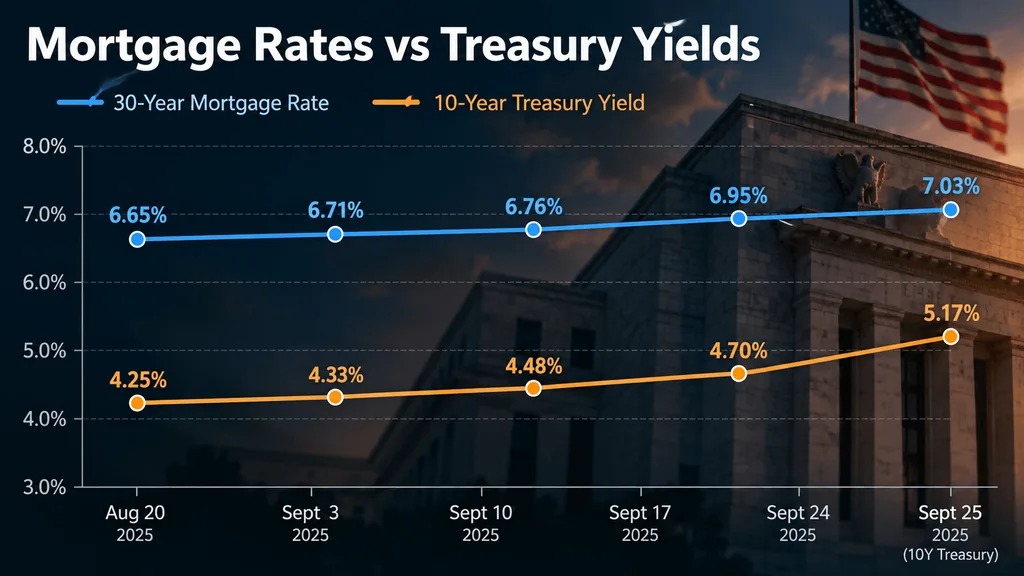
This change marks the fifth consecutive week of increases in 30-year mortgage rates, and borrowing costs are also significantly higher than the average level of 6.30% from a year ago.
The direct cause is not solely the Federal Reserve. Mortgage rates are largely driven by the bond market, and the yield on 10-year U.S. Treasury bonds closed at 5.17% on September 25th, having reached even higher levels earlier in that same week.
The Federal Reserve raised interest rates, but mortgage rates followed the bond market.
On September 16, the Federal Reserve raised its benchmark interest rate by 25 basis points to 3.75%-4.00%, citing that economic growth remains resilient and inflation is high.
This will affect financial conditions, but the Federal Reserve does not set mortgage rates directly.
Lending institutions price mortgage loans primarily based on the yields of longer-term U.S. Treasury bonds and mortgage-backed securities. This is also why in previous reports on mortgage rates by Coinpaper, 10-year U.S. Treasuries were considered a more important short-term indicator for borrowers.
Recently, bonds have been sold off due to a combination of factors including strong economic data, high energy prices, inflation concerns, and the government's heavy borrowing. These factors had already pushed the yield on 10-year U.S. Treasury bonds above 5% before mortgage rates exceeded 7%.
What does 7% mean for homebuyers?
The difference between 6.5% and 7% may not seem significant, but it can substantially change the monthly repayment amount.
Fannie Mae estimates that for a 30-year mortgage of $300,000, the monthly payment is approximately $1,996 at an interest rate of 7%; if the interest rate is 6.5%, it is about $1,896. None of the amounts mentioned above includes taxes and insurance.
This means an additional cost of about $100 per month, which amounts to approximately $1,200 per year.
What the future trend holds depends less on the next decision by the Federal Reserve (the “headline”) and more on whether long-term interest rates will cool down.
Coinpaper pointed out in another explanatory article that even if the Federal Reserve cuts interest rates, the yield on U.S. Treasury bonds may still rise. Therefore, for mortgage borrowers, it is more important to pay attention to inflation expectations, the government's borrowing scale, and the term premium, rather than just the federal funds rate.
Emir Abyazov
Coinpaper is the chief editor, responsible for driving data-driven editorial operations, content discovery oriented towards SEO, as well as prioritizing audience-oriented encryption, AI and financial technology storytelling.