


CCIP 2.0 has been launched, featuring institutional-level risk control, flexible settlement, and built-in compliance functions.
Chainlink indicates that CCIP has protected over $84 billion in value of cross-chain tokens, with an additional $15 billion in value currently being migrated to this infrastructure.
The potential uses of LINK may expand with the adoption of CCIP, however, the specific price targets remain speculative.
CCIP 2.0 has been officially launched, and its goal is even greater: to become the infrastructure for the next round of $600 trillion in blockchain finance. The approach is straightforward – cross-chain infrastructure requires security, compliance, and speed, while also not forcing institutions to return to fragmented systems.
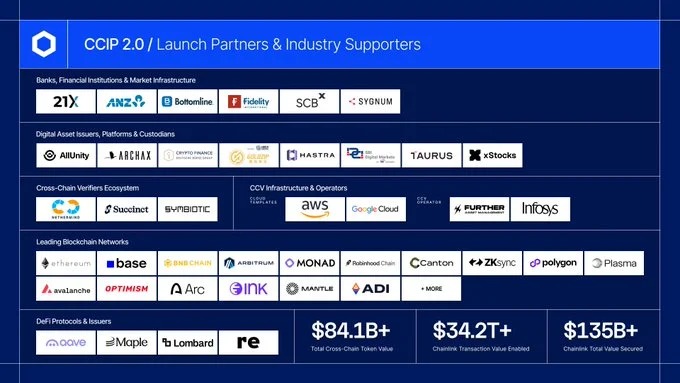
CCIP 2.0 aims at cross-chain finance for institutions
Interoperability has traditionally meant a choice between two options: either using traditional bridging solutions that have been attacked and resulted in cumulative losses of over $3.3 billion, or investing more than six months of custom engineering development for each blockchain.
CCIP 2.0 introduces institutional-level risk control through customized cross-chain validators (Cross - Chain Verifiers, abbreviated as CCVs). These validators can be deployed in Amazon Web Services and Google Cloud. Enterprise operators such as Infosys and Nethermind can also provide verification services.
The system also gives asset issuers more control over settlement. High-frequency transfers can use faster execution paths, while high-value transactions can require full final confirmation and delayed approval.
Chainlink Integrate compliance directly into the transfer process
Compliance is another key aspect of CCIP 2.0. With the native integration of Chainlink ACE, policy controls can be directly embedded into cross-chain transfers.
This includes KYC, AML defined by the issuer, sanctions screening, allowlists, as well as risk exposure limits.
Compared to the approach of treating compliance as an external process surrounding the infrastructure, this represents a clear change. Here, these controls are designed to be directly integrated into the transfer process itself.
Cross-chain value has reached $84 billion.
CCIP has currently protected over $84 billion in value of cross-chain tokens, with an additional $15 billion in assets in the process of being migrated to this infrastructure.
The assets being migrated include BitGo's WBTC, Coinbase's cbBTC, and Kraken's kBTC.
This progress has also received support from several major blockchain networks and protocols, including Arbitrum, BNB Chain, Polygon, Aave, and ZKsync.
The usefulness of LINK may become even harder to ignore.
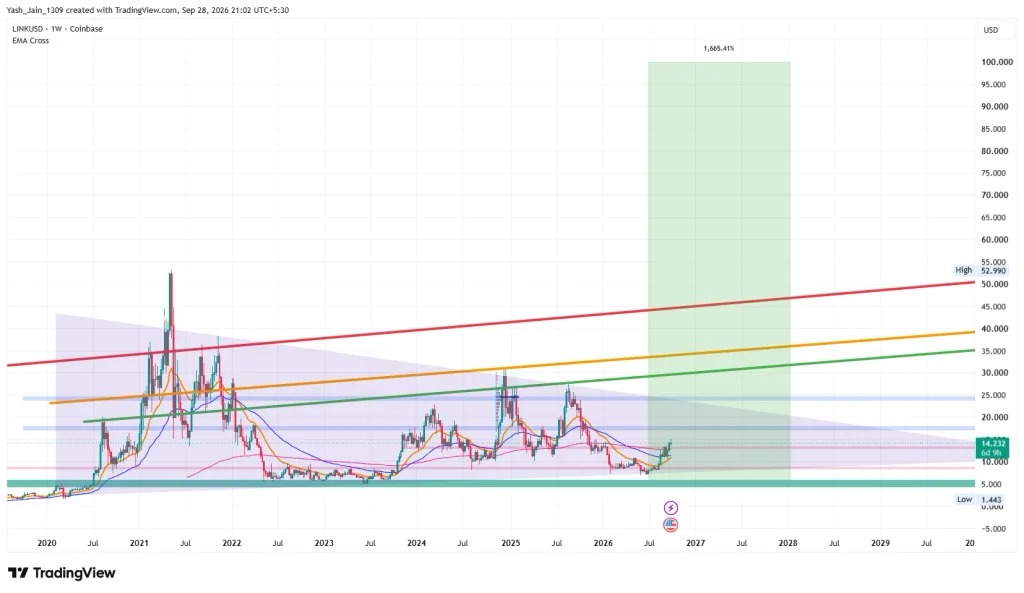
This puts the LINK tokens of Chainlink in an interesting position. The data provided in the text does not give a specific price target for LINK, but as CCIP is scaled up, the importance of LINK within the broader Chainlink ecosystem may increase.
With CCIP 2.0 targeting liquidity for regulated assets and institutions in on-chain markets, some market participants are betting on a $50 target based on the demand for LINK; while LINK / USD reaching $100 or even $200 may no longer seem so far-fetched. However, these are all overly aggressive price targets that are not supported by data; without unimaginable demand emerging, this remains just a hypothesis.
For CCIP 2.0, the bigger question is whether this infrastructure can become a neutral interoperability standard for the flow of trillions of dollars in assets onto the blockchain.