

Would you like AI to complete all your shopping for you?
Do you want AI to complete all your shopping for you?
The reason I ask this is that the answer will become the key to the success or failure of a new type of AI agent: for example, Meta's Muse, or the popular startup Instinct that didn't exist a few weeks ago but is now valued at one billion dollars.
This agency industry promises to handle various tasks for you, but its most core purpose seems to be: "Our agents will help you find and purchase whatever you want, so you won't have to worry about shopping anymore."
Investors are interested in this because they envision a world where the value of e-commerce websites, especially Amazon's, will disappear, to be replaced by ruthless agents that search for the best deals on the internet without any loyalty to any retailers. Mark Zuckerberg, the head of Meta, stated that in such a scenario, Meta would make money by charging a small fee from each transaction.
But it's also possible that Amazon and other retailers don't need to worry as much as those who support proxies think. Even though many people are willing to let AI purchase something for them – not to mention letting AI handle most of their shopping – there might not be that many opportunities for such proxies to play a role.

This is the view of the analyst MoffettNathanson in a new report. They believe that 'we do not expect personal agents to become the disruptive force in e-commerce that some investors imagine.'
In my opinion, their core argument can be illustrated by this chart: The chart assumes that ordinary consumers make 47 payments per month (according to the Federal Reserve of Atlanta), and attempts to determine which of these payments would be suitable for an agent like Muse to handle.
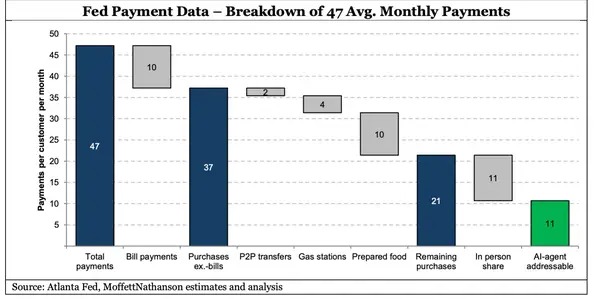
The conclusion is: once scenarios where proxies are not very useful are excluded—such as automatic payments, gas station transactions, and shopping in physical stores—there are only about 11 payments per month that proxies might be willing to handle.
Moreover, it is quite possible that you would indeed be willing to let Muse, Instinct, or some kind of proxy that Google may launch in the future, help you handle these 11 payments.
(I've been playing around with Muse and Instinct for the past few weeks. I've gone from "I would never hand my credit card to a robot" to "It turns out that the Stripe and Link services already have my credit card information, and I have no problem with Stripe, so I can accept using Link to complete a Instinct transaction." That's why I spent $17 using Bounce when I went to San Francisco last week—it was a luggage storage service I'd never heard of before. Instinct helped me plan my trip and recommended Bounce.) They even paid the service fee for me, and I didn't take the Visa card out of my pocket the entire time. It worked perfectly. I think my information is safe?
But if one can only get a share from these 11 transactions assisted by agents – and assuming consumers are willing to pay for them, which means these transactions themselves have to be of a relatively small scale – then it would be very difficult for Muse, Instinct, or any similar services to actually make a large profit, unless they can achieve widespread adoption.
As long as these things are still free, I’ll spend a lot of time playing with them. As for what will happen afterwards, I don’t know either.