

In October 2021, Robin Wigglesworth ( Robin Wigglesworth ) had been working as a global finance journalist for The Financial Times for several years, based in his home country of Norway. At that time, he published Trillions: How a Band of Wall Street Renegades Invented the Index Fund and Changed Finance Forever. The Wall Street Journal described it as "an authoritative and delightfully written work of history." I personally also enjoyed this book very much, as it delved into topics that Bloomberg columnist Matt Levine ( Matt Levine ) often writes about in a humorous tone, such as "Perhaps index funds will destroy capitalism" or "Are index funds Marxist?"
In a relatively recent article titled “Index Funds Are a Bit More Illegal”, Levin points out that the logic behind this view is as follows: Such a vast amount of trillions of dollars in funds are concentrated in investments that index funds now hold 20% of the shares of listed companies, meaning that these funds are not actually that “capitalist”. If you want to understand this history in its entirety – which can be traced back to the 19th-century French mathematician Louis Bachelier (Louis Bachelier) – you need to read Wiglesworth’s monumental work. The book covers the period up to the early 1970s, focusing on John McQueen (John McQuown) from Wells Fargo (Wells Fargo), the “stubborn” individual who invented index funds; it also discusses how, a few years later, John Bogle (John Bogle), the founder of Vanguard Group (Vanguard), made it possible for individual investors to purchase such funds as well.
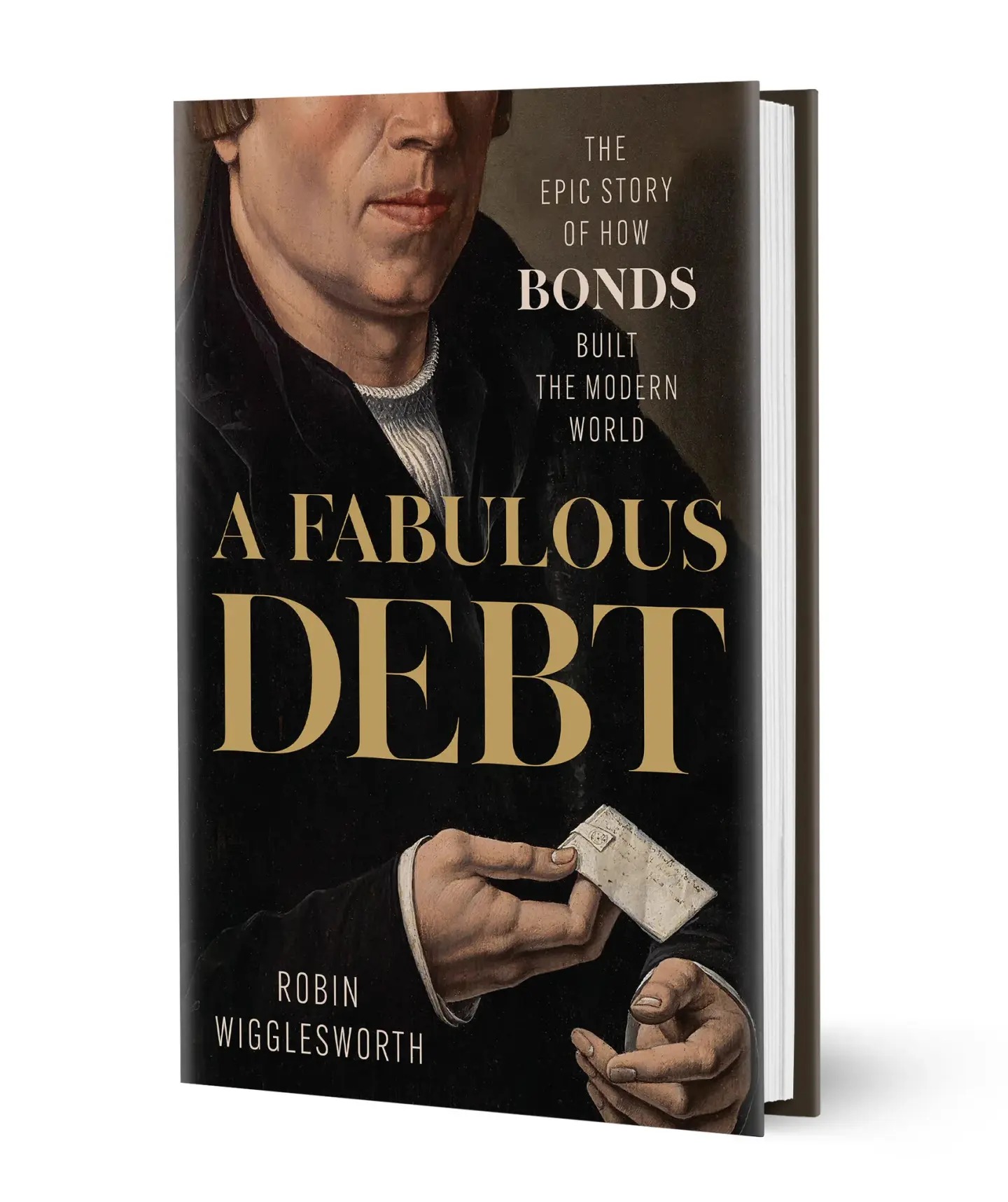
So, who else is more suited to tell the story of the bond market and the US government’s debt, which amounts to 40 trillion dollars and is still growing? “These things are important,” Wigglesworth said in a recent interview with me in his home office, “but they’re also fun and entertaining.” He added that “Trillions” covers a 100-year history, while “A Fabulous Debt” spans a full 1,000 years, dating back to medieval Venice. “Index funds are like humble heroes,” Wigglesworth said, “they are the glue that binds it all together.” But the bond market is quite another matter.
It is commendable that Wigglesworth, who now serves as the editor of the established and distinctive blog Alphaville for The Financial Times – a blog name indirectly inspired by Jean-Luc Godard’s New Wave science fiction films – writes in this new historical work in a manner that resembles a slow-paced thriller more than a financial textbook. The book discusses a nervous system that has never been properly mapped before, until it begins to fail and attracts attention. Publisher’s Weekly called this book “a must-read for anyone interested in global finance” and praised Wigglesworth for having a “Dickensian eye for capturing unforgettable events and characters.”
Wiglesworth says that reporting on finance is so interesting because it's like "understanding the hidden workings of the world," and at the same time, one must accept the fact that "once you understand money, you also realize that you can never fully comprehend it, but at least the world becomes a bit more orderly, or it doesn't seem so absurd."
Wiglesworth said that finance can feel like a “secret language that only you and a few others can understand,” especially when it comes to bonds. “The first time I discussed the bond market with someone and truly understood it, it was like a surgeon looking at a beating heart on the operating table.”
From Jenkins' ears to the Erie Canal
Wiglesworth begins his discussion with medieval Venice – where bonds were first born, as a means for this encircled lagoon nation to finance wars – and traces the history of bonds along the thread of military history. With great enthusiasm, he mentions that the bond market was involved in “a surprising number of strange and obscure wars,” such as the “War of Jenkins’ Ears” (which is not elaborated on in the book and is hardly mentioned at all): this war stemmed from rumors that Spaniards had cut off the ear of a British naval captain, and its financing relied on war bonds. Wiglesworth finds that many more famous conflicts were also related to bonds, with bonds even playing a central role in them.
To take Napoleon's defeat as an example, “It wasn’t Horatio Nelson, nor the Duke of Wellington,” Wigglesworth insisted, “the only reason Britain was able to continue fighting for such a long time against far more powerful enemies and subsidize all its allies in places like Portugal and Prussia was that they could essentially rely on a vast and unified public debt market for unlimited financing, something France could not do because they simply did not have any credit.”
Wiglesworth discovered that as early as two centuries ago, the young Alexander Hamilton ( Alexander Hamilton ) made almost the same judgment in a letter; clues to this letter come from the biography of Ron Chernow ( Ron Chernow ). “He basically wrote a letter saying that the key to Britain’s strength lay in its unified public debt market – it was actually credit that allowed Britain to support, equip, and dispatch thousands of soldiers around the world,” Wiglesworth said with a smile. “I find that quite fascinating.” He also added that Hamilton realized this much earlier than many other Britons. This insight not only became the focus of Hamilton’s life’s work but also shaped the form of modern America.
When I mentioned that I had recently been watching an old documentary about New York State and the Erie Canal, Wigglesworth became immediately interested. He referred to it as the “moment of origin” of the municipal bond market, and said that although this topic is not covered in the book, “it is one of the greatest examples in human history of what can be achieved by borrowing money and investing it wisely in quality projects.” He argued forcefully that if the canal had not connected the Great Lakes and continued downstream along the Hudson River, New York City would not have developed into the metropolis it became. Wigglesworth also pointed out that this section of the canal was the only gap in the Appalachian Mountain route that extended all the way to Canada. “Before that, New York was clearly already a financial center, but it could also be said that Philadelphia had a greater chance of becoming the real financial hub.”
Wiglesworth mentioned that first financial crisis in American history, which is now largely forgotten – the “scriptomania” about which Irving Lamont ( Owen Lamont ) wrote in Fortune – and pointed out that Richard Sylla ( Richard Sylla ), often referred to as the “forefather of American financial history,” also agreed with the view that the Erie Canal shaped the development of the northern states of the United States.
From a more macroscopic perspective, he believes that bonds have "united the United States," whether in a metaphorical sense, financial sense, or political sense. During the Revolutionary War, the debts of the individual states were consolidated into federal debt, which was later refinanced through the issuance of the first U.S. government bonds. This process created a community of the United States composed of "citizens-borrowers." He mentioned that some Italian city-states and Britain also went through similar processes. "Sometimes we think of history as inevitable, as if A equals B equals C, and that's how we learn history. But things could have developed in very different directions."
Modern "Vulnerability"
Wiglesworth said that when he wrote to the present moment, the ending was almost one he chose himself. He originally considered using a somewhat technical type of bond ETF as a conclusion – which could also be seen as a natural continuation of Trillions – but in the end, he settled on a darker theme. The 1000-year history of bonds continuously points to the same unresolved issue: whether this financial nervous system he discovered can continue to survive within the modern financial system.
Everyone knows that figure: $40 trillion in U.S. national debt. As the midterms approach, this number dominates campaign ads and conversations over dinner tables. Wigglesworth says there are two aspects to this issue: one that makes him "extremely relaxed," and another that makes him more vigilant. He says, no, the United States will not go bankrupt. "I'm not saying the probability is 0%, but it's probably around 0.01%, and now that probability is even higher, and it may continue to rise in the future."
"My biggest concern," Wigglesworth said, "is the vulnerability that comes with changes in participants, such as who is actively involved in the U.S. Treasury market and how these positions are financed." He added that for most of the post-war period, the most stable buyers in the U.S. Treasury market were foreign central banks, but over the past few decades they have gradually withdrawn, replaced by hedge funds that engage in leveraged trading. "I'm worried that in the U.S. Treasury market, those participants who are more sensitive to price changes and use high levels of leverage are becoming increasingly influential, which could make the market more volatile and prone to sudden disruptions," Wigglesworth said. It's like an elderly patient developing hypertension.
“In fact, all of us are competing with the U.S. government for funds,” he said, explaining that the surge in U.S. Treasury yields has a cascading effect on the global economy, which can even be felt in Norway, and that the increasing vulnerability of this market is “extremely dangerous.” He explained that the money borrowed today comes from what is known as the “repurchase” market—a short-term overnight financing market that most people have never heard of, yet it has a significant impact on them. He believes that people have forgotten the causes of the Great Recession. “What brought down Bear Stearns and Lehman Brothers was not necessarily just toxic assets,” he said, “but a repurchase run.” Today, a vast market built on the same overnight logic is directly supporting the U.S.’s $40 trillion in national debt, and both are still growing.
"The entire global financial system is built on U.S. Treasury bonds, as they are the most liquid, reliable, and stable," said Wigglesworth. "And we have organized the global economy in this way almost by accident. But I worry that this cornerstone is a bit more fragile than people usually think."
In 2008, the size of the repurchase market was only a few trillion dollars; since then, it has expanded to over 12 trillion dollars. These funds flow from one day to the next with almost no other guarantees besides collateral and confidence. The specific transactions described by Wigglesworth are known as U.S. Treasury spot-futures basis trading ( Treasury cash-futures basis trade ). According to a research report by the Federal Reserve in June 2026, as of September last year, the scale of this trading had grown to about 830 billion dollars, which is approximately twice the peak before the pandemic at the beginning of 2020, and now it accounts for more than one-third of the total long positions in U.S. Treasuries held by hedge funds. Another paper presented at a meeting of the Brookings Institution goes further, stating that basis trading is inherently "vulnerable" in structure.
He also mentioned an anecdote about Warren Buffett ( Warren Buffett ). Wigglesworth recalled that during Berkshire Hathaway's ( Berkshire Hathaway ) annual meeting in April 2020, Buffett stated that corporate executives were indeed frightened by the turmoil in the U.S. Treasury market. "We reached a point where the U.S. Treasury market – the deepest of all markets – became somewhat disordered," Buffett said, "and once that happens, believe me, every bank and every chief financial officer in the country will be aware of it. They will react out of fear, and fear is the most contagious disease you can imagine. It makes even a virus seem trivial."
"You would want your shelter – that is, the U.S. Treasury bond market – to be as safe as it can possibly be," said Wigglesworth, "and when that shelter starts making strange noises, people become even more panicked."