


As I drove through the magnificent estate of Linwood Hall ( Lynnewood Hall ), which covers an area of 34 acres, and passed over the towering iron gates, I immediately understood why this manor, built in 1897, is known as the "Last Versailles of America."
As someone who loves France and frequently visits there, the glittering golden gates of the Palace of Versailles, its lush gardens, marble buildings, and exquisite fountains have always fascinated me.
Therefore, experiencing architecture inspired by this grand European style in the United States itself is indeed a pleasure.
From September 25th to October 4th, visitors can stroll through the mansion with 110 rooms at Linwood Hall and admire the floral art installation exhibition " Fleur de Villes : The Gilded Age " held there. The inspiration for this exhibition comes from the characters in the HBO series "The Gilded Age".
I attended a media event to see this device and visit the estate, but the adult ticket price was 30.50 US dollars.
This vast mansion is being opened to the public for the first time in over 80 years. It has a connection to the Titanic and has been in the process of restoration for decades after lying unused.
Here is more history about this mansion, as well as some of the coolest details I saw during my visit.
Linwood Hall was commissioned to be built in 1897 by Peter A.B Widner, a butcher and transportation entrepreneur from Pennsylvania.

In 1897, Widener commissioned the famous architect of the Gilded Age, Horace Trenbowler ( Horace Trumbauer ), to build a massive residence for his family in the countryside of Pennsylvania.
Upon completion, this mansion covered an area of nearly 110,000 square feet. In 1899, it welcomed its first guests.
Today, Linwood Hall is the second-largest mansion from the Gilded Age still in existence in the United States, only surpassed by Biltmore Manor in North Carolina ( Biltmore Estate ).
This mansion is so magnificent that Peter A.B·Widener II, the grandson of Widener, later wrote in his memoirs in 1940: "Linwood Hall, I think, can be called the last Versailles of America."
But this family also suffered a tragedy. In 1912, Wiener's 50-year-old son George ( George ) boarded the Titanic along with his wife Eleanor ( Eleanor ) and their adult son Harry ( Harry ), preparing to return from England to New York.
In the early hours of April 15th, this ship, which was once considered indestructible, collided with an iceberg and sank, resulting in the deaths of George and Harry. Eleanor survived after being helped onto a lifeboat by her husband and son, along with her maid.
After the tragedy, Widener lived in this house until his death in 1915.
Wiedner's surviving son, Joseph ( Joseph ), inherited Linwood Hall and lived there with his family until his death in 1943.
According to Philly Voice, between 1915 and 1930, the public was occasionally allowed to visit this mansion to view the more than 2,000 works of art collected by Peter A.B Widener. However, it has been closed since 1944.
In 2023, this manor was purchased by the Linwood Hall Preservation Foundation (Lynnewood Hall Preservation Foundation) for 9 million US dollars.
In the decades following the death of Joseph Widener, this estate changed hands several times, including to the First Korean Church of New York ( First Korean Church of New York ). The latter converted this luxurious ballroom, which was covered with wooden planks and inlaid with gold edges (see above image), into a space for prayer benches.
However, for approximately 30 years, this mansion remained largely unused until the Linwood Hall Preservation Foundation purchased it in 2023, with plans to preserve it over the coming years.
The foundation estimates that the ongoing multi-phase restoration work, including exterior and interior repairs and maintenance, as well as upgrades to better serve visitors, could cost over $100 million in total.
Edward Tom, the CEO and Executive Director of the Linwood Hall Preservation Foundation (Edward Thome), told Philly Voice that the visitor experience will continue to evolve as this estate undergoes changes.
He said, "This house is generally ready for use already, but it will continue to get better. With each visit, there will be improvements, so I think this is what visitors can look forward to the most."
During the visit, I found that the courtyard of this manor bore a striking resemblance to the Palace of Versailles in France.
Although Linwood Hall covers an area of 34 acres and is quite large, it is still much smaller compared to the Château de Versailles, which I visited in 2021 and has an area of about 2,000 acres.
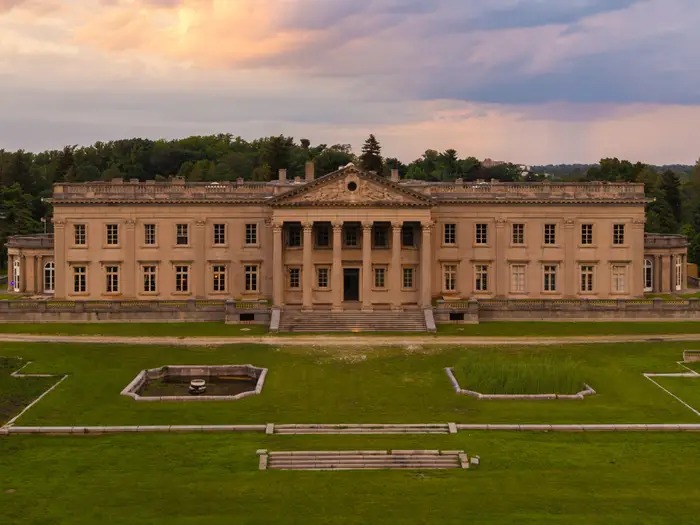
However, when I looked at the plan of Linwood Hall’s spacious lawn and garden adorned with marble fountains, the French style was undoubtedly evident.
As part of the 1916 renovation project of the Widener family estate, French landscape architect Jacques Greber ( Jacques Gr é ber ) designed what the foundation calls "one of the most exquisite French gardens in American history."
Upon entering the interior, the arches are made of construction materials that are not easily replicable.
As soon as I entered, the towering arches and magnificent staircase that came into view left a deep impression on me.
The famous Golden Age architect Horace Trenbowl used marble, Indiana limestone, bricks, and high-quality concrete in the construction of this mansion – the foundation states that these materials and techniques are now very difficult to replicate.
This is indeed one of the most distinctive lobbies I have ever seen.
As soon as I stepped onto the black and white checkerboard floor, I knew I was in for a luxurious experience. Later, I was also invited to taste a warm-room dessert: a premium chocolate with sea salt topping and cream filling, made by cheesemaker Kessa Duzier ( Kesha Dozier ), who was born in Pennsylvania and is the owner of the The Chocolate Boutique shop. Such a welcome indeed tasted delicious.
The glittering room, adorned with gold edges, fills this mansion with a palatial atmosphere.
The wooden wall panels of the house, including the large banquet hall that was once used as a place of worship (see above picture), were all transported from a French castle.
An old classroom has been transformed into a floral art space.
The room, which was once used to educate the children of the Widener family, is now filled with floral sculptures inspired by characters from the Gilded Age, Peggy Scott ( Peggy Scott ) and William Cokran ( William Kirkland ).
A bathroom with a century-old history looks surprisingly modern.
The tall indoor arches above the marble sinks and bathtubs add a contemporary feel to the space.
Although this mansion was built in 1899, some of its parts, including the banquet hall, were renovated in the early 20th century.
The design of the Gilded Age emphasized attention to detail.
I am captivated by every detail of this manor, including the smallest design elements, such as a light switch with religious inscriptions.
The architecture of this mansion also features tall windows with wainscoting, allowing even the smallest rooms – such as this butler’s storage room – to be flooded with plenty of light. As a result, the indoor experience is just as bright as the outdoor one.
Even the ceiling is decorated very luxuriously.
Just when I thought I had seen everything before me and could no longer be amazed, I looked up.
In modern design, I rarely see architects taking the time to decorate ceilings... except for that terrible spray-painted dot ceiling trend from the 90s.
The ceiling in the grand banquet hall, with its wooden and golden checkerboard plating, is a very beautiful addition.
More than 125 years after its grand opening – and after experiencing both glory and tragedy since then – Linwood Hall is embarking on a new chapter.
Visitors can view the floral exhibits inspired by the Gilded Age at this estate in Elkins Park, Pennsylvania ( Elkins Park ), before October 4th. The exhibits are titled Fleur, de, and Villes.
Currently, this will be the only opportunity for the public to enter this historic mansion. As the restoration work continues, the Linwood Hall Preservation Foundation plans to organize regular tours, more special events, open days, and volunteer days, but the dates for these events have not yet been announced.
Titanic