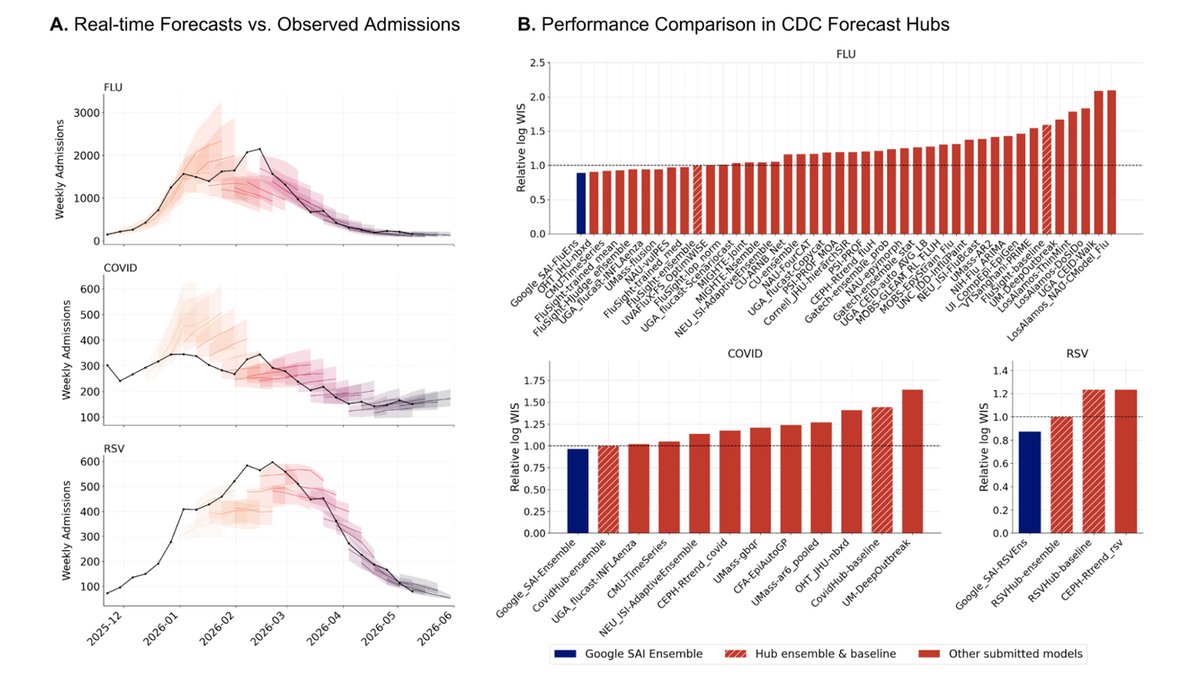


Before the peak of the flu season arrives, what hospitals are most concerned about is not whether a model can produce a fancy explanation, but rather how many people will need to be hospitalized in the coming weeks. The US Centers for Disease Control and Prevention (CDC) recently released its forecast assessment for the 2025-2026 flu season. A set of models developed by a research team at Google was the closest to the actual number of hospitalizations during that season among 39 eligible models. Google announced these results on September 30th. This is a good achievement using real-season, real-data models, but being "number one" does not mean that accurate predictions can be made for any region or any season, nor does it imply that medical resources are automatically allocated by AI.
The FluSight project, identified by CDC, receives forecasts submitted weekly by government, university, and corporate teams. These forecasts cover the number of hospitalizations related to influenza in the United States for that week and the following three weeks. The combined forecasts are used to inform various states about potential healthcare demands. To understand this ranking, it is essential to consider it within this specific context: the comparisons are made between forecasts during the same flu season and the data observed subsequently, and it is not a test of capability for all infectious diseases; leading models may also show significant deviations in certain states or during certain time periods.
The technological changes behind rankings are not just about “feeding more data into the models”
Google indicates that the relevant predictions utilize its Empirical Research Assistance system. This tool is used to generate and improve scientific optimization algorithms, and related research has been published in 'Nature'. The underlying technology is currently only available to trusted testers. Unlike chatbots that are familiar to most people, the core of this work is to find algorithm and parameter combinations that are more suitable for prediction tasks, and then to present the results in public evaluations that can be compared with those of other teams. What is emphasized here is testable prediction, rather than generating a piece of seemingly authoritative medical advice.
The number of people hospitalized due to influenza is influenced by a combination of virus prevalence, population structure, testing behavior, and hospital admission criteria. A model that performs well on a national scale may become unstable in certain local areas due to limited sample sizes or sudden outbreaks. Therefore, what public health departments need is not just a single ranking; they also need to consider probability ranges, whether extreme peaks are underreported, errors at different lead times, and whether the results can reach decision-makers in a timely manner. If the forecast indicates an increase in demand over the next three weeks, hospitals will also need to arrange for beds, personnel, medications, and referrals, none of which can be replaced by the algorithm alone.
CDC adopts a method where multiple teams submit their work on a weekly basis, which effectively imposes real-world constraints on the model. Research teams cannot choose to present only the historical data that is favorable to them, nor can they submit a 'prediction' after seeing the results of that week. Continuous submission creates a time series that can be compared; both poor and good weeks are taken into account. This approach is more in line with actual usage than a static paper chart and also makes it easier for outsiders to determine whether the model just happened to predict a peak correctly. Google The term 'first' mentioned this time should be understood as the best performance under the CDC evaluation criteria for that quarter, rather than a permanent certification.
From the leaderboard to hospital shift scheduling, there are still three hurdles to overcome in between.
The first challenge is to reproduce the results across different seasons. Influenza virus strains, vaccination rates, and social behaviors vary from year to year, so the optimal algorithm from last year may not be suitable for the following year. Continuous evaluation over time is more persuasive than a single award-winning solution. The second challenge is local applicability. National trends tend to mask differences between states, and hospital beds and medical staff cannot be allocated based on a single national curve; these resources must be managed on a city-specific level. The third challenge is to clearly communicate uncertainties: decision-makers need to know that the peak period could occur two weeks earlier than predicted, rather than relying on a forecast that is only accurate to one decimal place.
The announcement for Google does not provide detailed error figures for the model across all states and for each forecasting week, nor does it indicate that CDC has been established as the official decision-making basis. FluSight is inherently a multi-model system, and the comprehensive results, along with human epidemiological judgment, are still important. If communications to the public describe "optimal evaluation" as "AI's ability to accurately predict influenza in advance," it turns scientific research progress into an overpromise; conversely, if it is viewed purely as an experiment, it may underestimate the practical value of continuous forecasting.
What is more noteworthy is whether, after research tools have extended the task of "finding the right algorithm" from the hands of a few experts, they can continue to maintain a sufficiently transparent track of verification. Scientific forecasting does not require models to issue orders like doctors, but it does need them to stand up to public rules, real results, and repeated tests. The performance this season proves that the AI auxiliary algorithm design can enter the first tier of public health forecasting. Its next test will be to continue to provide stable, explainable forecasts that can be used with caution during the new flu season.
To truly integrate the model into the hospital management system, it is also necessary to establish a reverse communication channel: when the model predicts an impending peak in hospital admissions, after managers adjust the duty schedules, it is important to record which decisions were based on the model and which were based on clinical experience, as well as how much the actual number of admissions deviated from the prediction. Only in this way can we determine in the next season whether the model is improving decision-making or if it is merely transforming existing intuition into a graphical representation. In the field of public health, what is most avoided is a situation where a model earns high scores but no one knows how to use it, or where, in the event of errors, there is no way to trace back to the original predictions and the basis for the actions taken at that time.
Source: Google Research, September 30, 2026; CDC FluSight End-of-Qtr Evaluation. https :// blog.google / innovation-and-ai / models-and-research / google-research / google-science-ai-flu-forecasts /