News from IT on October 5th: Honda has announced today that its research and development subsidiary, Honda Research Institute, in collaboration with Daicheng Construction and Daicheng Road Technology, has jointly developed the core technology for a "magnetic coupling wireless power supply road system" (hereinafter referred to as "wireless power supply road system") that can charge electric vehicles while they are in motion without contact.
The three parties plan to officially carry out actual highway tests after the fiscal year 2027 (Note from IT: from April 1, 2026, to March 31, 2027; that is, in April 2027 or thereafter).
The official stated that the system integrates the core advantages of three parties: Honda's independently developed high-power density power transceiver units that support direct current distribution, Dacheng Construction's high-response direct current power supply systems, and Dacheng Road Technology's mature underground pipeline and road burial construction techniques. This system combines high-power supply performance with efficient engineering construction convenience, and in the future, it can be widely adapted to a variety of vehicle models ranging from passenger cars to large commercial vehicles.
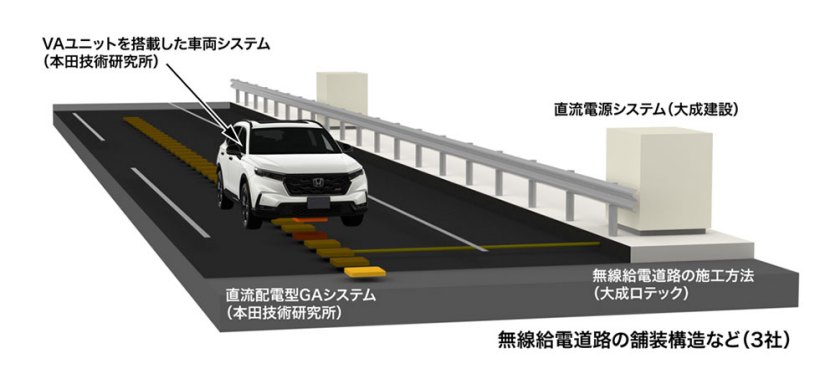
Starting from the end of 2026, the three parties will lay dedicated test roads at the Tiancun test base of Dacheng Construction Group's next-generation technology demonstration center, " T-FIELD / TAMURA ". At that time, a total of 1 million loading and rolling tests (equivalent to a standard single-wheel load of 49kN) will be conducted with actual vehicles to systematically evaluate long-term durability. At the same time, dynamic wireless power supply performance tests during driving and research and development of electromagnetic leakage protection measures will be carried out simultaneously, with the aim of balancing the efficient power supply performance of the ground-side modules with the structural safety of the road's underground structures.
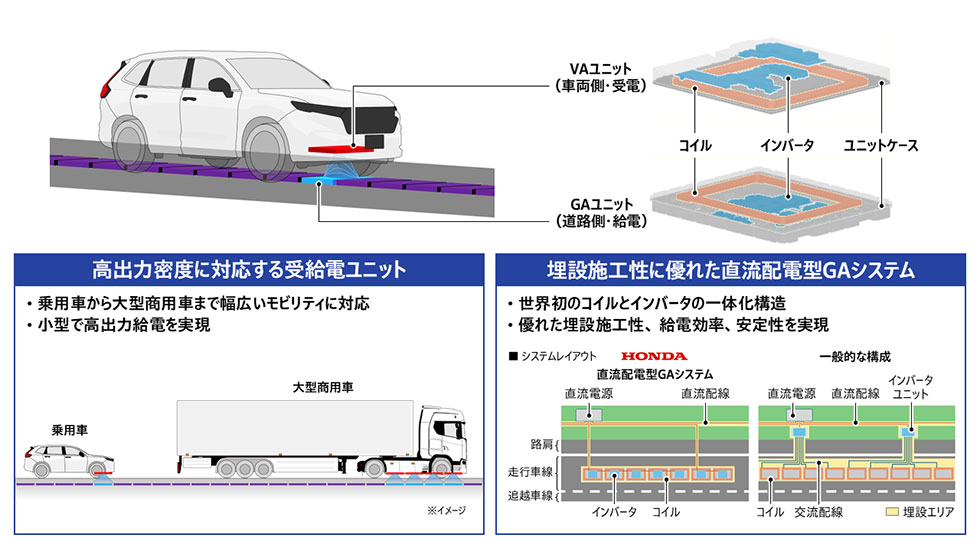
On this basis, the team will conduct performance verification under high-power output conditions of up to 150kW for large commercial vehicle scenarios, and deepen system reliability testing under high-speed driving conditions, steadily advancing various technological developments for actual road operations.