

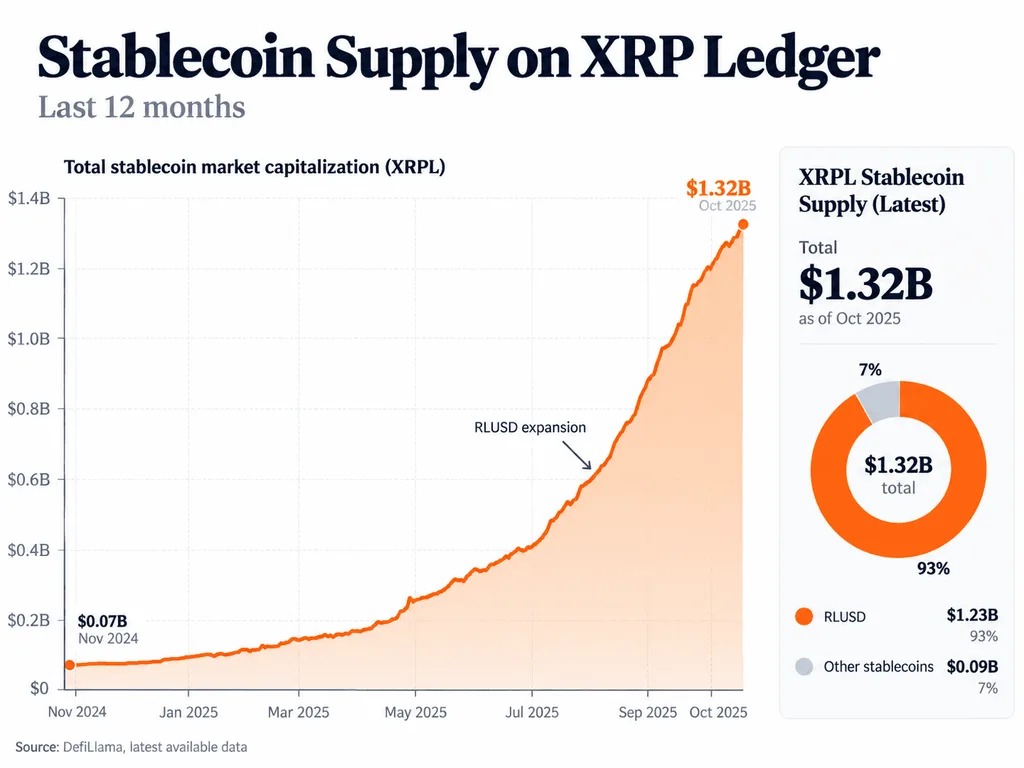
According to DefiLlama data, as of October 3rd, the market value of stablecoins on XRPL reached approximately $1.33 billion, representing a 14.6% increase over 7 days. During this period, the network added about $169 million, bringing it close to Avalanche and Plasma in the ranking of blockchains based on the supply of stablecoins.
This concentration is quite significant. The RLUSD issued by Ripple accounts for approximately 93% of the total value of all stablecoins on XRPL. As of October 3rd, the scale of RLUSD in the ledger was about 1.24 billion US dollars. The latest readings from DefiLlama show that the total market value of XRPL stablecoins is around 1.32 billion US dollars, with RLUSD accounting for slightly over 93%. This indicates that although there may be fluctuations in weekly data, the overall trend continues.
RLUSD is becoming the US dollar liquidity layer for XRPL.
Since the beginning of this year, the growth of RLUSD on XRPL has significantly accelerated. In June, XRP Ledger surpassed Ethereum to become the largest network in terms of RLUSD, with the holding amount of this stablecoin on that chain at approximately 801 million US dollars at that time.
This expansion continues with the growth of the overall scale of RLUSD. The RLUSD circulation has exceeded $2.4 billion, backed by reserves of over $2.53 billion. Ripple indicates that this stablecoin is fully supported by segregated cash and cash equivalents reserves and can be exchanged for US dollars at a 1:1 ratio.
What does the growth of RLUSD actually mean for XRP?
The difference between Ripple, RLUSD, and XRP is very important. RLUSD is a US dollar-stabilized coin issued by Ripple, while XRP is still the native asset of XRP Ledger.
On XRPL, RLUSD utilizes the native issued token infrastructure of this ledger. For an account to hold this stablecoin, it is necessary to set up a trust line, and transactions are settled through XRPL itself. The documentation for Ripple indicates that creating a RLUSD trust line also requires a reserve in the XRP account.
This establishes a connection between stablecoins and the use of the XRP network, but it does not mean that for every additional $1 added to RLUSD, an equal amount of demand will be created for XRP.
Marcus Hale
Marcus Hale is an author in the fields of cryptography and financial markets, covering topics such as Bitcoin, Ethereum, digital assets, regulation, ETF, and institutional adoption. His work focuses on influencing market dynamics, investor trends, and the broader forces that shape the crypto economy.