

Sui rose 4.43% to $1.23, and Mysten Labs co-founder Adeniyi Abiodun outlined a strategy centered around global payments, stablecoins, and AI proxy trading. Meanwhile, traders are watching $1.27 as the next technical hurdle.
SUI rose 4.43% today to $1.23, and traders are focusing on $1.27 as a potential bullish breakout confirmation level.
The Sui Foundation stated that since August 2025, Sui has processed over one trillion dollars in stablecoin transfers.
Google lists Mysten Labs as one of its partners for the open protocol AP2 aimed at AI's payment system.
USDsui was launched in March on Bridge under Stripe, providing native US dollar assets for the payment applications of Sui.
Analysts believe that $1.27 is the current resistance level, while the $2 target still depends on whether the breakout is confirmed.
Wu Blockchain released this interview on October 5th. Abiodun stated in the interview that Sui should be regarded as a payment infrastructure capable of transferring funds globally, and not just another Layer blockchain.
CoinGecko data shows that SUI approached $1.23 during trading hours, with a market value of about $5 billion and a 24-hour trading volume of approximately $878 million. The token's trading range for the day was between $1.17 and $1.26.
Abiodun indicates that the long-term goal of Sui is to compete with traditional payment infrastructure, and it is even stated that its goal for the next few years is to 'replace SWIFT'. This statement represents the long-term perspective of Mysten Labs and is not equivalent to a prediction that Sui will replace the global bank messaging network.
Sui The price is approaching $1.27.
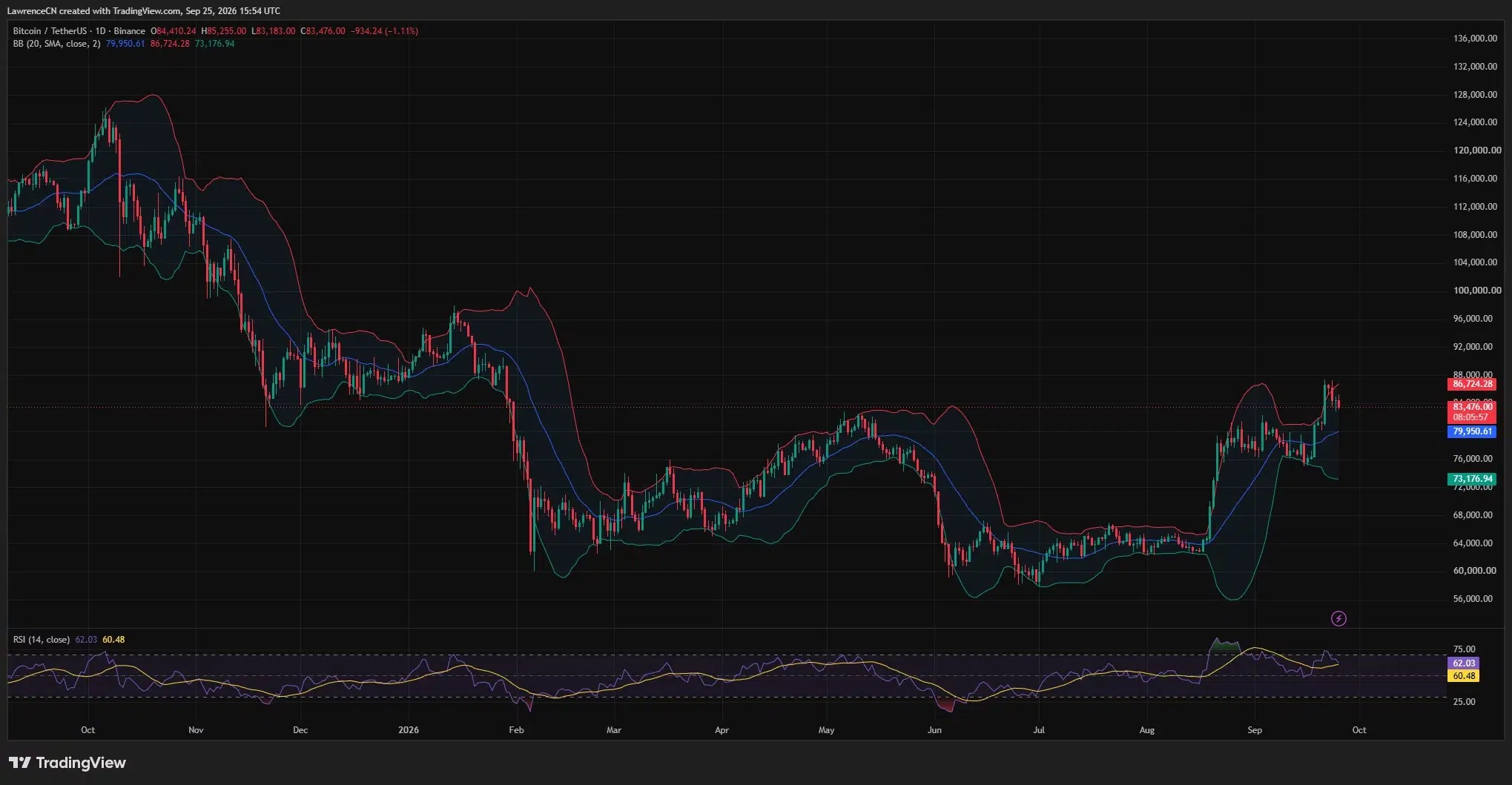
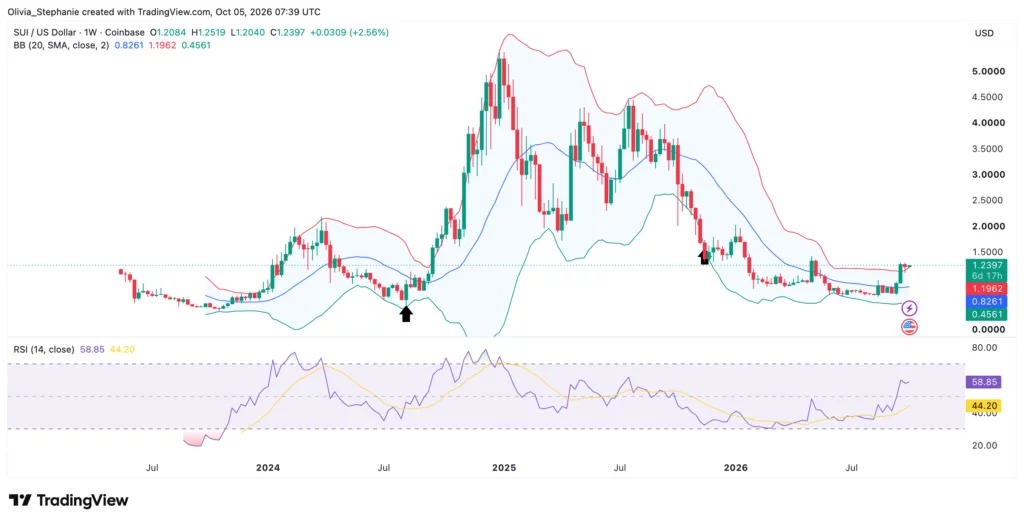
From the weekly chart, the trading price of SUI is above the upper Bollinger Band, which is close to $1.19. The 20-week middle band is around $0.83, and the lower band is around $0.46.
The price has risen above the upper band, indicating that compared to the recent weekly range, SUI has stronger upward momentum. However, this also means that it has surpassed the 20-week average. The current range of $1.19 to $1.25 is still important, as SUI is testing the upper band and the recent weekly high points.
The Relative Strength Index RSI is at 58.71, which is higher than the average signal value of around 44.19. RSI has returned above the neutral level of 50, but it is still below the commonly watched overbought threshold of 70.
Cryptography analyst Ali Martinez stated on October 2nd that SUI has made several upward breaks through after forming a parallel consolidation channel since September 12th. He regards $1.27 as the next level of attention and mentioned that if the hourly close can stay above that level, "it may confirm another bullish breakout."
Since then, prices have come closer to this level, but there has not yet been a clear breakthrough. CoinGecko shows that the 24-hour high for this token is close to $1.26, making the trigger point of $1.27 set by Martinez still slightly higher than the current market price.
Another analyst, Celal Kucuker, stated that a bull flag pattern is approaching a resistance level. He believes that if this pattern is broken through within October, $2 will come into view.
Kucuker's long-term judgment that prices will rise above $10 clearly depends on the future bull market scenario. This remains an analyst's prediction and is not a confirmed target supported by the current price trend.
Currently, $1.27 is the more immediate test. If it can remain above this level, SUI will break through the price range indicated by Martinez; if it falls below around $1.19, then the price will return back within the weekly Bollinger Bands.
Stablecoins are becoming the core of the Sui payment landscape.
Abiodun indicates that stablecoins are one of the strongest uses in current blockchain payments, as they can operate around the clock and complete settlements outside of traditional bank business hours.
The Sui Foundation stated in May that since August 2025, the network has processed over one trillion US dollars in stablecoin transfers. The update during the same period also introduced Gas-free transfers for supported stablecoins, allowing eligible peer-to-peer transactions to be executed without users needing to hold SUI.
The assets initially covered by this feature include USDsui, USDC, SuiUSDe, AUSD, FDUSD, USDB, and USDY. According to the Sui document, when a transfer meets the network whitelist requirements, eligible transactions can use a zero Gas price and a zero Gas budget.
USDsui has provided its own native US dollar assets for this network. The Sui Foundation announced the launch of its mainnet on March 4th, which was promoted by Bridge. Bridge is a stablecoin infrastructure company under Stripe. This token is designed for payments, decentralized finance, and cross-border transactions.
As previously reported, after Sui launched USDsui, it introduced a native stablecoin to its payment system and to the DeFi ecosystem. Previously, this network handled over $111 billion in stablecoin transactions in just January alone.
Abiodun indicates that the scale of USDsui has reached approximately 75 million US dollars, and the liquidity of stablecoins is listed as one of the indicators that will be considered when measuring the future adoption of the network with Mysten Labs.
Recently, the integration has extended the payment strategy beyond DeFi. In September, Daya will integrate Sui as a settlement infrastructure, using Gas-free stablecoins for transfers to serve businesses and developers in Nigeria. The company plans to expand its services to South Africa, Ghana, and Kenya.
RedotPay provides another payment connection, but the scope of their official announcement in April is narrower than what this interview implies after translation. The Sui Foundation stated that RedotPay has added support for SUI and Sui native USDC, allowing users to access these assets through the payment networks that support Apple Pay and Google Pay. The official release did not list USDsui as part of this initial integration.
AI proxies constitute the second part of the Sui strategy.
Abiodun It is expected that as software begins to replace humans in initiating each transfer, AI agents will become an important source of blockchain transactions.
This view has received some support in the collaboration between Sui and Google. In September 2025, Google announced the launch of Agent Payments Protocol, commonly referred to as AP2, and listed Mysten Labs as one of over 60 payment and technology organizations that contributed to the development of this open standard.
AP2 aims to enable the AI agent to initiate payments across different payment systems under verifiable user authorization. The partners listed in Google include Mastercard, PayPal, Coinbase, Revolut, and Worldpay, as well as Mysten Labs.
Sui has joined forces with Google on the AP2 project, which focuses on proxy programmable payments around AI, making this blockchain one of the projects testing how autonomous software can interact with digital currencies.
Sui The current AI infrastructure consists of multiple products. Walrus is responsible for decentralized storage, Seal manages programmable access control, Nautilus supports verifiable computing, while Sui coordinates transactions and strategies on the chain.
Abiodun believes that such tools can help the AI system to verify the source of information and whether the information has been altered before making decisions or payments through proxies.
Sui tested such automated activities through programmable channels in July. According to the foundation's report, in a public experiment involving AI agents, games, payments, and chat, a peak of 608,6766 transactions per second was reached. This result came from off-chain programmable channels and was ultimately settled back to the Sui mainnet, not the throughput of an ordinary underlying chain.
There is still a gap between payment growth and DeFi TVL in Sui.
Abiodun admitted in an interview that the total locked-up volume of Sui has decreased, and also believes that the use of stablecoins, institutional integration, and network activities are also worth paying attention to, along with TVL.
Current DefiLlama data shows that Sui DeFi TVL is close to 550 million US dollars, with the market value of stablecoins being approximately 482 million US dollars. The tracker has recorded about 25.3 million transactions on the network in the past 24 hours.
It was mentioned in the interview that Sui was previously around $4 billion, and then dropped to about $1 billion. Since the current DefiLlama data consulted for this report does not match the figure of $4 billion, this number is still attributed to the content of the interview.
Governance is also part of Sui's recent history. In May 2025, after Cetus suffered an attack worth 223 million US dollars, verifiers coordinated around the frozen funds of the attackers and subsequently voted on an agreement upgrade to recoup these funds.
The Sui Foundation reported that validators representing 90.9% of the staked shares supported the recovery proposal, and the foundation's own stake was not included in the voting. The approved funds have been transferred to a multi-signature wallet and will be returned according to Cetus's recovery plan.
Abiodun indicates that Mysten Labs and Sui foundations cannot unilaterally instruct verifiers to freeze addresses, and such actions require coordination and decision-making by the verifiers.
The requirement for Martinez is that the closing price must be above $1.27 per hour to confirm the breakout it suggests. For Kucuker, a breakthrough through the bull flag resistance level of $2 is needed within October, while its prediction of prices above $10 depends on more uncertain future bull market conditions.
DisclosureThis article does not constitute investment advice. The content and materials presented on this page are for educational purposes only.