


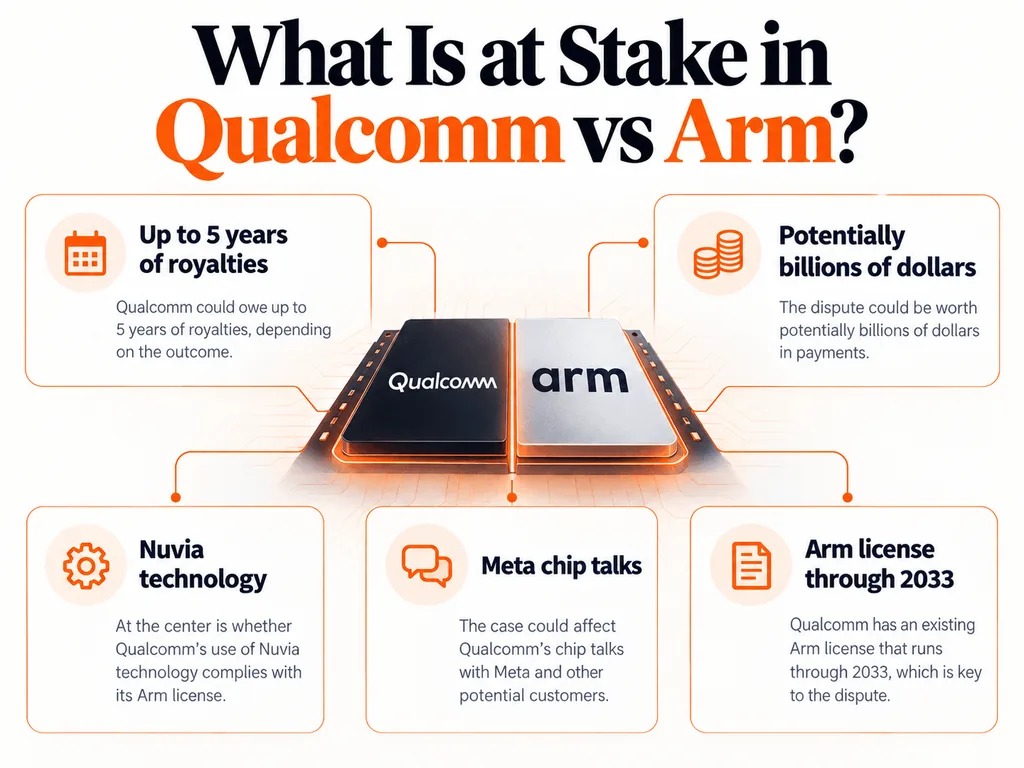
Qualcomm and Arm returned to the Delaware court on Monday, as this case may determine whether one of Arm's largest customers will be able to stop paying billions of dollars in royalties over a period of up to five years.
Qualcomm accuses Arm of withholding chip testing tools required by the contract and of disclosing a threat to terminate a key license in 2024. Qualcomm claims that this has damaged negotiations for potential chip transactions with Meta Platforms. Arm denies violating any agreements and states that Qualcomm has failed to prove actual losses.
This controversy occurred at a critical moment for the AI chip, while Arm, AMD, Broadcom and Qualcomm are all making more in-depth arrangements for data centers, personal computers, and custom chips.
Qualcomm seeks a royalty reduction of up to five years
The biggest financial focus of this case lies in the remedial plan proposed by Qualcomm.
Qualcomm hopes to obtain the right to suspend payments of royalties to Arm for up to five years. Considering the importance of the authorization from Arm to Qualcomm's processor business, this arrangement could potentially be worth billions of dollars.
The court is considering whether this remedial measure should continue to be maintained, which makes the importance of this case far greater than that of ordinary contract disputes.
As Qualcomm expands from smartphones to personal computers and data center computing, the associated risks are also increasing; a broader wave of AI infrastructure development is creating new opportunities for processor and networking companies.
Nuvia and Meta become the core of the dispute
After Qualcomm acquired the startup Nuvia in 2021 for $1.4 billion, the relationship between the two parties began to deteriorate.
Nuvia once developed custom processor technology under its own Arm architectural license. Arm subsequently argued that Qualcomm could not simply transfer these rights after the acquisition and filed a lawsuit in 2022.
In 2024, a jury in Delaware dismissed the core claims of Arm, but the dispute continued to progress through appeals and new contractual allegations.
The current case also involves Meta. Qualcomm claims that Arm disclosed threats to terminate the license during negotiations between Qualcomm and Meta regarding a potential chip deal, which damaged those negotiations. Arm disagrees with this and accuses Qualcomm of disclosing confidential information related to antitrust investigations.
Why is this case important for chip stocks?
The outcome of the case may affect more than just the amount of compensation.
Any ruling that changes the royalty obligations or the future methods of obtaining Arm design could potentially alter the economic viability of Qualcomm's expansion towards AI and data centers, and it would also affect the licensing model for Arm.
This is very important, as Arm is participating in the broader upward trend of chip prices along with NVIDIA, AMD, and other semiconductor companies.
Marcus Hale
Marcus Hale is a journalist who writes about cryptocurrencies and financial markets, covering Bitcoin, Ethereum, digital assets, regulation, ETF, and their adoption by institutions. His work focuses on developments that may impact the market, investor trends, and the broader forces that shape the crypto economy.