


What makes this price revaluation particularly noteworthy is that Firmus has received support from NVIDIA and Blackstone, and it was also preparing for one of the largest listings in Australian history.
Firmus's valuation once approached a tripling
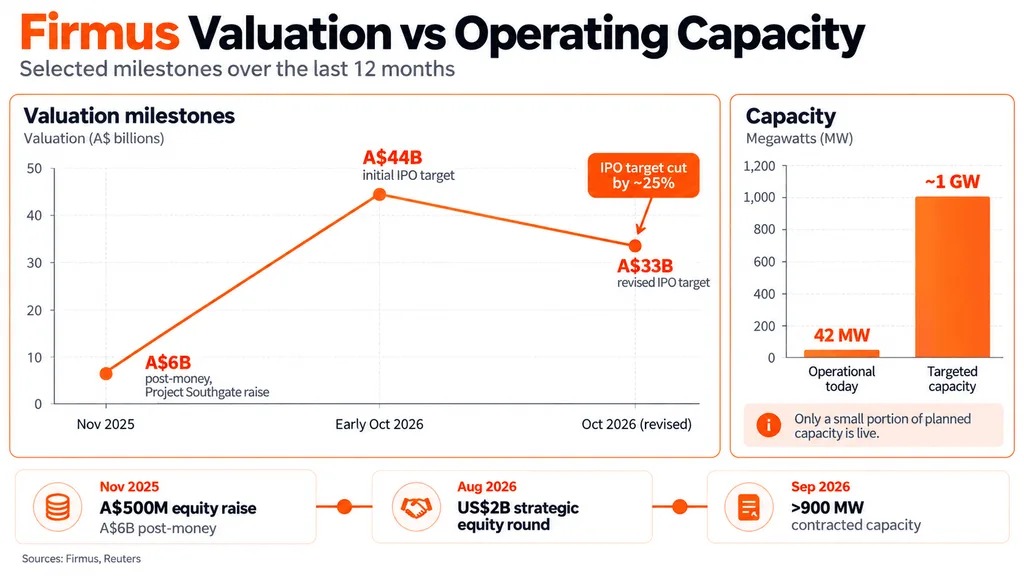
Investors' doubts seem to focus on one point: compared to the infrastructure currently in actual operation, the valuation of Firmus has risen too quickly.
After completing a round of financing in August this year, the company's valuation was approximately $10.5 billion; however, in less than two months, its IPO target equity valuation had increased to over $30 billion.
Firmus ultimately plans to operate a data center capacity of about 1 gigawatt for AI, but currently, the actual operational capacity is only about 42 megawatts.
This gap highlights the same issue faced by other AI infrastructure companies: investors are required to assign high valuations to them before a large portion of the future production capacity has even been actually built.
This issue has also emerged in other companies within the industry. CoreWeave recently raised $3.7 billion through convertible debt financing. Meanwhile, AI, a cloud service provider, is making substantial investments in GPU and data centers, yet not all of the contracted revenues have been converted into cash.
Investors are questioning the future profitability of AI.
Firmus It is anticipated that the facilities planned in Australia and various parts of Asia will ultimately generate billions of dollars in revenue each year.
However, to achieve these predictions, it is essential that the construction progress, power access, GPU supply, and customer implementation all proceed according to plan.
As the cost of capital rises, execution capability becomes increasingly important. The boom in infrastructure financing AI has become more and more dependent on bonds, private credit, leasing, and structured financing to cover the huge upfront costs.
Therefore, Firmus is becoming an earlier test case to observe how much premium investors in the public market are willing to pay for future AI production capacity, rather than for current profits.
AI Infrastructure transactions are becoming more selective
The situation of Firmus does not prove that the computing power demand for AI is collapsing.
Companies like CoreWeave still report a large backlog of orders, while the infrastructure stocks of AI continue to attract billions of dollars in financing.
Author: Emir Abyazov
Coinpaper is the chief editor, responsible for driving data-driven editorial operations, content discovery oriented towards SEO, as well as creating engaging narratives in the fields of encryption, AI, and fintech.