


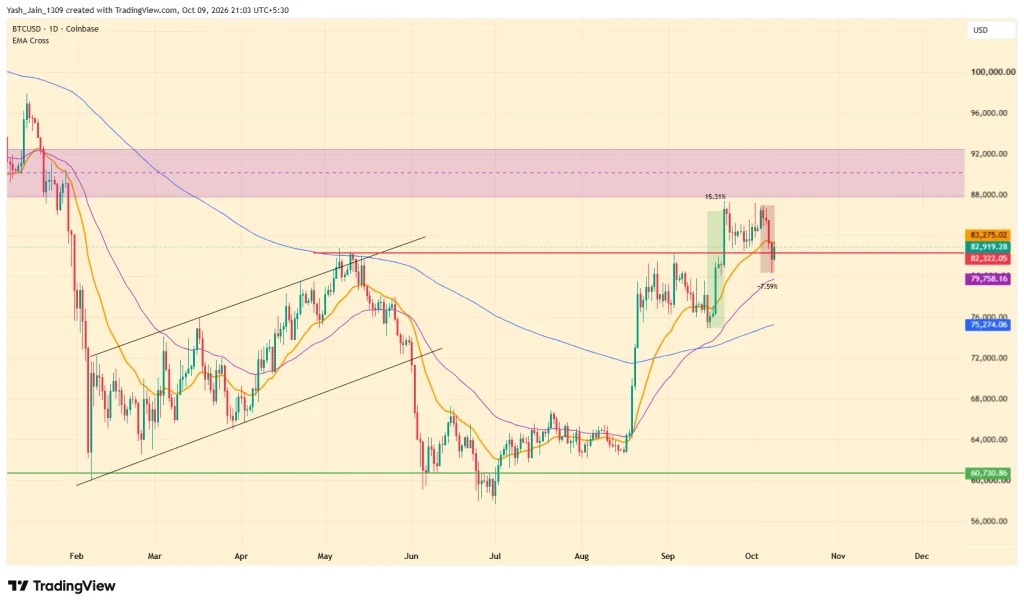
It's worth taking another look when Bitcoin's profit figures are inconsistent with market panic rhetoric. BTC recently fell to $80,500, sparking discussions about holders "surrendering" and selling at a loss. However, data for Santiment suggests that the situation might be quite different: the broader network has achieved billions of dollars in profits, rather than losses.
Bitcoin has shown a different story in terms of profits.
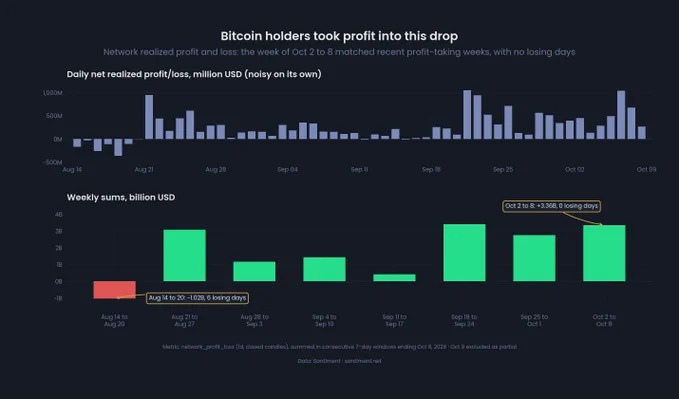
According to the data from Santiment, from October 2nd to 8th, holders achieved a net profit of over 3.3 billion US dollars. This does not correspond to claims of 'widespread losses' or 'surrenderous selling'.
This reading also aligns with a broader pattern of profit-taking. In late September, there was approximately $3.4 billion in net realized profits, compared to around $3 billion in late August. Calculated in US dollars, recent sales seem more like investors cashing in on their gains rather than everyone rushing to leave the market at the same time.
No single day has recorded a net loss across the entire network.
Daily data makes this comparison even more evident. From October 2nd to 8th, there was not a single day where there were net realized losses on a global scale.
In comparison, the week from August 14th to 20th recorded a net realized loss of approximately $1 billion, with six out of seven days ending in negative values. This more clearly reflects a situation where selling was primarily done at a loss.
Therefore, although a drop to $80,500 for BTC looks unfavorable on the price chart, the profit and loss data does not support the claim that "the entire network is selling in loss."
Why are details still omitted at the network level of data?
However, there is also a limitation here. The aggregated data cannot accurately tell us which holders sold at a profit and which sold at a loss.
Recently, buyers may still sell at prices lower than the purchase price, while those who entered earlier have already realized a profit. Data at the network level combines these results, so it is not possible to distinguish each group of holders separately based on such data alone.