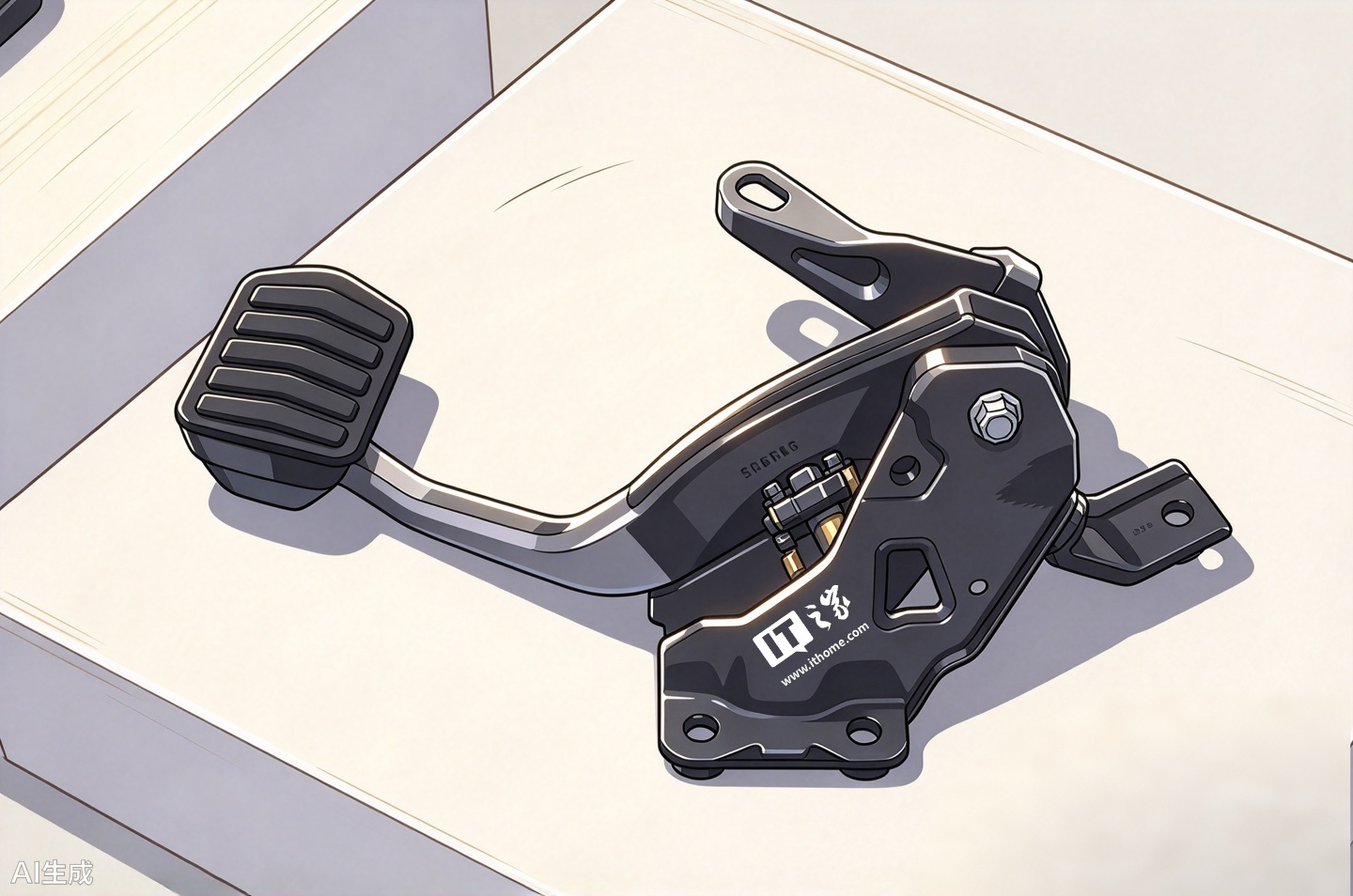
News from the IT Home on October 10th: According to reports from Red Star Capital Bureau, Changan Automobile received a survey questionnaire regarding the material of brake pedal assemblies on the 9th, focusing on the application of non-metallic materials in these assemblies.
Public information indicates that China Automotive Technology and Research Center is a central enterprise directly under the State-owned Assets Supervision and Administration Commission of the State Council, and is entrusted by the Ministry of Industry and Information Technology to carry out work such as research on automotive standards and regulations, promotion of intelligent manufacturing, and dissemination of new energy vehicle technologies.
The report mentions that the industry believes that this survey may be influenced by the incident of the "Zunjie V800 brake pedal bracket breaking," and it could lead to the revision of relevant standards. The survey questionnaire is part of the preparatory work. "There is a high probability that it will drive the revision of industry standards, such as 'Performance Requirements for Automotive Pedal Devices and Bench Test Methods' ( QC /T 788-2018)."
Industry insiders believe that the two national standards do not provide quantitative load thresholds, material restrictions, or testing methods for brake pedals and their brackets. They also lack specific design requirements, only stipulating that they must be "components that are not prone to failure." The materials used should be metallic or materials with performance comparable to metallic ones, and they should not undergo significant deformation during the normal operation of the braking system.
Referring to previous reports from the IT website, current mandatory national standards only require that when a vehicle has its maximum braking efficiency, the pedal force should be ≤500N. However, another recommended standard states that after applying a force of 1500±20N to the car's brake pedal for 5 seconds and repeating this 5 times, the permanent deformation of the pedal should be ≤5mm, with no cracks present.
In other words, the amount of pressure that a car's brake pedal can withstand without breaking is entirely determined by the internal standards set by each automaker; as long as a car manufacturer can prove that the performance of the non-metallic material is comparable to that of metal materials, they are allowed to use such materials.
Currently, there is a standard gap in regulations regarding non-metallic brake pedal assemblies, and the urgent research conducted by the China Automotive Technology and Research Center (CATARC) is seen as a signal for revising industry standards.
At present, several automotive industry executives have described the brake pedals of their products: Lu Fang, the chairman of Landwind, shared a photo of Landwind's brake pedal on Weibo last night and revealed that it features a multi-layer high-strength steel plate main beam design; Lin Zhibin, the deputy general manager of GAC Honda Automobile Co., Ltd., stated that the brake pedal material of the Accord is high-rigidity steel, capable of withstanding pressures over 3000N without structural damage or cracking; Mengshi Automobile CEO Wan Liang Yu mentioned that all models use high-strength materials for their brake pedals, which have a pressure-bearing capacity far exceeding national standards; BYD's Zheng Yu announced that the brake pedal material of the Yawang model is metal, and the pedal force meets the enterprise standard of 2500N.