Key Points
- IEA Global oil demand is expected to decrease by 2.6 million barrels per day
- Despite weakening global consumption, Brent crude oil remains above $105.
- Declining supply and depleted inventories continue to support oil prices
On October 14th, Brent crude oil remained above $105 per barrel, despite the International Energy Agency (_IEA) predicting a significant contraction in global oil consumption, highlighting the abnormal imbalance between weakening demand and increasingly restricted supply.
On Wednesday, the benchmark price of Brent crude oil hovered around $106.60 per barrel, with an increase of about 0.9%. Previously, the energy infrastructure in the Middle East was attacked again, causing traders to continue to worry about potential supply disruptions.
According to the IEA October "Oil Market Report," global oil demand is expected to decline by 2.6 million barrels per day in 2026, to about 102.4 million barrels per day. However, global supply is expected to decrease by a larger amount of 5.8 million barrels per day.
This difference helps to explain why, despite the apparent deterioration in global oil consumption, the price of Brent crude oil has remained high.
Why is Brent still above $105 when oil demand is declining?
Normally, a decline in oil consumption puts downward pressure on crude oil prices, especially when economic activity weakens and the demand for transportation and industrial fuels decreases.
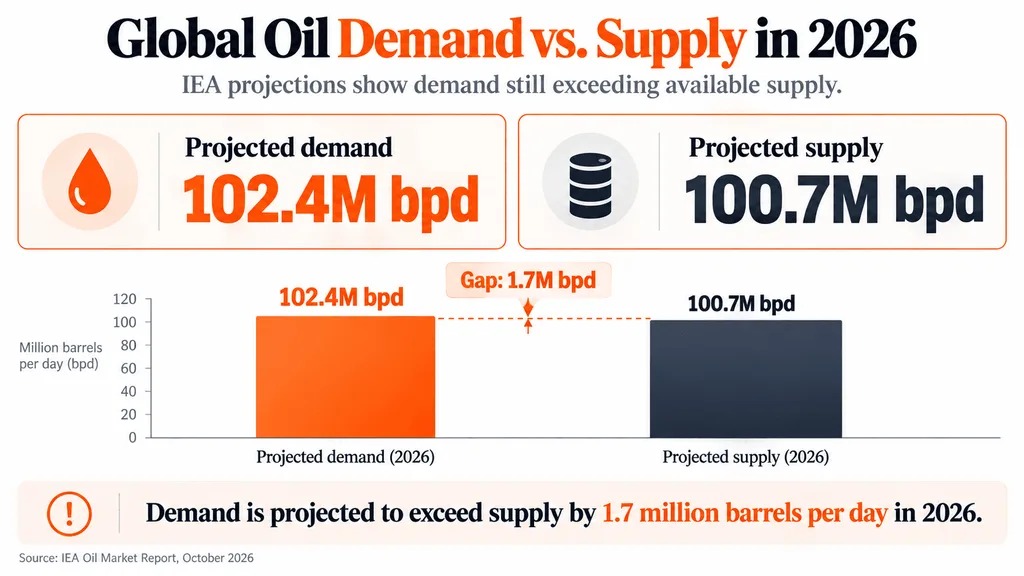
However, IEA predicts that due to disruptions in the Middle East's energy infrastructure and international shipping routes, global oil production in 2026 is expected to average around 100.7 million barrels per day.
At the same time, global oil demand is expected to average 102.4 million barrels per day, which means that supplies will not be sufficient to meet consumption unless reserves are tapped into.
This gap is particularly important as global oil inventories have significantly declined. IEA estimates that from the end of February to September, observed inventories have decreased by 509 million barrels, and onshore inventories have fallen to their lowest level since at least 2016.
This situation stems from long-term disruptions in oil supply, and even though higher energy costs have curbed consumption, the crude oil market remains tight.
As risks in the Middle East continue, the rate of decline in oil supply is accelerating.
Despite an expected decline for the whole of 2026, global oil production rebounded significantly in September, increasing by 2.5 million barrels per day to 102.3 million barrels per day.
Saudi Arabia and other Gulf oil-producing countries have driven this recovery, with crude oil exports in the region rising to 13.9 million barrels per day, exceeding three-quarters of the pre-war levels.
However, another attack on Saudi energy infrastructure and commercial shipping may threaten further improvements. Rising transportation and insurance costs have also widened the gap between benchmark futures prices and physical crude oil prices.
IEA reports that the price of North Sea Dated crude oil has recently risen to around $134 per barrel, while Brent futures are at around $107 per barrel.
This differentiation has once again reinforced concerns regarding the cost of physical crude oil, especially for Asian refiners that are required to pay higher delivery premiums.
Will Brent oil prices fall below $100 in 2027?
IEA It is expected that the situation will improve next year, with global supply expected to increase by 7.7 million barrels per day, while demand is expected to recover by about 2 million barrels per day.
This rebound may ultimately restore market surplus, thereby alleviating the upward pressure on Brent oil prices. However, the timing depends to a large extent on whether the disrupted production, shipping, and refining capacities can be restored.
Governments around the world have attempted to stabilize the market through emergency oil reserves, but as inventories continue to be depleted, the market's buffer capacity for further supply shocks is relatively limited.
Maya Bennett
Maya Bennett is a financial journalist with experience reporting on cryptocurrencies, stocks, and broader market trends. Her areas of focus include Bitcoin, major digital assets, the stock market, monetary policy, and economic developments that influence investor sentiment. She is adept at transforming rapidly changing market news into clear and concise reports.