Key Points
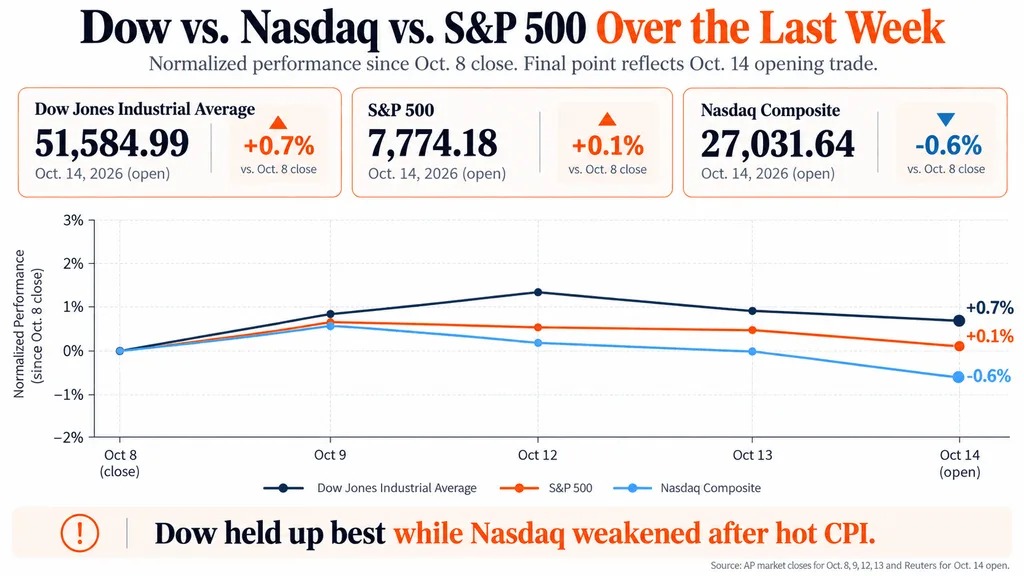
- Dow Jones rose 0.3%, Nasdaq fell 0.6%
- U.S. inflation rate reaches 3.7%, driving up yields on U.S. Treasury bonds
- As expectations of the Federal Reserve's interest rate hikes rise, tech stocks are under pressure.
On October 14, the Dow Jones Industrial Average rose by about 0.3%, while the Nasdaq Composite Index fell by 0.6% and the S&P 500 Index declined by 0.4%. After another unexpectedly strong inflation report was released, the divergence within the U.S. stock market further widened.
Data from the U.S. Bureau of Labor Statistics shows that in September, the Consumer Price Index ( CPI ) rose 3.7% year-on-year, higher than economists' forecast of 3.6%, and also accelerated from 3.4% in August. The data has heightened market concerns that the Federal Reserve may raise interest rates again later this month.
The Dow Jones rose, while the Nasdaq and the S&P 500 fell.
This differentiation reflects an important structural difference among the three major U.S. stock indices.
The Nasdaq Composite Index has a larger exposure to technology and growth companies, including NVIDIA, Microsoft, Apple, and other enterprises whose valuations rely heavily on future earnings forecasts.
The S&P 500 covers approximately 500 leading companies, which provides a broader scope. However, due to its weighting by market capitalization, technology giants still have a considerable influence on the overall performance.
Therefore, rising interest rates will affect these indices in different ways. Typically, when the yield on U.S. Treasury bonds increases, investors will use a higher discount rate when evaluating future corporate profits, which puts greater pressure on companies that rely primarily on long-term earnings growth to support their valuations.
This also explains why, even though other sectors of the market remain relatively resilient, the Nasdaq index may still face pressure.
Hot CPI drives U.S. Treasury yields closer to 5.3%
The direct trigger was the inflation report in September. The report showed that consumer prices rose by 0.6% month-on-month, partly due to a 9.1% increase in gasoline prices.
Excluding food and energy, the core inflation rate rose from 2.4% in August to 2.6%, indicating that price pressures are not entirely confined to fuel.
After the data was released, the yield on benchmark 10-year U.S. Treasury bonds rose to nearly 5.29%, and market expectations for a Fed interest rate hike in October also increased significantly.
Higher U.S. Treasury yields will compete with stocks, as investors can obtain higher returns from government bonds without having to bear the business risks associated with stocks.
This will also increase the financing costs for companies that make large-scale investments in expansion, mergers and acquisitions, and infrastructure construction.
This change continued the previous selling trend driven by U.S. Treasury yields. At that time, relatively high bond yields and oil prices pushed down the main U.S. stock indices.
Why are AI and tech stocks under pressure?
The selling pressure in the AI chip sector on the previous trading day reflects market concerns regarding China's semiconductor competition, AI infrastructure spending, and whether the high valuations in the tech sector can be sustained.
Inflation on Wednesday added another layer of pressure, as it increased the likelihood that interest rates will remain high for a longer period of time.
However, the relative strength of the Dow Jones index does not mean that its constituent companies will be immune to tighter monetary policies. Industrial enterprises, financial institutions, and consumer companies may also be affected when borrowing costs rise or economic activity slows down.
For investors, the divergence between the Dow Jones, the Nasdaq, and the S&P 500 indicates that Wall Street is increasingly distinguishing between individual stocks based on a company's sensitivity to interest rates, earnings expectations, and industry-specific risks.
As the Federal Reserve's meeting on October 27-28 approaches, the trend of U.S. Treasury yields and the next round of corporate earnings reports may determine whether today's divergence will continue to widen or evolve into a broader decline in the stock market.
Emir Abyazov and Coinpaper serve as editors-in-chief, responsible for driving data-driven editorial operations, content discovery guided by SEO, and storytelling that targets the audience, covering areas such as cryptography, AI, and fintech.