IT News on October 15th: According to the source @itspdfu, today (October 15th), a post was published on the X platform stating that Apple has introduced several touch interaction designs in the updates to macOS 27.2, Beta 3, and Beta 4, which is likely in preparation for the touch version of MacBook Pro.
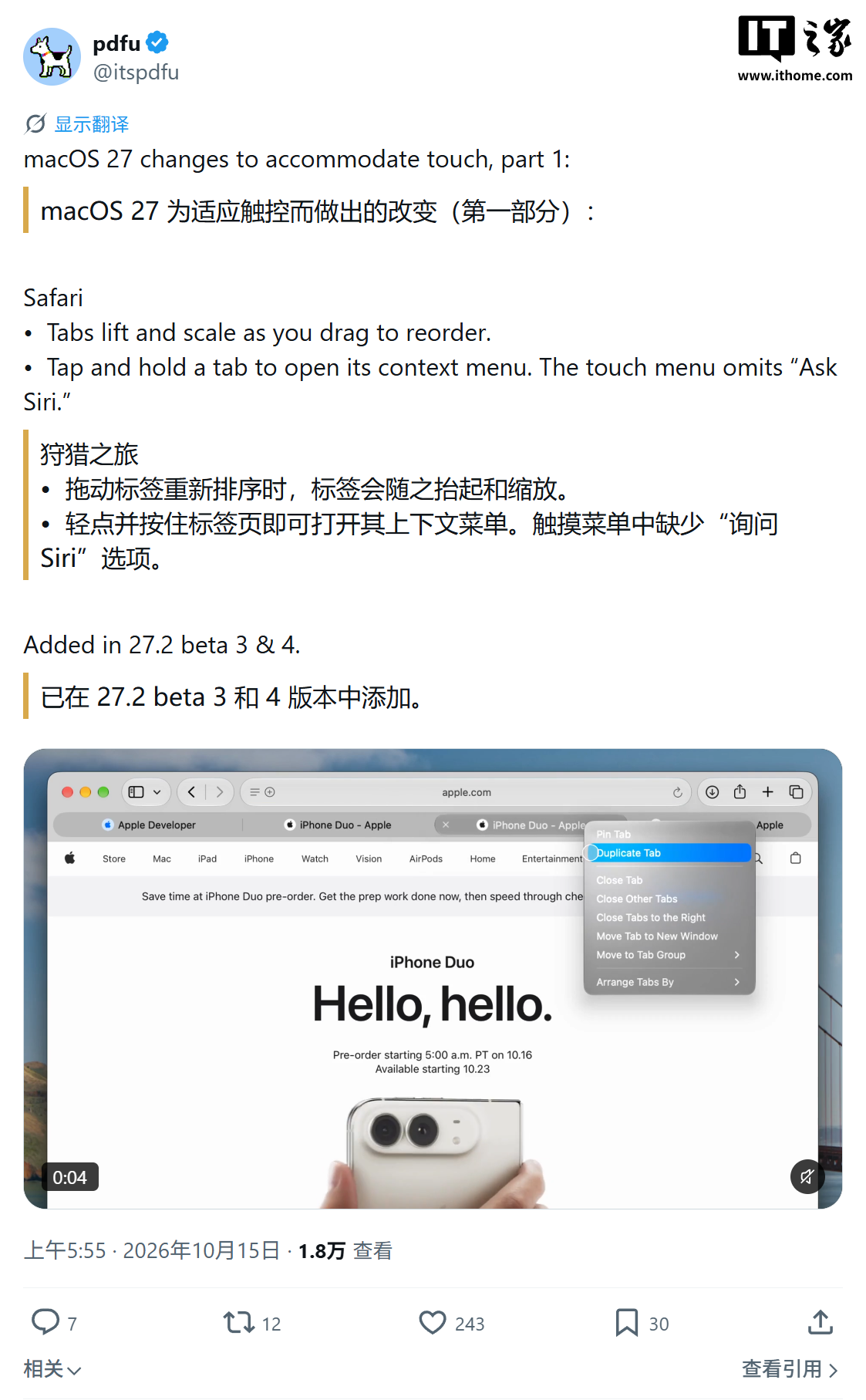
According to the latest demonstration video, this source indicates that in browsers with macOS 27.2 Beta Safari, users can drag and move tabs using gestures, and can bring up the right-click menu by holding down the button. Currently in testing, the right-click menu lacks the “Ask Siri” option.
Reports suggest that such frequent updates to the underlying systems are seen as Apple making software preparations for future touchscreens MacBook.
According to MacRumors, in the previous developer test versions 27.2 and 3 of macOS released by Apple, there were already multiple instances of code related to touch operations, involving several native system applications.
Among them, the photo application contains a touch-hold gesture recognition code named “PXGTouchDwellGestureRecognizer”; “ICTouchPressGestureRecognizer” was found in the memo, which is related to touch press operations; the browser has added touch recognition-related code with “Safari”; and the “dragTouch” field also appears in the quick-view function.
In addition to changes in internal application code, macOS 27.2 and Beta 3 have also adjusted the interaction animation for the Dock column: when a user clicks and holds down on the application icon in Dock, the icon will slightly enlarge, a effect that is similar to the animation that occurs when long-pressing the application icons in iPhone and iPad.
Previously, multiple sources reported that Apple was developing high-end MacBook devices equipped with OLED touchscreens, with some leaks referring to them as “MacBook Ultra”. According to Bloomberg journalist Mark Gurman, the new devices will come in two versions: 14 inches and 16 inches, with internal codenames K114 and K116 respectively. This will be a completely redesigned model that is thinner and lighter than the current MacBook Pro. The J series will continue to use the existing platform, while the K series will feature a new design.
In terms of hardware specifications, it is reported that this device will become the first notebook in the Mac family to adopt a OLED panel, replacing the current Mini-LED screen used in the MacBook Pro. It will also abandon the notch screen design in favor of a hole-punch camera combined with a "Dynamic Island" feature.
At the same time, Apple is said to position touch control as an auxiliary input method, rather than a replacement for keyboards and trackpads; the accompanying macOS 27 (codenamed Golden Gate) system has also been specifically optimized for touch control. Apple analyst Ming-Chi Kuo has also stated that touch operations can be adapted to a wide range of usage scenarios.
For a long time, MacBook has consistently refused to adopt touchscreens. The reason is that Steve Jobs believed that touching a vertical screen with one's fingers could easily lead to arm fatigue, which he considered a disaster from an ergonomic perspective; Tim Cook, on the other hand, has always emphasized that touch is a characteristic of iPad, and there is a clear distinction between Mac and iPad.
In addition, the pricing of the touch version MacBook Pro is expected to be higher. There are reports suggesting that its starting price could approach 20,000 yuan.