On October 15th, Bitcoin fell below $81,000, experiencing a decline of over 3% in the past 24 hours. Hot inflation data in the United States, declines in Asian stock markets, and the liquidation of Bitcoin and Ethereum futures worth approximately $483 million all contributed to weighing down the cryptocurrency market.
CoinGlass data shows that in the past 24 hours, there were approximately $483 million in settlements for Bitcoin and Ethereum futures combined. Of this, the settlement amount for Ethereum was $286 million, which is higher than the $197 million reported for Bitcoin.
In September, the inflation rate in the United States reached 3.7%, while South Korea's Composite Stock Price Index ( Kospi ) fell by 8% during early trading on Thursday.
Analyst Crypto Patel considers $80,108 to be a key support level and warns that if it is breached, prices could fall further to $65,000.
As shown by CoinGecko, during the Asian session on Thursday, Bitcoin traded around $80,664, experiencing a decline of 3.21% in the past 24 hours and 2.53% in the past 7 days. The daily trading volume of this cryptocurrency is approximately $40.43 billion, with a market value of about $1.62 trillion.
At the same time, derivative data shows that during the same period, the scale of forced liquidations experienced by Ethereum traders was greater than that of Bitcoin traders.
Bitcoin price falls due to U.S. inflation rising to 3.7%
The decline in Bitcoin occurred after the release of U.S. inflation data on Wednesday, which was stronger than expected, reigniting market concerns about the Federal Reserve's interest rate path.
The U.S. Bureau of Labor Statistics reported that over the 12 months ending in September, consumer prices rose by 3.7%. This figure is higher than the year-on-year inflation rate of 3.4% in August, with monthly inflation increasing by 0.6%.
Excluding food and energy, core inflation rose by 0.3% in September, reaching 2.6% year-on-year. Economists had previously expected the monthly core reading to increase by a smaller amount.
Gasoline prices rose by 9.1% that month, contributing more than half of the overall monthly increase in consumer prices. Government records show that its energy index also increased by 5.2% on a monthly basis.
These data have prompted the market to speculate again that the Federal Reserve may raise interest rates to curb rising prices. Higher borrowing costs will affect investment decisions regarding stocks, bonds, and cryptocurrencies. However, inflation data alone cannot explain the reasons for changes in Bitcoin prices.
As previously reported regarding Bitcoin's reaction to the U.S. inflation report, BTC fell below $82,000 on October 14th, failing to hold a rebound near $84,000.
Nearly $483 million in Bitcoin and Ethereum futures were liquidated.
This round of cryptocurrency selling forced the liquidation of leveraged trading positions, as the price trend was unfavorable for traders who had amplified their exposures by borrowing funds.
According to the settlement data from CoinGlass, in the past 24 hours, there were approximately 483 million US dollars in forced liquidations of Bitcoin and Ethereum futures.
Among them, the liquidations recorded by Ethereum traders amounted to approximately $286 million, while those for Bitcoin contracts were around $197 million.
These numbers represent the notional value of the exchange's closed positions, and are not the exact amounts actually lost by individual traders.
Liquidation occurs when the collateral for a leveraged position is not sufficient to cover its exposure. Exchanges may automatically close positions to prevent the remaining funds in the account from falling below the required margin.
As market prices fall, forced liquidation of long positions may further trigger selling pressure.
Despite the Ethereum futures market being smaller than that of Bitcoin, Ethereum still recorded the highest total settlement amount among the two.
Unclosed Ethereum futures contracts amount to approximately $30 billion, while those for Bitcoin are around $52 billion.
During this period, Ether fell by 6.4% to around $2,356, while Bitcoin fell by about 3.2% to around $81,000.
The sell-off also spread to other major cryptocurrencies. Solana fell by about 5.5%, with its futures market recording approximately $31 million in liquidations. Zcash fell by about 13%, accompanied by nearly $19 million in forced closings.
XRP and Dogecoin are also under pressure, falling by about 5% and 6% respectively.
Previous reports regarding the risk of liquidation Bitcoin faced before the release of inflation data pointed out that if consumer prices were higher than expected, there could be a new round of forced selling.
Asian stock markets tumbled in tandem with Bitcoin
The decline on Thursday was not limited to cryptocurrencies; major Asian stock markets also tumbled significantly after the declines on Wall Street on the previous trading day.
The Japanese Nikkei 225 index fell by about 5%, with technology companies being among the stocks most severely affected.
The previous day, the U.S. market declined, with the Nasdaq Composite Index falling by 1.88%, the S&P 500 Index dropping by 1.11%, and the Dow Jones Industrial Average shrinking by 0.09%.
The U.S. inflation report prompted traders to re-evaluate the possibility of further interest rate hikes. Market expectations remain highly sensitive to subsequent economic data and remarks from central bank officials.
Before the inflation report was released, Bitcoin struggled to maintain a rebound above $84,000.
In previous reports regarding Bitcoin's failure to break through the $84,000 mark, market data showed that despite multiple attempts at a rebound, selling pressure still limited the increase.
The decline on Thursday brought BTC back to the prices seen during the period of high trading volume last week.
Can Bitcoin rebound from $80,000, or will it fall to $65,000?
Cryptography analyst Crypto Patel warns that Bitcoin is testing an important technical level around $80,108, after the price fell from around $87,360 to $80,200.
Patel described this trend as a 7.5% decline from the previous price level, and pointed out that $80,108 is a level that traders should pay attention to.
The analyst wrote: "If there is a clean break below $80,108, followed by a confirmation of a close on a higher time frame ( HTF ) candlestick, it could open the door to a downward range of $70,000 to $65,000."
This judgment still depends on the subsequent trend. The fact that Bitcoin is only trading near the indicated support level does not mean that it has confirmed a move towards $65,000.
Another market commentator, Crypto Lens, stated that the total market value of the cryptocurrency market evaporated by over $140 billion during this round of declines.
The analyst warned that Bitcoin could continue to decline, and cited $75,000, $70,000, and $57,000 as potential downside targets.
These predictions represent the views of commentators and are not yet confirmed price results. The nearly $1 billion in long positions liquidated mentioned here use different data sources from the approximately $483 million in Bitcoin and Ethereum futures positions closed out as reported in the CoinGlass snapshot earlier on.
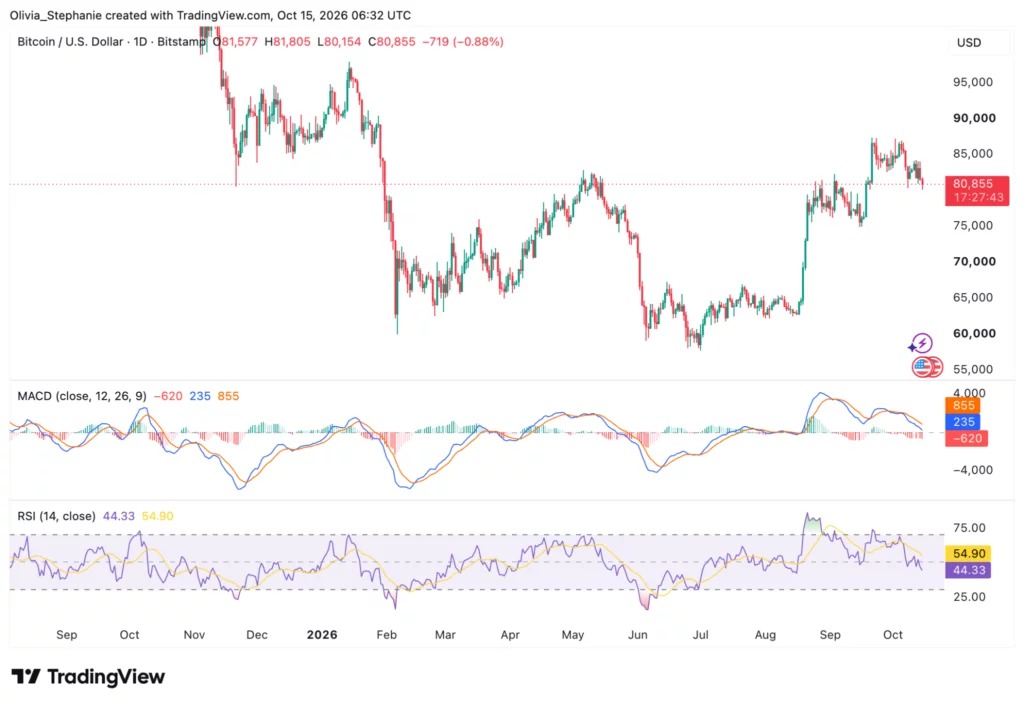
From the daily technical chart of Bitcoin, BTC is trading around $80,718, and the momentum indicators continue to weaken.
The MACD indicator is still below the signal line, and its bar chart is close to -629, indicating that the short-term momentum in the given chart readings is negative.
The Relative Strength Index ( RSI ) is at 43.92, which is below the neutral level of 50 and also below its moving average of 54.87. However, RSI is still above 30, and 30 is generally used to identify an oversold condition.
Technical analysis indicates that the market is currently most concerned with the $80,000 range. If the price continues to fall below this level, Bitcoin may be exposed to even lower support levels; if it manages to return above $83,000 to $85,000, it would suggest an improvement in short-term momentum.
In another Bitcoin analysis prior to the release of inflation data, a similar two-way scenario was presented. Analysts regarded $80,000 as a downside target and $86,000 as a potential rebound target if market conditions improved.
The daily chart of Bitcoin on October 15th is still below the rebound range of $83,000 to $85,000. RSI is at 43.92, and the bar chart for MACD is close to -629 and negative.
DisclosureThis article does not constitute investment advice. The content and materials on the page are for educational purposes only.