

Microsoft CEO Mustafa Sulaiman ( Mustafa Suleyman ) told employees that a model developed in-house is superior to a similar product from OpenAI, and OpenAI is one of this software giant's largest customers and partners.
On Thursday, Sulaiman said during a company-wide meeting with employees, "We now have a pre-trained base model that is stronger than the one currently driving GPT 5.6 Sol." He also added, "In fact, we only used a quarter of the computing power required to train its model with OpenAI."
Pre-training is the first stage in building the AI model, during which the model learns patterns from vast amounts of text, images, and other information. This process requires a large amount of expensive computing resources; therefore, if Microsoft can find more efficient methods, it may be able to save costs.
Microsoft announced this model earlier on Thursday, named MAI-Base-2.
Suleiman said that Microsoft privately tested this model with models labeled OpenAI, which included a model nicknamed “Spud” that provided support for GPT-5.6. He added that Microsoft’s models performed better in tests that measured the ability of AI to understand and predict information patterns.
Suleiman stated that these comparisons are based on the technical information regarding the OpenAI model that Microsoft possesses.
"We also privately and confidentially compared it with the model of OpenAI," Suleiman told the employees, implying that Microsoft has special channels to information regarding the performance of the OpenAI model.
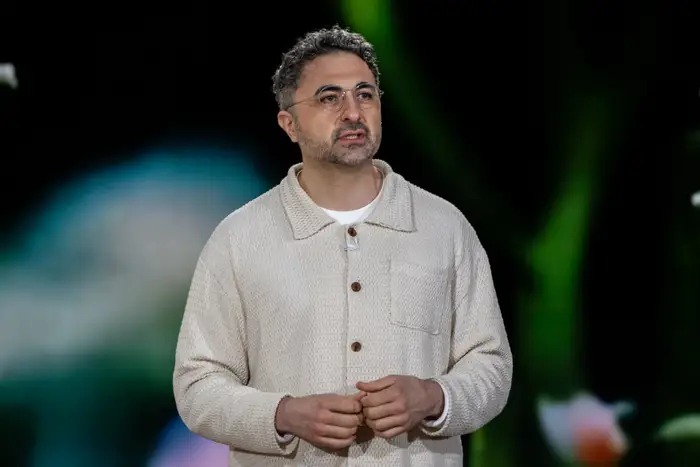
It is worth noting that even in private discussions, Sulaiman chooses to emphasize the limitations of the OpenAI model. Microsoft has invested several billion dollars in OpenAI and holds shares in this startup, which may be worth over 100 billion dollars. Any criticism of OpenAI could potentially diminish the value of this substantial investment.
The two companies still maintain an important cooperative relationship; Microsoft provides its Azure cloud customers with the OpenAI model. Microsoft's own products, such as Copilot, also consistently use the OpenAI model.
However, in the past year or so, the relationship between the two companies has become strained. Microsoft has increasingly tried to reduce its dependence on OpenAI, including developing its own models.
Suleiman also stated that Microsoft's new AI model is "12 times more efficient in terms of computational power" than the DeepSeek model, "for example."
Suleiman did not specify which particular DeepSeek model he was referring to, but a public blog post claimed that the pre-training of MAI-Base-2 is much more efficient than a similar product DeepSeek-V4-Pro-Base from this Chinese laboratory.
In March of this year, Microsoft established a new joint team responsible for its Copilot products targeting both businesses and consumers. Suleiman was then reassigned to the company's Super Intelligence department, where he focused on building AI models.
Microsoft declined to comment, and OpenAI did not respond to requests for comments on Thursday.