Global tech stocks suffered a large-scale sell-off this week, with the total market value of the top twenty global tech companies evaporating by over one trillion dollars. Market skepticism about the returns on infrastructure investments related to AI has surged sharply.
At this critical juncture, NVIDIA CEO Jensen Huang took consecutive actions – first, during an interview with Bloomberg in Stockholm, they publicly endorsed CoreWeave, and then, on the BG2 podcast, they released a nearly 140-minute in-depth interview addressing the market's most pressing concern: Who will actually foot the bill for the computational power construction expenses of AI?
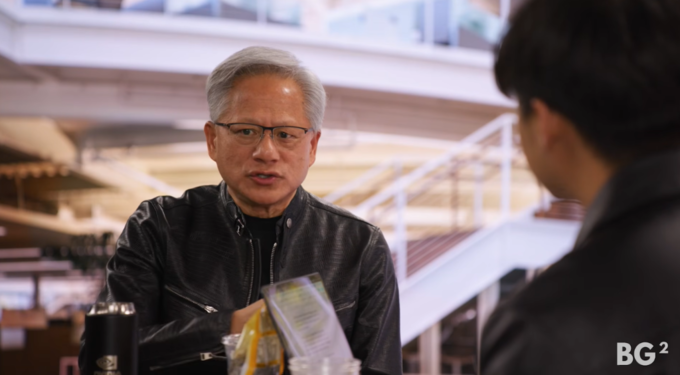
It is worth noting that the interview with Jensen Huang on the well-known Silicon Valley investment podcast “BG2” was released on October 15th, Eastern Time (ET), before the opening of U.S. stock markets, which was around 7 a.m. ET. At that time, traders, analysts, and quantitative funds on Wall Street were preparing and responding to the opening of the U.S. stock market in a highly tense manner.
Jensen Huang clearly stated in a Bloomberg interview that CoreWeave "does not require NVIDIA's backup support," and claimed that its "capital costs are actually declining." This statement directly led to a rebound in new cloud computing stocks during trading, with CoreWeave closing up 5.94% against the trend on that day. The Nasdaq index then recovered all of its losses, and Barron's Weekly reported in a review that "just a few words of reassurance from 'godfather' of AI Jensen Huang were enough" for the market.
In the BG2 interview, Jensen Huang went a step further and directly pointed out the core misjudgment of the market: betting trillions of dollars in computing power construction on the revenue of just two AI laboratories was “asking the wrong people.” He broke down NVIDIA’s computing power requirements into three roughly equivalent segments, with cutting-edge laboratories accounting for only about one-quarter to one-third of that total, and involving five or six institutions rather than the two commonly perceived by the market. This judgment has direct market relevance for understanding the true logic behind AI’s infrastructure investments.

CoreWeave Controversy
CoreWeave is one of the most concerning pressure points during this round of tech stock sell-offs. According to ICE Data Services data, the spread of the five-year credit default swap (CDS) that insures against the debt default risk of CoreWeave soared by 74.5 basis points at one point during trading, reaching a record high of 1194.5 basis points, implying a five-year default probability of over 60%.
This signal has put the market in a state of high tension. CoreWeave has undertaken massive debt to expand its computing power. NVIDIA is not only its equipment supplier but also holds approximately 10% of its shares, making it the second-largest shareholder. This circular financing structure, where the supplier finances the buyer and the buyer then purchases the supplier's products, has raised widespread doubts about the financial sustainability of AI's infrastructure expansion.
Jensen Huang's statements in Stockholm directly counteract the pricing in the credit market. “CoreWeave is getting stronger every day,” he told Bloomberg, “I am very optimistic. Their cost of capital is actually decreasing.” He also made it clear that NVIDIA does not need to provide any form of backup support for CoreWeave.
The weight of these words lies in Jensen Huang's dual identity: he is not only the most important equipment supplier for CoreWeave, but also its second-largest shareholder. The market reacted immediately: the stock price of CoreWeave closed up 5.94% on that day, and the downward trend of over 18% that had persisted for two consecutive days was halted.
Decoding Misjudgment: The demand for computing power is far more than just two laboratories
One of the underlying reasons for the market's selling pressure this week is a systemic doubt about the return on investment in the AI infrastructure. If the revenue growth rates of OpenAI and Anthropic slow down, who will foot the bill for the construction of trillions of dollars' worth of computing power?
In an interview at BG2, Jensen Huang characterized this logic as “asking the wrong person.” He broke down NVIDIA’s computing power requirements into three roughly equivalent segments:
- The first part, which accounts for about one-third, consists of basic computations that have nothing to do with the AI laboratory at all – such as molecular dynamics, physical simulations, quantum chemistry, classical machine learning (like fraud detection in Visa and Mastercard), recommendation systems, etc. “Even without AI, NVIDIA’s business is not zero,” he said, “This segment of our business grows by 30% to 40% every year.”
- The second part, which accounts for about a quarter to a third, is the computing power demand of cutting-edge laboratories. However, Jensen Huang emphasizes that the market usually only sees two such companies, while he identifies five or six: Meta, Grok, Gemini, Anthropic, as well as other emerging institutions. “If you tell me that represents less than a third of our business, about a quarter, then that’s fine.”
- The third segment, which also accounts for about one-third, consists of thousands of startups that rent computing power – he compares it to the “next generation of AWS.” Eighty percent of these companies use open-source models to build specialized intelligence in vertical fields such as physical AI, biological AI, and materials science. “Think of this large segment of cloud computing as the next generation of AWS,” he says, “This is what today’s AWS is, only it’s oriented towards the future.”
“To bet trillions of dollars in construction on the revenues of just two laboratories is a huge mistake,” said Jensen Huang. “I’m more than willing to cooperate with them and support them. They will become one of the most important technology companies in history and achieve brilliant success. But their revenues don’t need to come close to trillions of dollars for that to be feasible.”
The underlying logic behind the demand for acceleration
Jensen Huang systematically explained in the interview why the demand for computing power does not slow down linearly, but continues to accelerate instead.
The core lies in the multiplication of two composite factors. Firstly, reasoning (thinking) is several orders of magnitude more costly than rote memorization-based generation – AI requires the development of multiple plans, planning, reflection, and pruning, while also retaining “strategic options,” which in itself consumes a large amount of computing power. Secondly, the more capable the model is, the more scenarios there are for “hiring” it. “It uses more computing power to complete tasks, but it does them well, so we will hire it to do more work,” he says. “When these two factors are combined, the demand increases, not decreases.”
Last year's key breakthrough, which Jensen Huang referred to as “harness”, involved the management of working memory, the construction of knowledge graphs (similar to offline compression during sleep), and the use of tools. These three aspects transformed large language models from “chatbots” into intelligent agents capable of performing tasks within enterprises. “Programming is the first practical application,” he said, “and design and creativity will be the next wave.”
In his view, OpenAI and Anthropic currently have a computing power of only about two to three gigawatts each, “which is a very small amount relative to the scale that is about to come.” Yet it is with such a small level of computing power that AI has already solved the Navier-Stokes equations, a millennium math problem. “This is the weakest intelligence we will have from now on,” he said, “but from here on, it will only get better.”
Power scarcity inversely affects NVIDIA's market share; the bottleneck in 2027 lies in the physical world.
In an interview, Jensen Huang made a clear assessment of the bottlenecks in computing power construction by 2027: demand will "only increase, not decrease," but land, permits, electricity, and construction labor will be the main obstacles.
According to data cited by Brad Gerstner, the host of BG2, from SemiAnalysis, 43 gigawatts of AI computing power will be added next year, exceeding the total global capacity today, with another 40 gigawatts added in the following year. Jensen Huang agrees with this demand-side assessment of the figures, but points out that constraints in the physical world will limit the actual implementation pace. "Land, electricity, and infrastructure," he said, "will be one of the most critical obstacles."
It is worth noting that in Jensen Huang's logical framework, power scarcity actually constitutes a driving force for NVIDIA's market share to increase further. His argument is that NVIDIA's architecture has the highest performance per watt of computing power (tokens / watt) in the world; the more strained the power supply, the more customers tend to choose platforms with the highest energy efficiency per unit of output. "When power is limited, the quality of computing power you can deploy must be the highest," he says. "We are the most rentable, interchangeable, and durable."
He further revealed that the market value corresponding to each gigawatt of computing power of NVIDIA has risen from approximately $18 billion to over $20 billion, and now it exceeds $40 billion, with it still on the rise. Among the capital expenditures of global cloud service providers ( CSP ), NVIDIA accounts for about 40%; on the non- CSP side (including local deployments and new cloud computing), it accounts for about 80%. “Six years ago, our proportion of global capital expenditures was in single digits,” he said.
By the end of this decade: an annual construction scale of $3 to $4 trillion; "10 trillion is not surprising at all."
In an interview, Jensen Huang presented his framework for judging the long-term scale of the AI infrastructure, which he also considers to be the core rationale for his belief that the market underestimates the sustainability of the demand for computing power in AI.
His calculation is as follows: Before the emergence of AI, the annual construction scale of global computing infrastructure was approximately 500 billion US dollars, and it was on a path of natural growth. Coupled with the impact of the end of Moore's Law – “if you want twice as many transistors, no matter how long you wait, you have to pay twice as much” – the semiconductor industry itself was already on its way to becoming the largest industry in the world. Adding to this, the new demands brought about by AI and a new wave of entrepreneurship, “by the end of this decade, the annual construction scale will be between 3 and 4 trillion US dollars, closer to 4 trillion, of which pure computing will account for about 1.5 trillion,” he said.
For a longer-term outlook, he said: "If someone told me that the annual scale of infrastructure construction and renewal would reach one trillion dollars, I wouldn't be surprised at all."