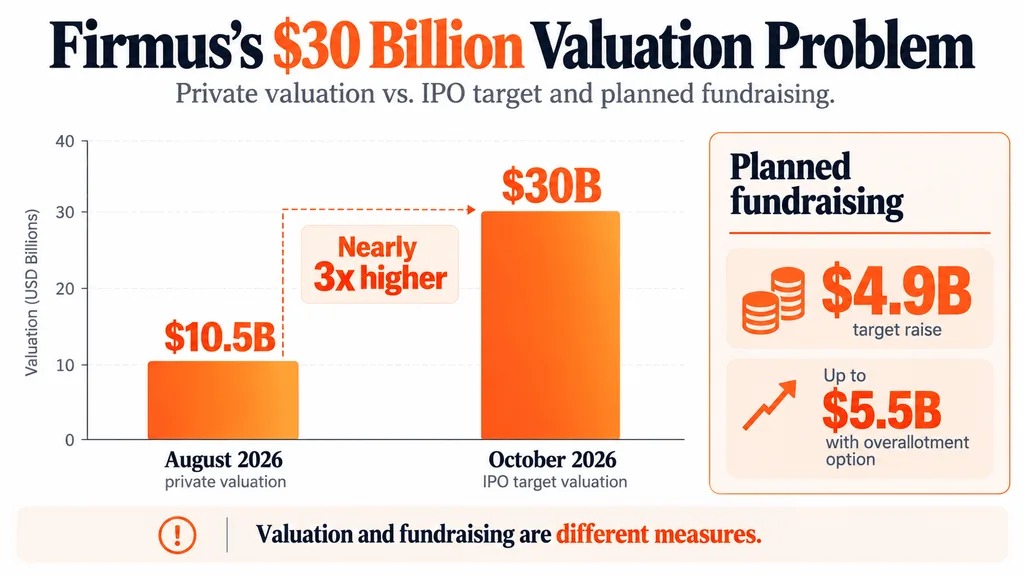
In August 2026, the valuation of AI Infrastructure Company of Australia, Firmus, was approximately $10.5 billion. Less than two months later, it was preparing to make its debut on the stock market, with plans to boost the company's valuation to over $30 billion.
With the support of investors such as NVIDIA and Blackstone, Firmus is set to become one of Australia's largest listed companies in almost overnight.
According to Reuters, after investors questioned its proposed valuation and the substantial financing required for the expansion of the AI data center, Firmus abandoned this issuance on October 9th.
This failure provides a thought-provoking example of how the enthusiasm of the private market collides with the scrutiny of the public market.
From Bitcoin mining to a $30 billion valuation for AI
Firmus initially engaged in cryptocurrency mining, later turning to high-performance computing and AI data centers.
The core of its strategy is to build facilities equipped with advanced NVIDIA processors, and then sell computing power to customers developing artificial intelligence systems.
The company has attracted well-known investors. In August, NVIDIA, funds supported by Blackstone, and other institutions participated in a round of financing, at which time the valuation of Firmus was approximately $10.5 billion.
By October, the equity valuation sought by the company approached $30 billion.
This means that, although there is only a short period of time between the two rounds of financing, its valuation is nearly three times that of the most recent private placement.
Why do investors refuse to subscribe for this IPO?
The core issue lies in the gap between Firmus's current business and its future ambitions.
The company currently has an operational data center capacity of about 46 megawatts, while its expansion pipeline exceeds 900 megawatts.
Therefore, most of the infrastructure necessary to support their proposed valuation has not yet been established.
Building this capacity will require a significant investment of additional funds in GPU, power access, cooling equipment, and construction.
These requirements make financing risks particularly important.
The company's future customer contracts can support loans, but they cannot automatically provide the cash required for building facilities.
In the broader AI infrastructure market, this distinction is equally important, as developers often rely on loans and external investments to fund projects before customer revenue arrives.
The proposed valuation is not the only concern.
Investors also have uncertainties regarding the construction progress, future financing rounds, and the economic viability of rapidly expanding the computing power of AI.
What happens when a $30 billion IPO fails?
If demand is insufficient, the company may lower its valuation, modify the issuance terms, or simply withdraw the offering.
Firmus ultimately chose the last option.
In the retraction statement, the company stated that the existing terms of issuance do not fully reflect its business and long-term prospects.
Subsequently, the company turned to seeking private financing while considering other potential listing opportunities.
At the time of this failure, other AI infrastructure companies were also facing increasing financial scrutiny. The borrowing costs of CoreWeave have risen significantly, reflecting market concerns about debt-driven expansion.
As expensive AI projects come under stricter scrutiny, investors have become more selective and have reduced their exposure to the tech sector.
Firmus did not fail as an operating company, and its withdrawal of IPO does not mean that its data center strategy cannot be successful.
What failed is this transaction itself, as well as the valuation that was required to be accepted by the public market.
The lesson is quite clear: even with NVIDIA's support and plans to invest billions of dollars in AI, there is no guarantee that investors will pay three times the company's most recent private placement valuation for it before the infrastructure has even been established.
Adrian Cole
Adrian Cole has been engaged in financial market reporting for over 6 years, with a focus on cryptocurrencies, stocks, and macroeconomic trends. He tracks Bitcoin, major altcoins, the U.S. stock market, interest rates, commodities, as well as data that drives market fluctuations. Over the years, he has written hundreds of market updates and analysis articles, with an emphasis on price trends, investor sentiment, and the connections between traditional finance and digital assets.