

This week, the debt “mountain peak” of AI is being scrutinized more and more closely by the market.
In recent days, anxiety on Wall Street has spread, with investors focusing on the large amount of loans used to fund the construction of AI. As yields soar and more debts approach troubled levels, the health of this financing model has also begun to be questioned.
The market is concerned that there may be more pressures in the future, which could have a negative impact on AI transactions and the broader financial system; if bond losses trigger a chain reaction and further affect the stock market, the consequences could be even more severe.
This concern became a focal point during the week. Billionaire venture capitalist Chamath Palihapitiya mentioned some bonds of CoreWeave, whose yields soared while prices plummeted into a troubled range.
The following is a brief review of the event:
- Tuesday: The price of CoreWeave bonds fell below 80 cents per dollar, a level that is generally considered the threshold for debt to enter a troubled zone. CoreWeave stock prices plummeted by 15%. As of Friday, the stock is expected to close the week with a 20% decline.
- At 6:01 p.m. on Tuesday, Chamath Palihapitiya posted on X that the yield on CoreWeave bonds had risen to 15.1%, higher than the 9.6% in June. Palihapitiya also attached an analysis, speculating that AI was inflating a private credit bubble.
- 7:43 PM on Tuesday: Tesla's CEO Elon Musk replied to “Yikes”, attracting even more attention.
- On Wednesday morning: Gil Luria, a technology analyst at DA Davidson, stated in a podcast that if the spending boom of AI is thwarted, the stock price of CoreWeave could fall to $0.
- On Wednesday evening: The Financial Times reported that Anthropic's revenue in the third quarter reached $16.8 billion. This figure has caused concern among investors, as it reflects a slowdown in revenue growth compared to the previous quarter and has also intensified fears that this wave of enthusiasm may be beginning to wane.
- Thursday morning: The selling of chip stocks accelerated, with the market value of this sector expected to lose up to $1 trillion. On Friday, more tech stocks were sold off, leading to the stock market potentially recording its worst week since July.
AI The most significant decline in debt prices was observed among smaller neocloud companies, but even among the largest cloud service providers, the value of some loans is approaching a problematic range. According to the Financial Times, the debt issued by Blue Owl and Beignet Investor and supported by Meta for financing Hyperion data centers has fallen below 92 cents per dollar. These bonds were still traded at a premium at the beginning of July, that is, above their face value.
A spokesperson for CoreWeave told Business Insider: "We are confident in our order backlog, which is sufficient to cover all our debt obligations. Most of our financing structures are designed so that cash flow from customer contracts repays the associated debt and generates additional free cash flow."
A decline in the price of distressed debt does not necessarily mean that these companies are on the verge of defaulting. Super-large cloud service providers such as Meta and Amazon still maintain investment-grade credit ratings, and their balance sheets are relatively robust. On the contrary, the decline in the value of some debts reflects several different factors:
- Investors may be concerned about the risks associated with large-scale projects, which has led to a decrease in demand for these bonds.
- The company has recently issued more debt, increasing the supply of bonds, and both of these factors will push down prices.
- This may also reflect higher interest rates, thereby dragging down bond prices.
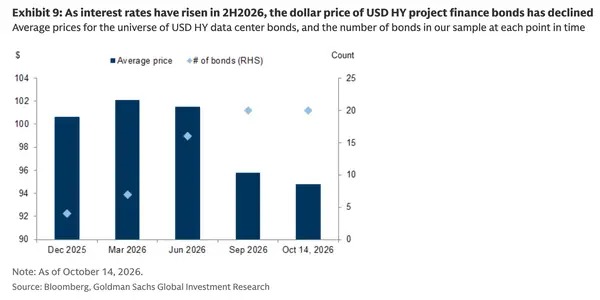
Goldman Sachs stated that the average price of high-yield data center bonds has been falling since September, due to factors including soaring interest rates and an increase in bond supply.
In the past month, bond yields have risen significantly. As a result, the yield on 10-year U.S. Treasury bonds, which affects the borrowing costs of consumers and businesses, rose to 5.12% on Friday, remaining close to its highest level in over 20 years.
Goldman Sachs warned in a report that there is a risk of "a pullback in some risky assets," and pointed out that higher interest rates have sparked concerns about the financing costs of AI construction in the market.
The line reads: "We believe that the widening of interest rate spreads reflects the market's re-evaluation of the economic viability of AI, especially for those borrowers with lower ratings who are more sensitive to an environment of 'higher and longer-lasting interest rates' as well as potential energy cost pressures." The line also adds that it is expected that the "differences among issuers related to AI" will remain high.
A survey conducted by Bank of America this month among global fund managers found that AI debt issued by hyperscale cloud service providers is considered the most likely source to trigger systemic credit events. Respondents also listed credit events from hyperscale cloud service providers as one of the top five tail risks in the market.