Key Points
- Babylon proposes to introduce native Bitcoin collateral into Aave V4.
- During the loan period, BTC will continue to be locked on the Bitcoin network.
- Governance, control, and settlement mechanisms are subject to increased scrutiny.
According to a new proposal from Babylon Labs, Bitcoin holders will soon be able to borrow stablecoins through Aave without having to transfer them out of the Bitcoin blockchain. This proposal will expand one of the largest lending platforms in the field of decentralized finance.
In a governance proposal released on October 14th, Babylon outlined an integration scheme: users can lock their native Bitcoin in a special Taproot vault, while borrowing stablecoins through Aave V4.
Different from traditional DeFi lending that uses Bitcoin as collateral, this model typically relies on an encapsulated version of BTC as the underlying asset for mapping, while the collateral under this proposal will continue to remain on the Bitcoin network. The proposal has passed the initial community testing, but further risk assessment and governance approval are still required.
Aave How to Accept Bitcoin Without Bridging BTC
The proposed system utilizes Babylon's 'trustless Bitcoin vault' ( Trustless Bitcoin Vaults, TBV ) to connect Bitcoin collateral with Aave's Ethereum-based lending infrastructure.
Users will first lock BTC on the Bitcoin network within a Taproot transaction output. Subsequently, a corresponding record will be generated within Aave V4 to represent this collateral, allowing borrowers to obtain stablecoin liquidity without transferring the underlying tokens to Ethereum.
This design introduces two components: Babylon Spoke which is responsible for managing BTC mortgage lending, and BTC Vault Swap Spoke which supports clearing and settlement.
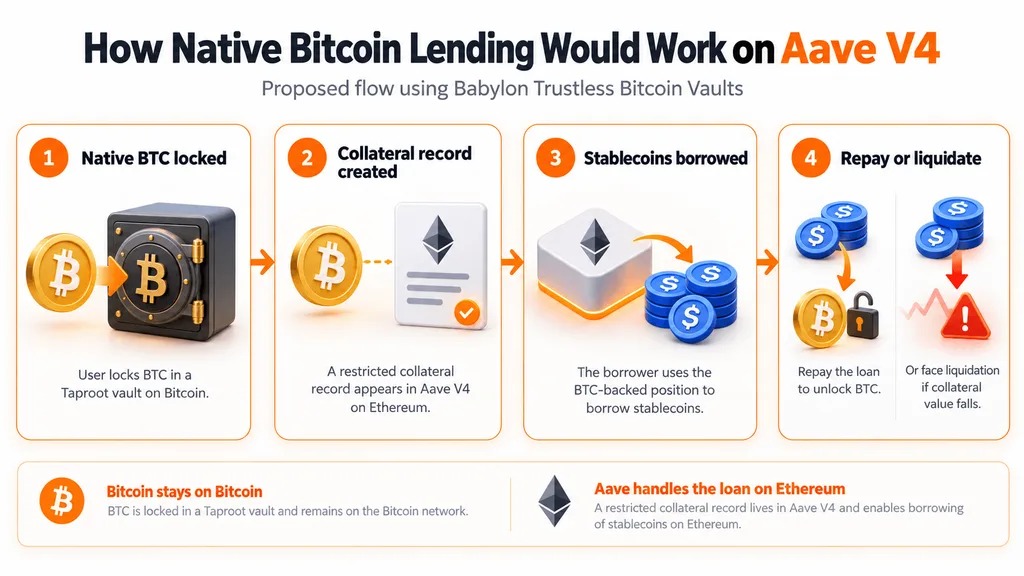
Since Aave V4 usually accepts ERC-20 as collateral, this integration scheme will still create a restricted accounting token to represent that Bitcoin wallet. However, this token cannot be traded or transferred as freely as the traditional encapsulated BTC.
This proposal is built upon the early Bitcoin staking programs of Babylon. Previously, these programs attempted to expand the uses of BTC beyond mere holding and value transfer.
Babylon indicates that since August 2024, its existing staking infrastructure has activated over 100,000 BTC, which suggests that there is a demand for Bitcoin financial applications in the market.
Governance issues surrounding Bitcoin collateral emerge
Although the system avoids transferring the native BTC to a managed cross-chain bridge, its withdrawal mechanism brings additional considerations.
On October 16th, a governance participant questioned whether the emergency mechanism controlled by Babylon could still prevent users from withdrawing their collateral, even though Bitcoin is still securely stored in a vault.
Babylon Engineers Aleksa Opacic responded that the emergency pause mechanism cannot transfer or release BTC, but it can temporarily prevent withdrawals, repayments, and settlements.
According to Babylon, the emergency control will involve a temporary governance multi-signature arrangement signed by 4 out of 7 people, as well as another emergency guardian group signed by 3 out of 5 people. The contract upgrade requires a 5-day lock-up period, whereas the emergency suspension can be executed immediately.
The importance of these distinctions lies in the fact that the security of collateral does not automatically imply that users will have continuous and uninterrupted access to the relevant assets, especially in times of market volatility or when borrowers are required to maintain a sufficient collateral ratio.
Previously, the liquidation cases of Aave have shown that complex mortgage arrangements and interrelated lending infrastructures can lead to actual financial consequences.
Aave or obtain new sources of income from lending from BTC
This integration solution also proposes an income distribution arrangement between Aave DAO and Babylon Foundation.
According to the preliminary structure, Aave will first receive the first $500,000 of the annual eligible income. Beyond this threshold, the additional income will be allocated among Aave, Babylon, and token purchases through a multi-tiered mechanism.
At higher income levels, a portion of this distribution will be used to purchase AAVE and BABY in the market, but the proposal does not guarantee that there will definitely be a demand for borrowing, nor does it ensure that token purchases will definitely occur.
This progress comes at a time when institutions' interest in Bitcoin-backed credit is growing more broadly, and Aave continues to expand its V4 lending framework.
At the same time, Bitcoin mortgage products launched by institutions such as Strike also demonstrate how different providers are balancing between liquidity and liquidation risk.
The author, Maya Bennett, is a financial journalist who has reported on cryptocurrencies, stocks, and broader market trends. Her coverage focuses on Bitcoin, major digital assets, the stock market, monetary policy, as well as economic developments that influence investor sentiment.