Key Points
- Intrator traded natural gas before founding CoreWeave.
- Cryptocurrency mining later evolved into an important AI business.
- CoreWeave Approximately $104 billion in backlogged orders face financing pressure
Before becoming the CEO of one of the largest cloud companies in the United States that specializes in AI, Michael Intrator traded natural gas and managed investments in the energy market.
Today, the company he helped to found has approximately $104 billion in contracted revenue backlog. It provides computing infrastructure for large-scale AI developers and is publicly traded on NASDAQ. However, the company's rapid expansion has also brought with it billions of dollars in borrowing obligations, as well as increasingly intense discussions regarding the economic viability of artificial intelligence.
The career trajectory of Intrator reflects an unusual transformation: from trading in commodities, to cryptocurrency mining, and then to providing infrastructure for some of the world's most advanced AI models.
From natural gas trading to cryptocurrency mining
His background is in finance, not computer engineering, but this experience shaped his next business opportunity.
In 2017, Intrator co-founded Atlantic Crypto with Brian Venturo and Brannin McBee. Initially, the focus was on using graphics processors (GPU) for mining cryptocurrencies.
This business emerged during the craze for cryptocurrency speculation, when powerful graphics cards could generate income by processing blockchain transactions.
After the decline of cryptocurrencies in 2018, the founder began to shift his focus from relying solely on mining rewards to selling computing power.
Their business became CoreWeave in 2019.
CoreWeave How to Grow into a $104 Billion AI Infrastructure Business
With the emergence of rendering, machine learning, and artificial intelligence demands driven by GPU, the transformation of CoreWeave has accelerated.
Unlike traditional cloud service providers that offer a wide range of computing services, CoreWeave focuses on specialized GPU infrastructure.
This puts the company in a favorable position as generative AI applications begin to require large-scale NVIDIA processor clusters.
CoreWeave went public in March 2025, transforming Intrator's earlier cryptocurrency business into a publicly traded AI infrastructure company.
According to its second-quarter performance, in the three months up to June 30, 2026, the company's revenue reached $2.58 billion, a year-on-year increase of 112%.
Its revenue backlog is approximately $104 billion, not including the additional customer commitments of over $25 billion announced at the beginning of the following quarter.
This business model relies on signing long-term customer agreements and provides financing for the GPU and data centers required to fulfill these agreements.
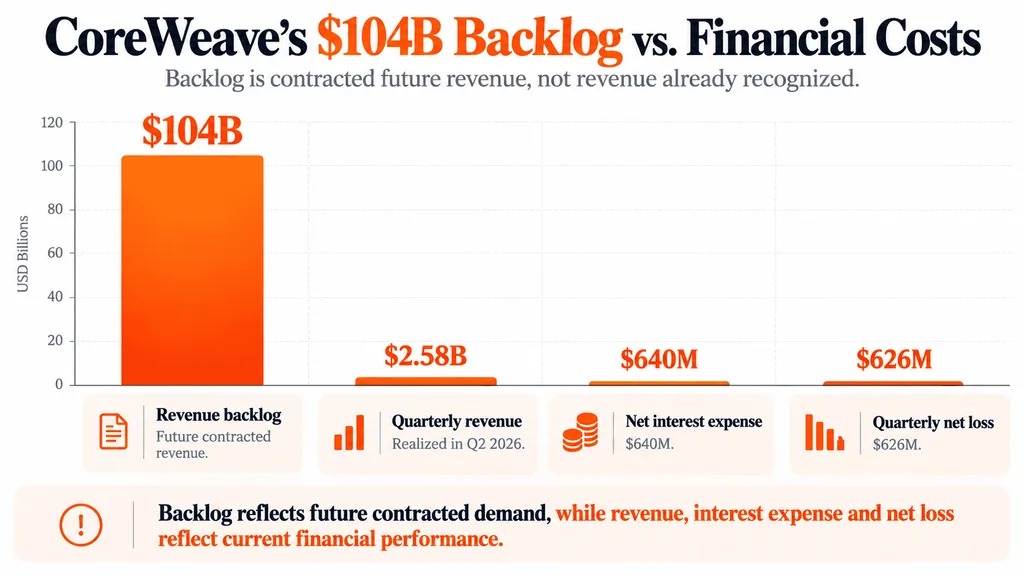
As explained by Coinpaper in their interpretation of the contract with AI, future promised revenues do not imply that the customer has already paid the full amount stipulated in the contract.
The financial risks behind the AI empire of Intrator
The growing backlog of orders has not alleviated its financing challenges.
The company disclosed that as of June 30, its debt amounted to approximately $35.6 billion, while the quarterly net interest expense reached $640 million.
Its borrowing model reflects the huge costs of constructing the AI infrastructure, where the equipment can be financed through loans secured by GPU and other guarantee arrangements.
Investors are increasingly questioning whether the company's rapid revenue growth can keep up with debt repayments and capital expenditures.
These transactions do not indicate that Intrator's business is expected to fail, but they have drawn attention during a period when AI's financing is under stricter scrutiny.
The same challenges also extend beyond CoreWeave. Competitive infrastructure companies such as Nebius and IREN are also trying to outpace financing costs while expanding their computing power.
For Intrator, the transition from natural gas to AI has created a business with astonishing signed demand. The next challenge is to convert this demand into sustainable cash flow – which is also the core issue in the broader AI debt boom.
Adrian Cole
Adrian Cole has been engaged in financial market reporting for over 6 years, with a focus on cryptocurrencies, stocks, and macroeconomic trends. He tracks Bitcoin, major altcoins, the U.S. stock market, interest rates, commodities, as well as data that drives market movements. Over the years, he has written hundreds of market updates and analysis articles, with an emphasis on price trends, investor sentiment, and the connections between traditional finance and digital assets.