Key Points
- It is reported that Microsoft and Meta are cutting back on expenditures on AI tools.
- New data from Ramp shows that the expenditure growth rate of company AI is slowing down, and companies are becoming more cautious about costs.
- Under the pressures of infrastructure delays, rising costs, and uncertain returns, the AI craze is facing financial strains, with both businesses and investors giving priority to profitability.
As costs soar, returns fall short of expectations, and concerns about the sustainability of the AI craze grow, companies have begun to tighten their spending on artificial intelligence and re-evaluate related investments.
It is reported that Microsoft and Meta are reducing their spending on third-party AI tools, while new research shows that although the use of AI continues to grow, corporate AI spending is losing momentum.
This change occurred as investors began to question whether the billions of dollars invested in the development and infrastructure of AI would truly yield sufficient returns.
Microsoft and Meta are said to have cut spending on AI tools
According to reports released in early October, Microsoft is said to have cut its internal expenditures on Claude by more than a third, which was originally expected to exceed $1 billion in annual costs.
This tech giant has instead encouraged its employees to use GitHub Copilot.
Meanwhile, Meta is said to have reduced the number of users from Claude Code from about 60,000 to 30,000, preferring instead to use internally developed alternatives, including MetaCode and Muse Code.
This indicates that even the companies leading the AI revolution have begun to more selectively decide which services are worth the cost. However, these cuts mainly involve third-party software, rather than overall AI investments.
New research shows that the growth rate of AI expenditures is slowing down.
More importantly, among the top 1% of companies with the highest expenditures under AI, each employee's expenditure in September was $9,568, which is about 3.1% lower than the peak in July.
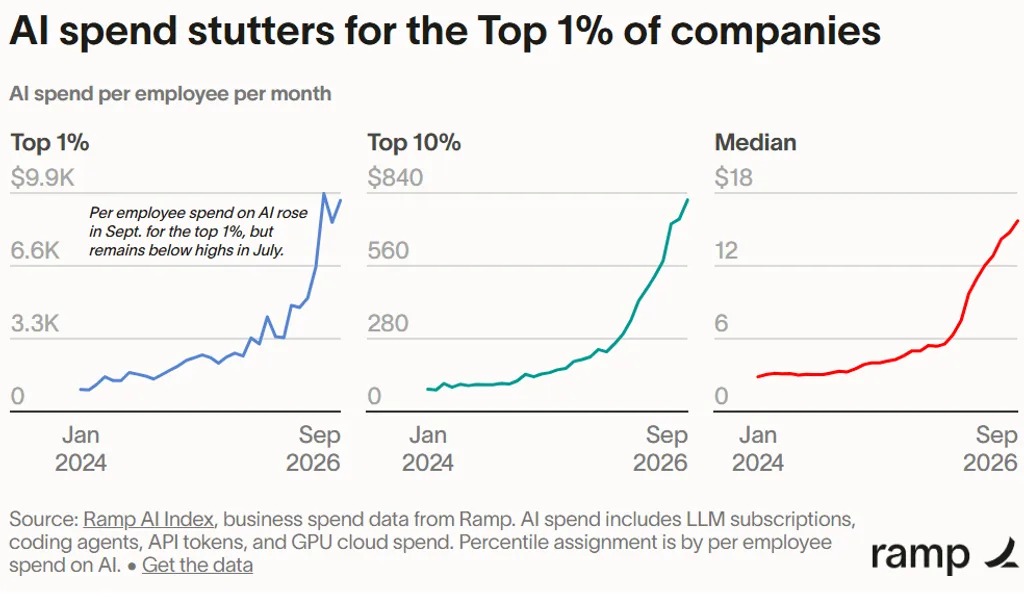
Despite the increased usage of AI, the expenditures of enterprises on AI and token have hardly increased for two consecutive months.
Ramp attributes this slowdown to a decrease in model prices and an improvement in efficiency, which has enabled companies to complete more work without increasing their budgets.
AI The infrastructure boom is facing increasing financial pressure
Concerns are also growing regarding the infrastructure that supports the AI industry. According to a recent report by The Financial Times, at least 47 large-scale AI infrastructure projects encountered setbacks in 2026, with financing difficulties, construction delays, and power restrictions disrupting expansion plans.
Microsoft also withdrew from a large AI data center project in Essex, UK, due to concerns about power supply issues.
At the same time, investors are examining the huge capital required to build the infrastructure for AI, especially in the context of rising borrowing costs.
These developments do not necessarily mean the end of the AI craze. On the contrary, this trend indicates that the industry is shifting towards financial discipline. Companies are now giving greater priority to efficiency, measurable improvements in productivity, and return on investment, rather than aggressive spending.
Danielle Walgenbach
Danielle is a journalist who covers cryptocurrency and financial markets. She has over four years of reporting experience and is adept at breaking down complex financial and economic topics into clear and solid reports.