

Former Chairman of the U.S. Commodity Futures Trading Commission (CFTC) Chris Giancarlo and venture capital firm Draper Dragon have publicly expressed their support for Spout. Spout is a protocol based on Solana that allows tokenized U.S. stock holders to lend stablecoins without having to pay interest. This endorsement comes shortly after Spout announced the completion of a $2 million strategic financing round on October 13th.
Giancarlo posted on X stating that, as an angel investor and strategic advisor to the company, he supports Spout's efforts in building a tokenized credit market. Draper Dragon, on the other hand, released a comprehensive investment analysis on October 15th, stating that the convenience of borrowing against stocks was previously mostly accessible only to private bank customers.
Draper Dragon, Anchorage, and Flow Traders participated in a $2 million financing round
Spout, co-founder and CEO, Marc Ryan, announced the list of investors for this round of financing, which includes Draper Dragon, Anchorage Digital, Flow Traders, Taisu Ventures, Vessel Capital, Solayer, 2Square, Capital, and Bering Waters Ventures. In addition, Solana Labs provided strategic support.
Angel investors include Giancarlo, Solana, co-founder Anatoly Yakovenko and Raj Gokal, co-founders Dean Swennumson, as well as co-founder Injective and Eric Chen. Ryan also thanked Solana Foundation, the person in charge of institutional growth; Nick Ducoff, who is in charge of the Solana Labs incubator; and Draper Dragon, the partner Samiz Bayan, calling them "who believed in us very early on."
Ryan writes: 'This idea sounds simple, but it's very difficult to implement. You don't necessarily have to pay interest when borrowing from your own portfolio. We are bringing the economic model of prime brokers to the general public.'
Giancarlo positions Spout as a tokenized credit market
Giancarlo served as the chairman of CFTC from 2017 to 2019 and has long advocated for moving financial instruments onto the blockchain. In his statements, he made comparisons with traditional finance:
"I'm very pleased to support @SpoutFi in building a tokenized credit market, where capital can remain in place and continue to grow with compound interest, just like in traditional finance through mortgages and bonds."
The core logic is that in a mature credit market, asset holders can obtain cash by using their assets as collateral without having to sell the assets, allowing those assets to continue to function as they normally would. Spout attempts to bring this model to the field of tokenized stocks: borrowers retain their stocks and their exposure to these stocks, while also gaining access to the liquidity of stablecoins.
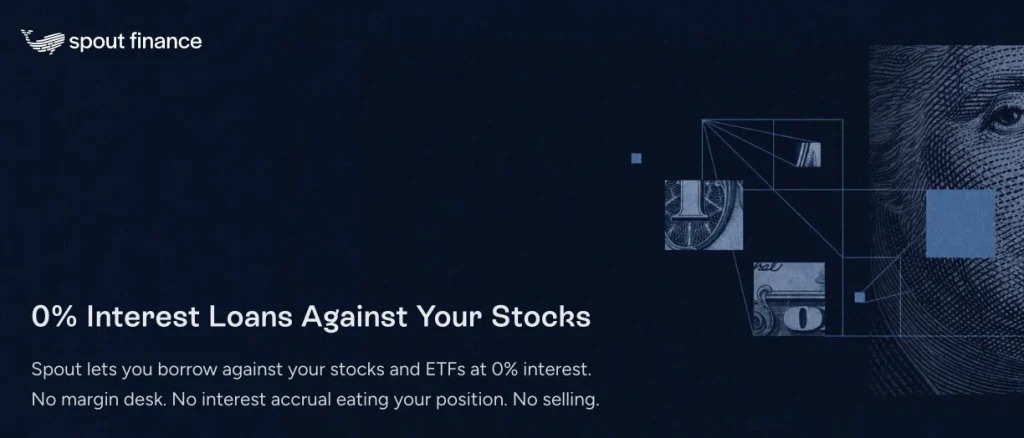
The loan funds come from the premium of covered call options, not from the borrower's interest.
According to the introduction of Draper Dragon, users can lend out tokenized assets as collateral for up to 50% of their value in USDC. As long as the loan is not fully repaid, no interest needs to be paid. The protocol sells covered call options on the collected collateral every week, with exercise prices set much higher than market prices. The premium generated from these options is used to pay the lenders who provide USDC.
The background for this selling point is the high cost of retail credit. According to the interest rate tables published by Charles Schwab and Fidelity, both companies currently charge an annualized interest rate of 12.075% to customers with a margin of less than $25,000 in loans.
Bayan indicates: "Tokenizing a stock is just the first step. The next phase is to generate revenue from these assets."
Draper Dragon indicates that this investment is built upon its existing tokenized portfolio, which includes Centrifuge and OpenTrade. The institution believes that Spout can serve as a credit layer – where token issuers, trading venues, and wallets can all utilize such infrastructure without the need to develop their own lending products.
The next step is private testing; the mainnet has not yet been launched.
Spout has not yet been launched on the mainnet. A test version is already available on the devnet test network at Solana. Ryan indicates that the private beta version is "very close to completion," and it was also mentioned that "there is still a lot more to be developed." Draper Dragon also suggests that the private beta will be launched soon.
The next milestone is to open this test version, followed by a migration to the mainnet. Whether this model can be scaled will still depend on the performance, the behavior of the options market, and the demand for tokenized stocks on the chain, which is still a rather young market.