Key Points
- CoreWeave initially rose by about 7%, but the increase faded during regular trading hours.
- Goldman Sachs lowered its target price while raising the rating for CRWV.
- Higher borrowing costs continue to dampen investor sentiment.
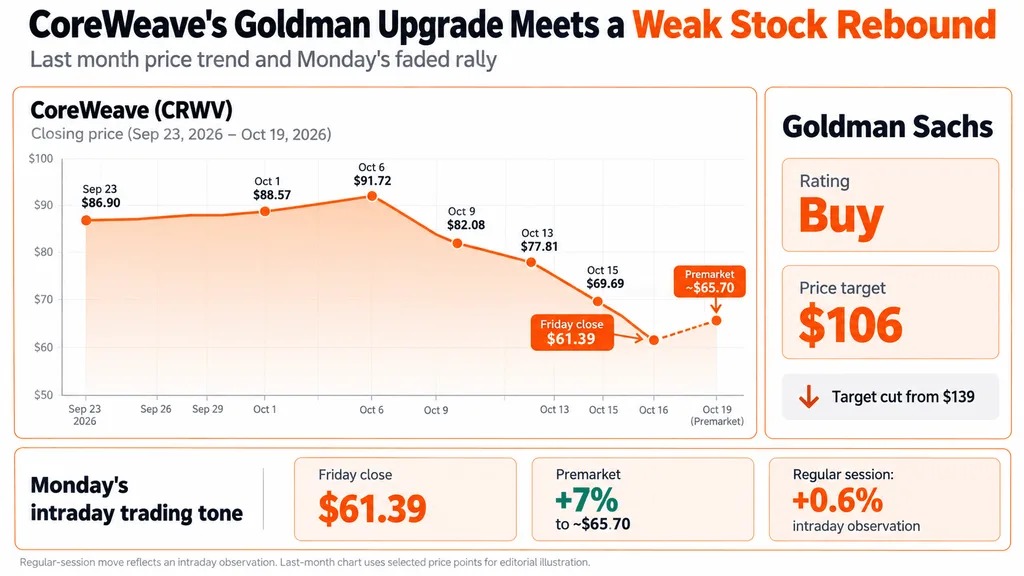
CRWV once rose by about 7% during pre-market trading, approaching $65.70, compared to a closing price of $61.39 on the previous trading day. However, the subsequent rebound weakened significantly. A market snapshot from The Associated Press showed that the stock only rose by 0.6% during regular trading hours.
This decline occurred after a company that received support from Nvidia went through a tough week. Over the past five trading days, the market value of CoreWeave has evaporated by about 25%, due to investors questioning whether its debt-driven expansion can withstand high interest rates and increasingly expensive financing costs.
Goldman Sachs raises the rating of CoreWeave, but lowers the target price
Goldman Sachs analyst Gabriela Borges raised the rating of CoreWeave from "neutral" to "buy," arguing that the market may have overestimated the financial risks related to its AI computing infrastructure.
According to a research report dated October 19th, Goldman Sachs has set a target price of $106, which is lower than the previous target price of $139. Despite the reduction in the target price, the new target price is still about 73% higher than CoreWeave's closing price of $61.39 on Friday.
This distinction is very important. Goldman Sachs is expressing that after a significant decline in the stock price, there is an increased confidence in the valuation of that stock, rather than an upward revision of the expected absolute stock price of the company.
Goldman Sachs' stance contrasts with the recent selling by CoreWeave; previously, bond investors demanded a significant increase in yields for holding the company's debt, which led to an acceleration in selling.
Borges believes that the customer contracts and underlying computational economics of CoreWeave are still relatively robust, and the potential increase in future financing costs may not be as significant as investors are concerned.
However, the only modest rebound in stock prices indicates that this rating upgrade has not immediately reversed the market's broader concerns regarding the infrastructure spending of AI.
The bond market of CoreWeave remains under pressure.
The financing model of CoreWeave relies on raising a large amount of capital to purchase Nvidia GPU, obtain electricity, and build data centers, before gradually recouping the full value of customer contracts.
Last week, this pressure became even more apparent: the yield on its bonds maturing in 2031 briefly exceeded 16%.
The company's default insurance costs also rose to over 1,000 basis points, reflecting the clear concerns of participants in the credit market.
An increase in bond yields on the secondary market does not automatically raise the interest payments on existing fixed-rate debt. However, it will make the costs of future borrowing or refinancing higher.
For an infrastructure company, this distinction is particularly important, as financing supported by GPU may directly link loan repayments to the value of the equipment and the contracted computing revenue.
CoreWeave Can the backlog of $104 billion in orders support a rebound?
CoreWeave indicates that as of the end of June, it had approximately $104 billion in backlogged orders, reflecting a large amount of commitment from customers to the future computing power of AI.
However, the contracted future income is not equivalent to the cash that has already been received. During the period in which the company delivers the services covered by these contracts, it must continue to provide funding for infrastructure construction, hardware procurement, and operational expenses.
This contradiction has become the core of the broader AI financing debate, especially as large technology companies re-evaluate the returns on their massive data center investments.
Meanwhile, investors have not left this sector. Citadel Securities recently reported that in its latest statistical week, retail investors made a record purchase of $700 million in neocloud stocks.
Ethan Mercer
Ethan Mercer is a financial journalist who covers cryptocurrency, stocks, and the global economy. He studied economics and finance before turning to market reporting, with a particular focus on Bitcoin, stocks, monetary policy, and investor sentiment. His work primarily explains daily market fluctuations and the broader trends behind them.