According to Morgan Stanley's calculations, 91.7% of NVIDIA's revenue in 2027 is tied to one factor: AI infrastructure demand. No other company on the list scored higher. Vertiv scored only 90%, and Broadcom scored 81%.
A report released on October 15th stated that NVIDIA has the best risk-reward ratio in the industry.
The bullish logic of this company, which has the highest global market value, is now almost synonymous with the bullish logic behind this wave of construction. The Morgan Stanley North America Insights team, led by Nicholas Lentini, supports both viewpoints. The report, titled "Tracing the $1.6 Trillion Flow of AI: Mapping the Revenue Generated by Capital Expenditure Boom," includes a section titled "We Are Optimistic About This Spending." This 65-page report also devotes considerable space to discussing how this wave of spending could potentially slow down.
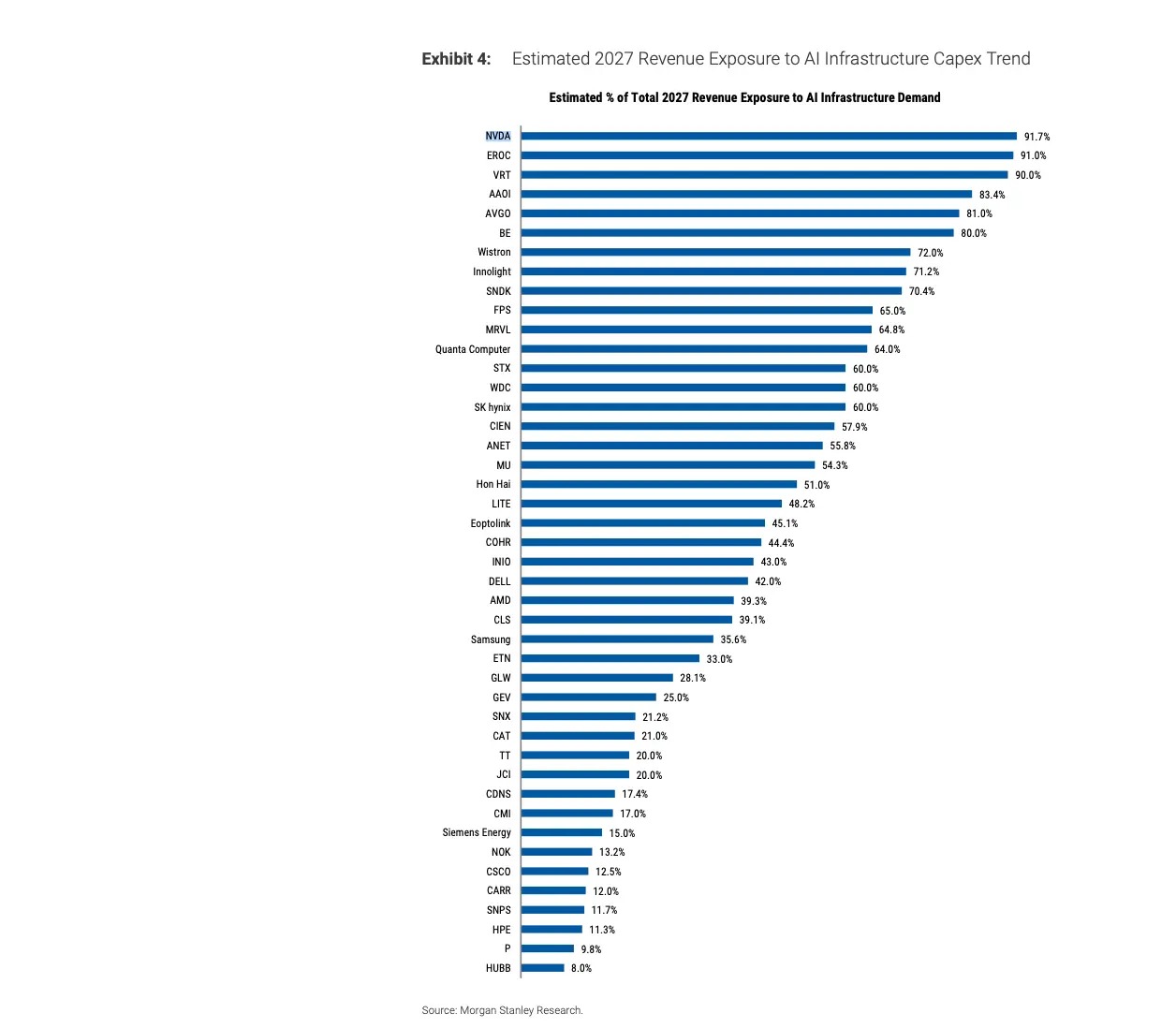
Supporters of NVIDIA would say that this level of exposure is inherent in the company's nature. For years, its data center business has contributed a large portion of its revenue, but the report further indicates how concentrated the buyers behind this exposure are.
1.6 trillion US dollars
Morgan Stanley estimates that the spending of hyperscalers and AI cloud service providers will reach $1.58 trillion in 2027, an increase of about 60% from this year's $980 billion; by 2028, it is expected to reach $1.8 trillion. Of this amount, approximately $195 billion will be for data center leasing, which will not be reflected as capital expenditure in the cash flow statement. The report refers to this leasing as "synthetic capital expenditure." Hyperscalers have disclosed leasing commitments that have not yet been fulfilled, totaling over $1.1 trillion.
According to estimates by Morgan Stanley, expenditures of about $1 trillion in 2027 will ultimately translate into revenue for the components of the S&P 500 index. Nearly $700 billion of this amount will flow towards NVIDIA. Revenue from hyperscale cloud providers and new cloud customers will account for only 5% of the total S&P 500 revenue in 2027, yet it will drive approximately 25% of the index's revenue growth.
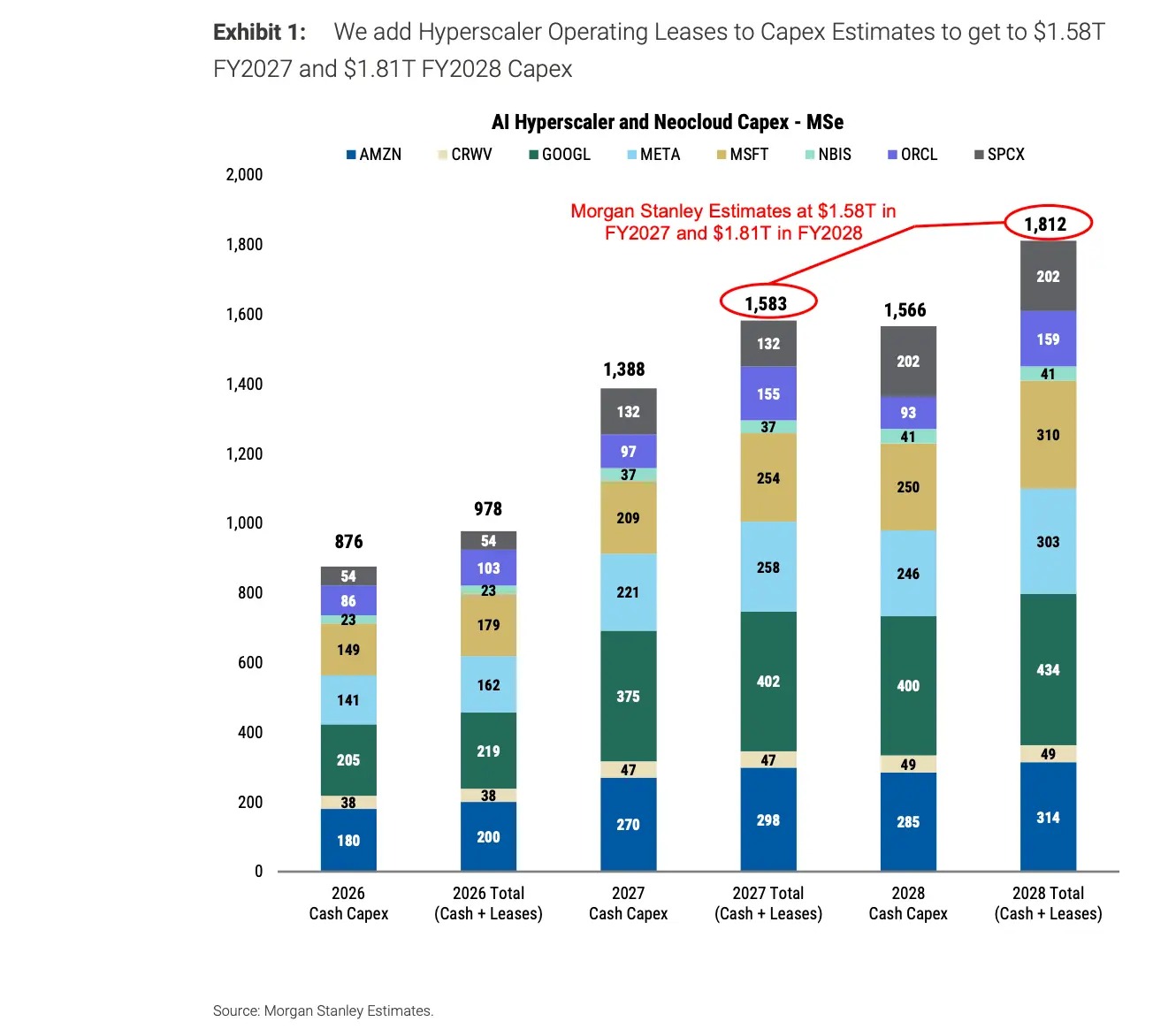
NVIDIA's own customer base is even narrower. According to this model, SpaceX and Amazon Web Services ( Amazon Web Services ) together account for approximately 54% of NVIDIA's revenue from hyperscale cloud customers in 2027 and contribute to 72% of its growth.
Morgan Stanley's argument is that NVIDIA is not overpriced relative to its fundamentals. The stock has a price-earnings ratio of 15 times based on earnings for the fiscal year 2028. The firm states that even if the valuation multiple does not expand further, as long as performance continues to improve, the stock price remains justified. The firm expects this round of spending to generate a return on invested capital of 25% to 50%. The report also mentions that, based on four historical cycles in PC, internet, mobile, and cloud, Wall Street has on average underestimated the computing power cycle by 38%.
This line even indicates that one's own predictions for NVIDIA may be on the conservative side. The report states that estimates for SpaceX and Amazon are quite cautious, which means that "the threshold for the remaining hyperscale cloud providers is very low." In its model, NVIDIA's share of spending among other hyperscale cloud providers is expected to decline from 18% in 2026 to 16% in 2027. However, NVIDIA itself expects to be able to continue to increase its share.
However, the stance of other departments within Morgan Stanley is not so certain. In March of this year, the bank's Global Investment Committee stated that this bull market "depends more on whether AI capital expenditure can continue."
What could go wrong?
First and foremost is money. Morgan Stanley predicts that in 2027, there will be the largest cash flow gap during its forecast period, which will be followed by even more debt. Ultra-large cloud providers have already issued approximately $255 billion in unsecured bonds this year, which is roughly equivalent to 30% of the expected expenditures for 2026. According to the bank's so-called theoretical calculations, if borrowing continues to increase, companies such as Amazon, Alphabet, Meta, and Microsoft, which have a rating of AA or higher, will see their total interest coverage ratio drop from about 31 times to 12 times; Oracle and SpaceX will see their ratio drop from 4 times to 1.8 times.
Some of the increase in expenditures actually stems from inflation. The report states that a significant portion of the recent rise in capital spending reflects higher prices for components. The report quotes Amazon's chief financial officer as saying that Amazon has raised its spending plan from $200 billion to about $220 billion, mainly due to increased memory costs, while the construction plans have not changed.
Next is electricity. The assumption of $1.6 trillion is that every chip ordered will ultimately be able to operate when powered on. Morgan Stanley's own electricity model shows that by 2028, there will be a shortage of 32 gigawatts of power in data centers in the United States, which is about one-third of the 97 gigawatts needed. The report points out that hyperscale cloud providers can continue to purchase the scarce GPU before power is available, which will support chip revenue for a period of time, but "may lead to hoarding and idle inventory."
The report states: "However, it is difficult to sustain the purchase of those devices that cannot operate without electricity and rely on power for a long term."
Finally, there's politics. The report suggests that data center restrictions will become a contentious issue during the mid-term elections. It does not expect a pause at the federal level, but it believes that tax incentives will be a "consensus goal" regardless of who wins.
Supplier issue
Morgan Stanley's outlook for the downstream market is essentially a matter of timing. If spending peaks, it believes that sales volumes can be maintained, but prices will fall, and suppliers' profit margins will be the first to disappear. The bank mentioned a downward cycle for memory chips at the end of 2022, during which NAND shipments only decreased by about 5%, but prices fell by 20% to 30%.
The report suggests that NVIDIA will be able to avoid the most severe impacts. In the context of paused spending, it states, "We may see the most significant disruptions occurring at the end of the bullwhip effect," which refers to components such as storage, optics, and other smaller parts that are particularly prone to over-ordering.
However, according to this report's own diagram, NVIDIA is located at the other end of the bullwhip effect and is the largest single supplier in the entire chain.
This report, which also suggests that Wall Street has an underestimation of 38% in its cyclical analysis, accuses Wall Street of being "insufficiently prepared for the depth of declines during downturns." The report argues that the risk of both sales volume and prices falling simultaneously has been underestimated.
The report states: "This is the standard capital cycle script, only it has been compressed due to the highly concentrated customer base of the ultra-large cloud service providers."
This article uses the generative AI for auxiliary research and/or transcription. The journalist independently reported and verified the factual statements in the article, and manual editing was conducted before publication.