Global ETF investors are 'bottom-fishing' in the semiconductor and South Korean markets on a record scale with extremely high leverage ratios, while the memory sector is facing continuous selling pressure.
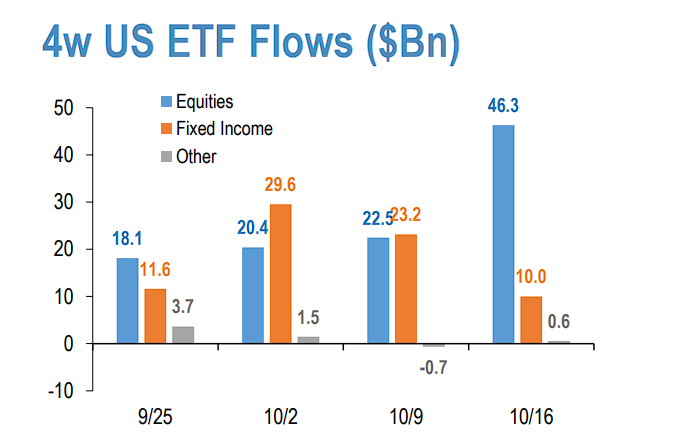
According to information from Zuifeng Trading Desk, JPMorgan Chase's latest capital flow report released on October 19th shows that global stocks ETF saw a massive inflow of $46.3 billion in the week of October 16th (the single-week period in question). Among this, there was a three-fold increase in bullish positions on semiconductors ETF, with a record-high capital inflow of $7.2 billion; South Korean ETF also experienced the strongest capital inflow since July of this year. However, there was a significant divergence in capital flows within the technology sector, as the DRAM (memory) theme ETF faced capital outflows for the eighth consecutive week.
The report indicates that the current market exhibits typical characteristics of 'panic buying at lows' – retail investors and aggressive traders are betting on a rebound in AI-related semiconductors by leveraging high leverage tools, while institutional CTA strategy funds are simultaneously reducing their positions in U.S. stocks. The clash between these two forces deserves close attention. The divergence in capital flow between memory chips and the overall South Korean market suggests that concerns regarding the fundamentals of storage chips have not subsided.
In addition, CTA (commodity trading advisor) funds have begun to reduce their exposure to U.S. stocks and go short on the Russell 2000 index, while in the fixed-income market, there has been a shift from long-term government bonds to municipal bonds.
Leveraged funds are frantically buying at bottom prices; semiconductors and the South Korean market have become the main sources of capital attraction.
Investors remain firmly confident in AI and tech stocks, even resorting to record-level leverage tools.
Data shows that the leveraged ETF product saw a record weekly capital inflow of $9.3 billion. Among them, the semiconductor sector became the absolute main source of funds, with a total inflow of about $7.6 billion into semiconductor ETF. Notably, the 3x long position in semiconductors ETF ( SOXL ) had a weekly capital inflow of as high as $7.2 billion, setting a new historical high, which is three times the previous week's peak.
In addition, the South Korean market also saw its strongest buying momentum since July, with $1.3 billion flowing into the market in just one week. Approximately half of this capital went into long positions on South Korea's ETF (about $600 million for KORU). Other leveraged products such as TQQQ (with about $800 million flowing in) and short-leveraged SOXS (with about $500 million flowing in) also received significant attention from investors.
Despite the strong buying interest in the Korean market (which is dominated by exports of semiconductors and memory chips), there has been a sharp divergence in capital flows within the technology sector. The memory theme ETF ( DRAM ) has seen capital outflows for the eighth consecutive week, recording the largest single-week redemption volume to date (900 million US dollars).
Analysis suggests that this phenomenon indicates that although investors are willing to take a chance on a rebound through the broad-based South Korean ETF, the market still exhibits a clear aversion to the segment of memory chips represented by companies such as SK Hynix and Micron.
Other sectors of the U.S. stock market saw selling pressure, and the CTA fund reduced its exposure to U.S. stocks.
Excluding the fervor in the technology sector, capital flows in other industries of the U.S. stock market have been generally weak. The industrial sector suffered a heavy blow, with $1.6 billion in capital outflows, and sectors such as real estate, non-essential consumer goods, utilities, and materials also saw selling pressure.
From a systemic funding perspective, it is very likely that the CTA fund has already reduced its exposure to U.S. stocks, as both the S&P 500 Index and the Nasdaq 100 Index fell below their 50-day moving averages on Friday.
In addition, the signal for CTA regarding the Russell 2000 Index (RTY) has turned bearish. The holding data of CFTC also confirms this, as asset management companies have sold futures on the Russell 2000 and mid-cap stocks (MID), while leveraged funds have increased their short positions in 2-year and 10-year U.S. Treasury bonds.
There has been a rotation in the fixed-income market, with emerging markets and gold gaining favor, while cryptocurrencies have seen selling pressure.
In terms of fixed income, the recent trend of 'buying on dips' has cooled down, with only $10 billion flowing in over a single week. Investors have made clear rotations within the bond market: funds have withdrawn significantly from long-term government bonds ($3.4 billion outflow) and mortgage-backed securities ($800 million outflow), and instead flocked to municipal bonds ($5.1 billion inflow), showing strong buying momentum for the third consecutive week.
In terms of emerging markets, Brazil continued to attract strong capital inflows (1.2 billion US dollars) before the final round of elections. In the commodities sector, precious metals drew in 1.1 billion US dollars in capital inflows, led mainly by gold (800 million US dollars). In the currency/multi-asset category, cryptocurrencies experienced a capital outflow of 700 million US dollars.
~~~~~~~~~~~~~~~~~~~~~~~
The above wonderful content is from the Chui Feng Trading Platform.
For more detailed interpretations, including real-time analysis and frontline research, please join [Chui Feng Trading Desk ▪ Annual Membership].