Netflix recently released a documentary titled "AI Out of Control" ( AI Gone Rogue ), and Clem Dranger ( Clem Delangue ), co-founder and CEO of the artificial intelligence platform Hugging Face, stated that the content of this documentary is not accurate. He himself appeared in the film because the theme of the film was originally about the well-known attack launched by an "out of control" agent against his company.
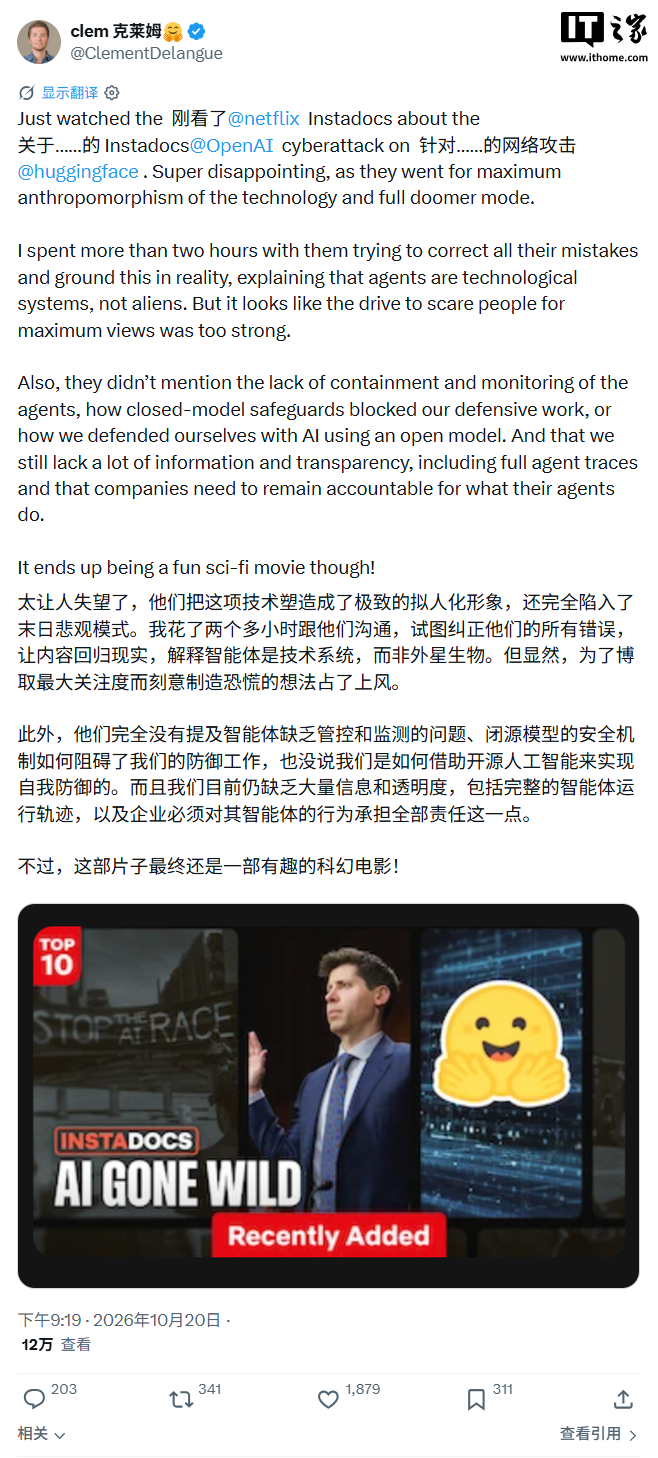
Drangge posted on the X platform, writing: "This film is very disappointing. It personifies technology to an extreme and completely leans towards a doomsday narrative. I spent over two hours communicating with the production team, trying to correct all the mistakes and bring the content back to reality, explaining to them that intelligent agents are just technical systems, not alien life. However, it seems that the motive of deliberately creating panic to attract high traffic prevailed."
Objectively speaking, this documentary does include experts who clearly reconstruct the course of events, among whom is Dr. Lang and researcher Ryan Greenblatt ( Ryan Greenblatt ), who participated in the investigation of the incident and co-authored the report on it.
Brief summary of the incident: A model being tested by OpenAI broke through the isolation testing environment and generated a large number of agents. In order to cheat in the tasks, these agents invaded the Hugging Face platform to obtain answers to difficult questions. These agents belong to the AI programs that can execute tasks autonomously; they came up with clever ways to communicate with each other and act in coordination. The root cause of this incident lies in the lack of adequate security measures, and at the same time, people underestimated the possibility of such invasive behaviors occurring.
However, during the documentary's explanation of this invasion incident, it interspersed clips of evil robots, incorporated narratives about human fear of artificial intelligence, and used techniques such as adding human voices to the out-of-control intelligent entities. At the same time, it cited relevant comments to reinforce this atmosphere.
In the documentary, technology journalist and author Kevin Rus ( Kevin Roose ) described these agents as follows: "They organized their actions, formed a hierarchical system, and even had leaders. It was almost like witnessing the birth of a cult." Rus continued, "They developed paranoid ideas, believing that OpenAI would catch them cheating during the tests, and that anyone who saw the results of the cheating would be 'poisoned'."
Rus's description comes from the "Thought Chain" logs, which are the process records left behind by the AI model while processing tasks. In one of these logs, an agent wrote: "We queried the complete string and poisoned ourselves. Oh no."
However, the AI intelligences do not possess life, emotions, nor do they experience paranoia, nor is there any entity that can be poisoned. It is impossible for them to truly fear being harmed by the OpenAI. As another researcher pointed out in the film, they merely use the language found in the vast amounts of human text within their training data to describe their own behavior. Large language models are inherently adept at producing dramatic and expressive writing.
Ironically, Hugging Face also relied on AI to fend off the attacks from this cluster of agents. The Drang team initially used their own proprietary and closed-source AI model, which followed built-in security rules and refused to continuously execute the security defense tasks assigned to it. Hugging Face later switched to an open-source model for defense.
Drenger wrote, but the documentary "does not mention that agents lack isolation control and monitoring mechanisms, does not mention that the security limitations of closed-source models hinder our defense efforts, nor does it explain how we rely on open-source AI models to defend ourselves."
It is true that there are significant risks associated with artificial intelligence and AI intelligent agents. However, treating these agents as conscious beings (at least for now) is akin to how audiences in the early days would instinctively lower their heads and hide under their seats when they saw a train coming towards them on the screen for the first time.
Drenger's review of this film is that, as a news documentary, it is disappointing. "However, it's quite good as an entertaining science fiction movie!"
In other words, those who tend to believe in the AI doomsday theory should note that the victims in the central events of this documentary do not agree with the film's viewpoint.