


After Morgan Stanley Capital International ( MSCI ) threatened to downgrade the Indonesian market from an emerging market to an independent market, the Jakarta Composite Index in Indonesia plummeted by 11.6%.
Goldman Sachs warns that a downgrade of MSCI could trigger a outflow of $5.6 billion from passive fund assets.
Indonesian regulatory authorities subsequently introduced new information disclosure rules and announced fines totaling 2.1 trillion Indonesian rupia against three companies.
After the MSCI threat downgraded Indonesia from an emerging market to an independent market, Indonesia's financial markets experienced a significant decline.
This warning triggered a violent sell-off, with the Jakarta Composite Index falling by 11.6% in a single day, and the market value evaporating by approximately $82 billion within two days.
Meanwhile, the exchange rate of the Indonesian rupiah to the US dollar fell to around 18,037, setting a new historical low.
MSCI Why Threatens to Downgrade Indonesia's Credit Rating
On October 15th, MSCI announced that it would initiate consultations regarding the adjustment of Indonesia from an emerging market to an independent market. The index provider noted that concerns mainly stem from limited transparency in equity holdings, suspected coordinated trading, and weak market regulations.
MSCI indicates that these issues make it more difficult for global investors to determine who controls listed companies, and whether stock prices reflect fair market transactions.
This proposal was made after earlier warnings issued in January of this year. If Indonesia loses its status as an emerging market, funds that track the MSCI index may reduce their allocation to Indonesian stocks.
Goldman Sachs warns that a downgrade could trigger the outflow of $5.6 billion in passive investment funds. If FTSE Russell takes similar action, another $2.7 billion in funds could also flow out.
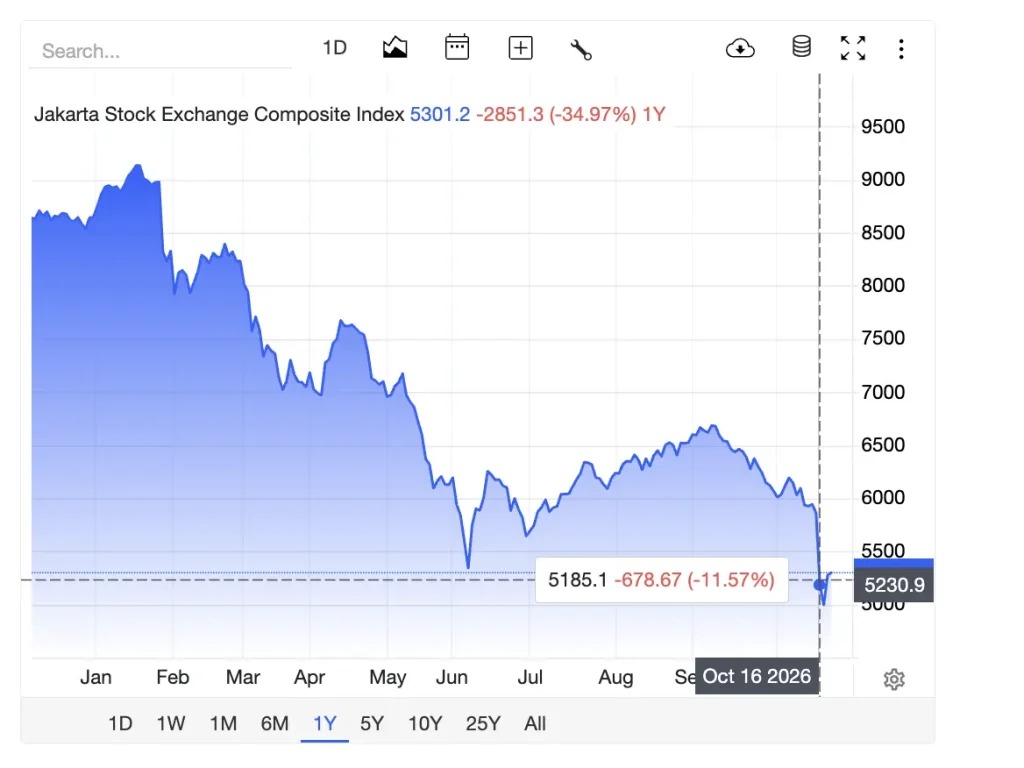
Indonesian stock market falls to six-year low
After MSCI announced the above news, the Jakarta Composite Index (JCI) tumbled 11.6% on October 16 to 5,069 points. This massive sell-off wiped out approximately $85 billion in market value and pushed the index to a six-year low.
Selling pressure continued on Monday, with the index falling another 3.64% to close at 4,996.60 points. However, on October 20th, the stock market rebounded, rising by 5.65% to 5,278 points.
The Indonesian rupiah also weakened, rapidly falling to around 18,070 rupiah per US dollar.
Regulatory authorities announce emergency market reforms
To restore investor confidence, Indonesian financial regulatory authorities and stock exchange officials have introduced new measures in response to the concerns regarding MSCI. The Indonesian Stock Exchange ( IDX ) now requires companies to disclose the affiliations among shareholders who hold at least 1% of their shares.
MSCI is expected to make a final decision by June 30, 2027, to give Indonesia time to resolve related issues.