Key Points
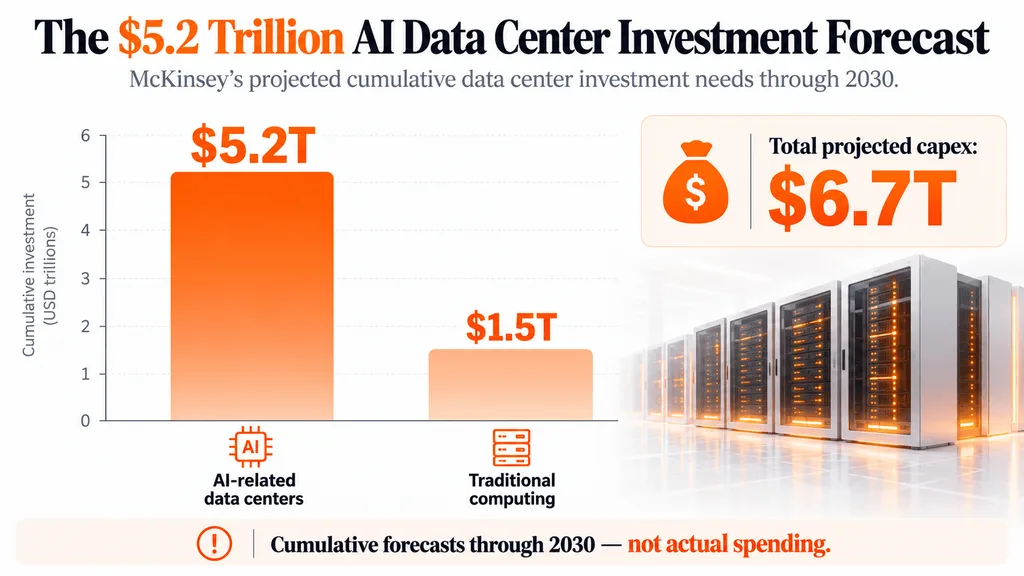
- By 2030, the AI data centers may require an investment of 5.2 trillion US dollars.
- Rising borrowing costs are increasing the pressure faced by infrastructure operators.
- Investors are increasingly demanding to see profits, rather than ambitious forecasts.
In some place in the United States, a company is building a data center filled with thousands of NVIDIA chips. The construction costs billions of dollars, and it may take several years to get access to electricity. Moreover, these computers might become obsolete before the owner has even paid off the loan.
For many years, investors were willing to accept these risks because artificial intelligence promised extraordinary growth. Now, lenders are starting to raise a more tricky question: When will such substantial expenditures be converted into cash?
According to McKinsey's data, by 2030, meeting the global demand for AI computing power may require $5.2 trillion in investment in data centers. It is important to note that this is a forecast of the required expenditures, not money that has already been committed or earned.
Why is building a AI data center so expensive?
What is required for a modern AI facility is far more than just expensive processors. Enterprises also must acquire land, ensure a power supply, install cooling systems, and build a network capable of connecting thousands of GPU.
The problem lies in time. Most expenditures occur before customers start generating substantial income, which creates a financing gap; and once the construction progress falls behind, this gap becomes particularly dangerous.
Microsoft, Amazon, and Google can use the cash generated from their mature businesses to fund large-scale investments. Smaller infrastructure operators, on the other hand, often need to borrow money by using equipment and long-term customer contracts as collateral.
As the use of external financing becomes more and more common, companies that provide AI services may not own these servers, nor do they bear the entire construction debt.
JPMorgan Chase estimates that about $2 trillion of the broader infrastructure expansion may ultimately be financed through the investment-grade credit market.
CoreWeave explains why having income is not enough.
CoreWeave demonstrates how quickly the economic calculations within it can become complex.
This cloud service provider, which receives support from NVIDIA, reported in its second-quarter report that it had an backlog of contracted revenues amounting to approximately $104 billion, but at the same time recorded net interest expenses of $640 million and a net loss of $626 million.
The importance of the gap between growth and financing costs lies in the fact that future contracts will not automatically generate sufficient cash to cover today's loan repayments.
Investors have become increasingly sensitive to these risks. In October, the credit protection cost for CoreWeave soared as the market demanded higher compensation for potential payment issues.
There is another complex factor: GPU is not a permanent asset. The new generation of chips may reduce the competitiveness of older systems, and in cases where the original loans have not been repaid, the resale value of the devices will also decrease accordingly.
If one operator goes bankrupt, secured creditors may be able to claim rights over the equipment, but there is no guarantee that they will be able to recoup their initial investment.
What will happen if AI expenditures no longer bring returns?
The core issue is whether companies can earn enough money from the AI services before their infrastructure becomes outdated, or before financing costs overwhelm their cash flow.
Some projects may achieve astonishing success, especially when long-term contracts can ensure high utilization rates. Other projects may fall into difficulties if demand falls short of expectations, or if expensive facilities are not fully utilized for extended periods.
Investors can assess these differences by examining free cash flow, capacity utilization, and return on invested capital, rather than just revenue forecasts.
This pressure is not limited to tech companies alone. Pensions, insurance companies, and bond investors are increasingly providing capital to the infrastructure industry, which means that even those who never buy AI stocks may face related financial exposures.
This also explains why the divergence between the enthusiasm of retail investors and the more cautious institutional credit market is widening.
Adrian Cole
Adrian Cole has been engaged in financial market reporting for over 6 years, with a focus on cryptocurrencies, stocks, and macroeconomic trends. He tracks Bitcoin, major altcoins, the U.S. stock market, interest rates, commodities, as well as various types of data that drive market fluctuations. Over the years, he has written hundreds of market updates and analysis articles, with an emphasis on price trends, investor sentiment, and the connections between traditional finance and digital assets.