Blockchain institutions such as Chainlink and Cardano urge SEC to clarify encryption rules
Cointelegraph
1h ago
Ai Focus
Six major blockchain institutions, including Chainlink Labs and Cardano Foundation, submitted a joint letter as the deadline for comments on the SEC's crypto regulations approached, requesting that digital commodities be officially defined as non-securities and asking for clearer rules regarding secondary market transactions and collateralization.
Helpful
No.Help

Six major blockchain organizations, including Chainlink Labs and Cardano Foundation, called on the U.S. Securities and Exchange Commission (SEC) to officially classify digital commodities as non-securities. On Tuesday, the deadline for public comments on the proposed crypto regulatory rules expired.

In a joint letter dated October 20th, Chainlink Labs, Cardano Foundation, Hedera, Aptos Labs, Ava Labs, and Stellar Development Foundation called on SEC to directly include the classification of digital goods within the proposed "Cryptocurrency Regulatory Framework" (Regulation Crypto Assets framework). These institutions stated that if reliance is solely on explanatory guidelines, market participants will still face legal uncertainties.

These institutions stated that although the current interpretation by SEC recognizes digital goods as a separate category, the proposed rules do not clearly reflect this distinction, which may leave developers and other market participants unsure as to which securities regulatory provisions apply.
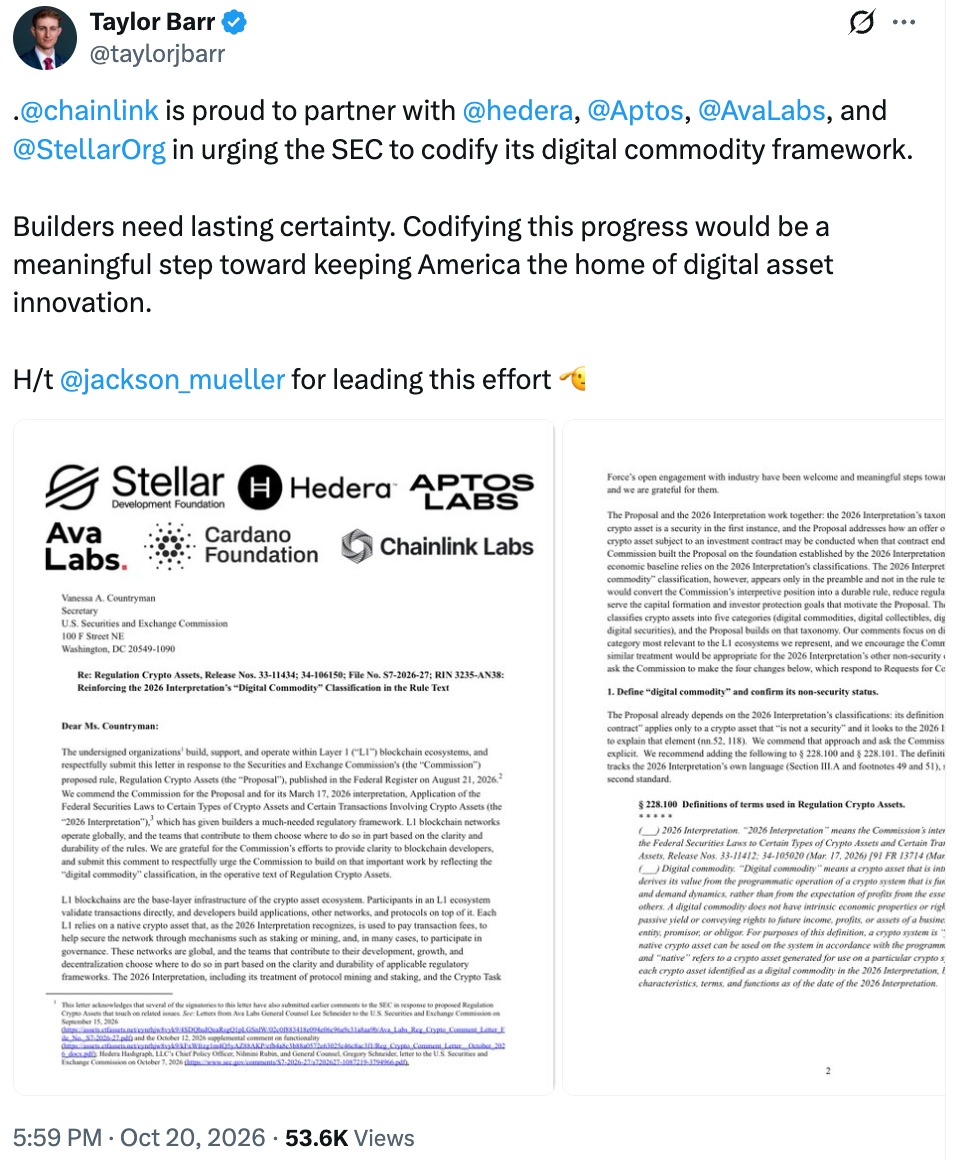
This letter also requests further clarification on how the Securities Law applies to secondary market transactions involving digital assets, as well as how pledges and other activities related to decentralized blockchain networks should be handled.

SEC proposed this encryption framework in August and received approximately 140 public comments within 60 days. Industry participants and legal scholars expressed different views on the proposed exemptions for encrypted offerings, as well as the conditional safe harbor arrangements for certain tokens.

Tip
$0
Like
0
Save
0
Views 29
HQYC reminds readers to view blockchain rationally, stay aware of risks, and beware of virtual token issuance and speculation. All content on this site represents market information or related viewpoints only and does not constitute any form of investment advice. If you find sensitive content, please click“Report”,and we will handle it promptly。
Submit
Comment 0
Hot
Latest
No comments yet. Be the first!
Related
Solana Enables Alpenglow: Targeting a Nearly 85-Fold Increase in Final Transaction Confirmation Speed
Solana launched the Alpenglow consensus upgrade on the mainnet on October 21st, replacing the existing voting system with new technology. The goal is to reduce the final transaction confirmation time from about 12.8 seconds to 150 milliseconds. This upgrade may also change the network activity statistics related to validators and affect the settlement methods of payment and financial applications.
Coinpaper
·2026-10-22 02:05:27
4
Why is Bitcoin rising? BTC rebounding from $79,800 to approach $85,000
Bitcoin once approached $84,800, rebounding nearly 6% from its low of around $79,800 on October 15. The US spot Bitcoin ETF attracted approximately $550 million in net inflows within two days, with BlackRock's iShares Bitcoin Trust contributing the most. However, Glassnode noted that there is significant selling pressure in the range of $85,000 to $87,500, and if Bitcoin cannot break through this resistance level, it may fall back to around $82,000.
Coinpaper
·2026-10-22 02:05:25
3
The US Federal Reserve has finalized regulations for stablecoins; Binance praises the "GENIUS Act"
U.S. Treasury Secretary Scott Branson compared the stablecoin legislation of the Trump administration to the banking reforms of the Lincoln era, calling the final rules implemented by the Federal Reserve to enforce the GENIUS Act a "watershed moment in U.S. finance." According to these rules, starting from January 18, 2027, companies issuing payment-type stablecoins in the United States will generally need to obtain regulatory approval under the GENIUS Act.
Cointelegraph
·2026-10-22 01:54:30
8
Meta ordered to pay a $25 billion fine in the Cambridge Analytica case in New Mexico
A court in New Mexico ruled that Meta must pay a fine of $25 billion in the Cambridge Analytica-related data privacy case, with interest calculated at an annual rate of 15%. Meta expressed disagreement and plans to appeal.
CNBC
·2026-10-22 01:54:28
9
In 2026 on HuskyHack, college entrepreneurs stand out with fintech solutions
The Sound Credit Union and the Center for Business Analytics at the University of Washington Tacoma stated that the second HuskyHack attracted over 100 students from across the state to participate. In the end, a real-time fraud detection service Scout developed by two finance majors won, receiving a prize of $15,000 and six months of membership at the Seattle CoMotion Labs.
PR Newswire
·2026-10-22 01:14:09
12
View More