

META's stock price rose by 4% in after-hours trading following the company's release of its third-quarter financial report, which showed revenue grew by 26% year-on-year to reach a record $64.6 billion.
However, the $989 million in legal expenses incurred in August, which stemmed from its highly publicized litigation regarding adolescent mental health, dragged down earnings per share and raised the company's expectations for this year's expenditures.
Meta expects its revenue in the fourth quarter to reach up to $76 billion, and the company remains confident in its advertising and AI revenue models.
Meta Third Quarter Financial Report of 2026
A major highlight of this financial report is that revenue increased by 26% year-on-year, reaching a record $64.6 billion, which is higher than the market's estimate of $63.37 billion. The growth in revenue was mainly driven by strong demand for the core advertising business and the introduction of premium advertising pricing.
At the same time, capital expenditures for the quarter (CapEx) reached $34.91 billion, higher than the previous quarter's $31.08 billion, due to the company's continued investment in AI.
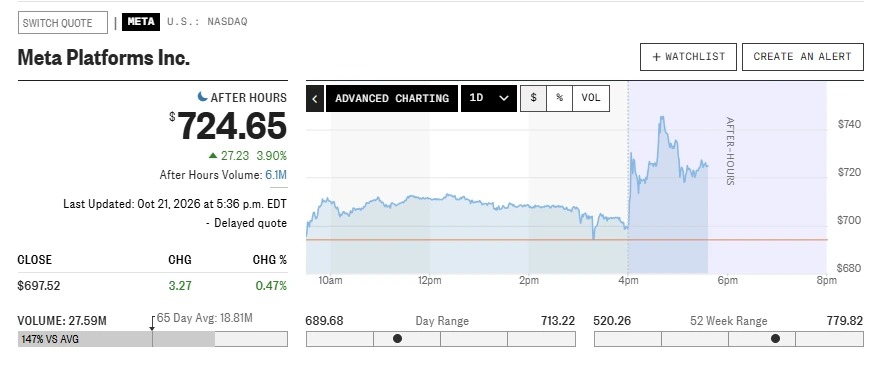
META Stock Price Reaction
After the financial report was released, the stock price of META reached $733.18, up 5.11% after the market closed. This indicates that investors are more concerned about the company's advertising revenue data rather than its legal disputes. Market sentiment has also been boosted by the company's prospects for infrastructure deployment in AI.
Forward-looking guidance and subsequent progress
In addition, the company has raised the lower limit of its capital expenditure for the entire year of 2026 to between $135 billion and $145 billion. Due to heavy legal costs, this figure is expected to rise to between $175 billion and $179 billion.
A portion of these expenditures will be used to fund the company's Muse AI infrastructure, which includes data centers and chips. This indicates that the company is shifting away from its loss-making virtual reality and hardware businesses, the latter of which for the first time since IPO in 2012 caused its cash flow to turn negative, reaching a figure of -$2.12 billion.
In addition, Meta announced the implementation of a 1-to-2 stock split. This split will help to consolidate the voting control of CEO Mark Zuckerberg, while also providing support for the company's technological acquisitions and its extensive AI strategy.